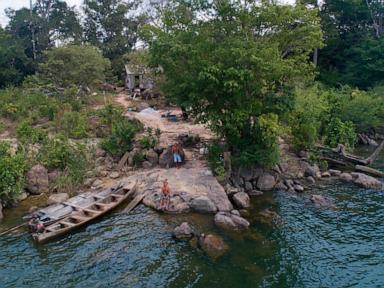
Water does not care about borders. It does not read injunctions, nor does it wait for a gavel to fall in Brasília before carrying what lies in its path down toward the people who drink from it.
Up along the muddy bends of a tributary feeding the Amazon basin, the morning smells of wet bark, diesel smoke, and crushed wild herbs. If you have spent enough time near river communities in northern Brazil, you learn to listen before you speak. You listen to the outboard motors whining in the distance. You listen to the sudden silence of howler monkeys when heavy machinery rolls too close to the tree line. And you listen to the women washing clothes along the bank, noticing whether the water feels slick against their knuckles or carries a faint, metallic tang that wasn't there five years ago. If you enjoyed this article, you should read: this related article.
For years, a massive gold mining permit hung over a stretch of this green world like a cloud that promised both rain and drought. On paper, it looked like progress. Millions of dollars in projected investment. Jobs. Royalties for struggling municipalities. A shiny yellow prize pulled from deep beneath roots that have held soil together since long before anyone drew lines on a map.
Then Brazil's Supreme Court stepped in and suspended the permit. For another perspective on this development, check out the latest update from The Guardian.
A headline like that sounds neat. Tidy. Almost clinical. A court pauses a mine. Legal wheels turn. Everyone goes back to their desks.
Except nothing in the Amazon is neat, and nothing stops at a property line.
When a Permit Becomes a Fault Line
To understand why a suspended mining permit in Brazil sends tremors far beyond a courtroom in Brasília, you have to picture what a mine actually asks of a place. Not just the clearing of trees or the digging of pits, though those are dramatic enough on satellite maps. A mine asks a living ecosystem to surrender its memory.
Consider a hypothetical scenario to make the scale clear. Suppose a family—let's call them Raimundo and his sister, Luciana—lives in a small riverside settlement three hours by boat from the nearest paved road. This family is invented for illustration, yet their daily rhythm mirrors thousands of real households across the basin. Every dawn, Raimundo checks the fish traps set among submerged roots. Luciana tends manioc plants on high ground and walks her younger nephew to a one-room schoolhouse where the roof leaks when the afternoon sky turns the color of a bruise.
When news arrives that a major gold mining project has been greenlit upstream, town meetings fill with two kinds of tension. Some neighbors see a lifeline: steady wages, a clinic with better supplies, a chance for young people to buy motorbikes and send money home. Others see a slow-moving threat: muddy plumes turning clear creeks into chocolate soup, mercury slipping into the food chain, and traditional territories shrinking piece by piece until the forest feels like a cage instead of a home.
Neither side is made of cartoons. Wanting stability in a place with scarce opportunities is human. Wanting clean water and intact ancestral land is human, too.
That collision is the real story behind any court order pausing a major gold mine in the Amazon. The legal dispute is a surface ripple. Underneath are competing versions of survival.
The Invisible Cargo in Every Gram
Gold has a strange hold on the human imagination. It doesn't rot, it doesn't rust, and it has carried meaning across empires for millennia. When people think of gold mining, they picture heavy excavators, gleaming ore, and balance sheets weighed in ounces.
They rarely picture what travels alongside it.
In many parts of the Amazon, extracting gold involves disturbing vast volumes of earth and, frequently, relying on toxic inputs or releasing heavy metals naturally locked in sediment when soil is churned and exposed to air and water. Even when a project claims modern standards and formal permitting, local communities know how easily promises fray once operations scale up. Enforcement stretches thin across thousands of square kilometers. Monitoring stations are expensive to maintain. A single tailings failure or chemical leak can poison a stretch of river for generations.
I have stood beside riverbanks where the water looked deceptively calm—glassy and dark under overhanging branches—while elders warned children not to swim too long or eat certain predatory fish too often. There is a quiet dread in that kind of caution. You cannot see heavy metals floating like trash. You cannot smell them the way you smell smoke. You only learn years later, through neurological symptoms, developmental worries in children, or declining catches, that the river was carrying more than water.
If I sound weary when I talk about this, it is because I have seen how easy it is for distant debates to treat affected communities as background scenery. Policy papers talk about "stakeholders" and "mitigation." Meanwhile, a mother watches her son catch a river fish and wonders what is inside it.
Let's be honest: the legal and environmental issues here are genuinely tangled. Brazil's constitution recognizes both the right to economic development and the protection of Indigenous lands and the environment. Courts aren't writing poetry; they are wrestling with complex questions of jurisdiction, prior consultation, environmental impact assessments, and constitutional rights. Anyone who claims the answer is simple hasn't spent enough time reading the filings—or walking the trails.
Why the Supreme Court Stepped In
When Brazil's Supreme Court suspends a major gold mining permit, it is usually responding to a clash over foundational rules rather than acting on a whim. In Brazil's legal architecture, major projects touching sensitive ecosystems or Indigenous and traditional communities trigger strict requirements: thorough environmental licensing, meaningful consultation with affected peoples, and respect for constitutional protections.
When those steps are rushed, bypassed, or contested—or when questions arise about whether a project could cause irreversible harm before full review—the court acts as a constitutional brake.
Think of it like slamming on the brakes when a bridge ahead is under dispute. Traffic stops. Drivers get frustrated. Delivery schedules slip. Yet stopping in time can prevent a collapse that no tow truck could fix afterward.
In practical terms, a suspension doesn't permanently erase a mine overnight. It freezes the clock on construction or expansion while legal and technical questions are examined more closely. Companies face uncertainty and delay. Local governments worry about paused revenues. Environmental defenders and local communities catch a breath—though often a nervous one, knowing appeals and negotiations will follow.
Still, pause matters. In ecology, time is everything. A few extra months or years of standing forest means another breeding season for birds, another cycle of seed dispersal, another stretch where the canopy keeps the forest floor cool and damp.
A Metaphor for What Is at Stake
Picture an old woven hammock strung between two massive trees. That is a metaphor—a way to see how delicate balance works when weight is added.
For centuries, the hammock holds together because the threads are braided tightly and anchored deep. If you hang a small lantern from the center, the fabric dips a little, and the trees hold firm. If you start piling heavy stones into the middle without checking the knots or the bark, the tension climbs quietly. One strand frays. Then another. By the time you hear the snap, the whole thing drops at once.
The Amazon is not a hammock, and a gold mine is not a stone. Yet the logic of cumulative strain is real. A single project rarely exists in a vacuum. Roads follow mines. Settlements follow roads. Hunting pressure shifts. Water tables change. Courts step in when the weight threatens to snap threads that cannot be rewoven in a human lifetime.
The People Caught Between Two Futures
Walk through a bustling frontier town near a mining zone at dusk and you'll see the human paradox up close.
Generators hum behind corrugated metal shops. Dust coats the leaves of roadside palms. At a plastic table outside a modest diner, a young man who came north looking for work traces circles in a spilled ring of coffee. He isn't trying to destroy a rainforest. He wants to send money home so his mother can fix her roof and pay for medicine. Two tables over, an Indigenous leader speaks quietly with legal advocates, reviewing maps and documents that carry the weight of survival for a village whose ancestors walked these paths long before national borders existed.
Both people have real needs. Both carry real fears.
That is why reducing this story to "good guys versus bad guys" misses the deeper tragedy. When economic alternatives in rural and forested regions are scarce, people gravitate toward whatever pays. When environmental safeguards are weakened or sidelined, the most vulnerable people—often Indigenous communities, river dwellers, and small farmers—bear the heaviest price when things go wrong.
Real solutions require more than saying no to a mine. They require asking how a region can thrive without poisoning its rivers or erasing its people. Can sustainable forestry, agroforestry, eco-tourism, bio-economy enterprises, and better public services offer real livelihoods? Yes, in many places they already do, though they rarely get the splashy headlines or rapid capital that mining attracts.
What a Suspension Really Changes Today
If you are reading about this ruling from thousands of miles away, it is fair to wonder what actually shifts on the ground tomorrow morning.
First, legal accountability gets a spotlight. A Supreme Court suspension signals that shortcuts—whether in environmental studies, community consultation, or oversight—carry real risk. Investors and operators have to reckon with the fact that ignoring constitutional and environmental rules can stall billion-real or multi-million-dollar plans.
Second, communities gain time to organize, present evidence, and make their voices heard in formal proceedings. In regions where local residents are often outmatched by well-funded corporate legal teams, time itself is a form of leverage.
Third, the broader debate over Brazil's future sharpens. Brazil sits at a crossroads that matters to the entire planet. Its forests regulate rainfall across South America and store vast amounts of carbon. Its rivers feed immense biodiversity. Its people deserve dignity, opportunity, and justice. How Brazil balances extraction and protection isn't just a domestic legal puzzle; it is one of the defining tests of our era.
Doubt lingers, of course. Suspensions can be lifted. Permits can be reissued after revisions. Politics shift, economic pressures mount, and enforcement remains a daily grind in remote terrain. Nobody who knows the region expects a single court ruling to solve everything forever.
Hopeful? Sometimes. Exhausted? Often. Determined? Always.
The River Keeps Flowing
Evening settles fast near the equator. One moment the sky is blinding white-blue above the treetops; twenty minutes later, deep indigo swallows the horizon, and frogs start their chorus in the reeds.
Down by the water's edge, the current keeps moving. Leaves drift past. Dragonflies skim the surface in tight, silent loops. No court order can tell the river where to go, and no mining permit can tell it to forget what it carries.
Somewhere tonight, in a quiet house beside dark water, a child falls asleep to the sound of rain on leaves while adults wonder what tomorrow will bring—a brighter paycheck, a cleaner stream, or another fight to keep the place they love alive.


