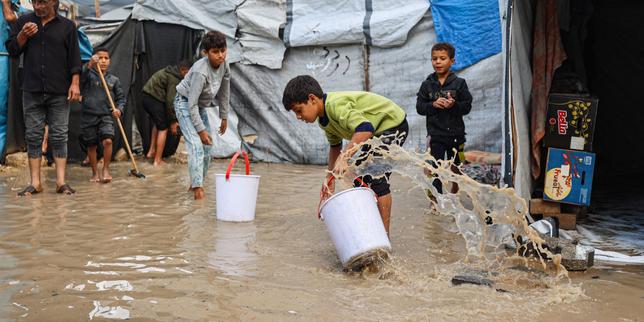
Torrential seasonal rains are submerging makeshift displacement camps across the Gaza Strip, turning packed sandy clearings and coastal dunes into knee-deep pools of mud, stagnant rainwater, and raw sewage. For hundreds of thousands of people living under thin plastic sheeting and salvaged tarpaulins, a predictable Mediterranean winter weather pattern has become an acute public health and survival emergency. The flooding is not merely a natural disaster caused by heavy precipitation; it is the foreseeable mechanical failure of destroyed municipal drainage networks colliding with extreme population density in low-lying terrain.
The Anatomy of a Man-Made Flood
Rain along the eastern Mediterranean coast follows a well-documented seasonal rhythm. Between November and March, intense low-pressure systems sweep off the sea, dumping heavy volumes of water over short intervals. Under normal urban conditions, coastal cities manage these surges through graded asphalt streets, storm drains, retention basins, and pumping stations that channel runoff back toward the sea or into treatment facilities.
In Gaza, that hydraulic system has largely ceased to exist.
Months of bombardment, heavy armored vehicle traffic, and widespread structural collapse have shattered underground stormwater pipes and crushed surface drainage channels. Rubble from collapsed multi-story buildings acts like a series of unplanned dams across former roadways. Instead of flowing along engineered gradients toward coastal outlets, rainwater hits walls of pulverized concrete and rebar, pooling rapidly in neighborhoods and spillways before spilling into adjacent encampments.
Consider the geography of the coastal zone where the largest concentrations of displaced families have been pushed. Areas like Al-Mawasi, stretching along the southern coastline between Rafah and Khan Younis, were historically agricultural lands and open sand dunes. Sand absorbs water up to a point, yet once the water table rises or the surface is compacted by foot traffic and tent foundations, absorption stops. Because coastal dunes sit near sea level and feature natural depressions between ridges, water collects in the hollows where families pitch tents to shield themselves from coastal winds.
The result is a cruel physical trap. Seeking shelter from gales off the Mediterranean leads families straight into the lowest topographical pockets—the exact basins where runoff accumulates first.
Why Tents Fail When the Water Rises
Standard emergency shelter design relies on basic physical barriers: a waterproof canopy overhead, anchored guy-lines to resist wind, and a raised floor or trenching system to divert surface runoff. Almost none of those conditions exist across Gaza's sprawling tent cities.
Most shelters currently standing are not standardized humanitarian expedition tents built with heavy-duty bathtub floors and sealed seams. Many are improvised structures assembled from agricultural greenhouse plastic, woven polypropylene sacks, salvaged wooden pallets, and worn bedsheets. Over months of exposure to intense ultraviolet radiation and salt air, thin polyethylene sheeting degrades, turning brittle and porous. When driving rain hits, water does not simply bead and run off; it seeps through micro-tears and drips steadily onto bedding below.
Even intact tarpaulins cannot stop water rising from underneath. Without pallets, gravel beds, or raised wooden platforms to elevate living spaces off the earth, surface water flows directly across the ground and saturates thin foam mattresses and blankets. Once wet, cotton and synthetic bedding lose almost all thermal insulation value. In temperatures hovering around 10 to 15 degrees Celsius at night, wet clothing and damp blankets strip body heat rapidly, creating widespread risks of hypothermia, particularly among infants, the elderly, and people weakened by prolonged malnutrition.
Digging drainage trenches around tents—a standard field technique in humanitarian camp management—frequently backfires in hyper-dense encampments. Tents are pitched inches apart, separated by narrow footpaths rather than planned firebreaks or drainage corridors. When one family digs a shallow trench to divert water away from their sleeping area, that runoff immediately floods the neighbor's floor.
The Sewage Factor Nobody Wants to Look At
Water logging alone destroys belongings and causes cold-related illness. Mixing that rainwater with untreated human waste turns a shelter crisis into an epidemiological time bomb.
Before the war, Gaza's wastewater infrastructure was already fragile, strained by years of blockade, fuel shortages, and underinvestment. During the conflict, wastewater treatment plants, municipal sewage pumping stations, and main trunk lines suffered extensive damage or shut down entirely due to lack of electricity and fuel. Without active pumps to push sewage through pressurized mains toward treatment lagoons, raw effluent backs up into the streets and overflows into open cesspits dug near encampments.
When heavy rain hits, stormwater overwhelms these makeshift latrine pits and broken sewer lines. The two waste streams merge.
"In a flooded displacement camp, there is no distinction between rainwater and wastewater. Within hours of a heavy downpour, every puddle becomes a vector for waterborne pathogens."
Families wading barefoot or in worn plastic sandals through ankle-deep water are walking through diluted fecal matter. Children playing outside tents touch contaminated mud and put their hands to their mouths. Inside crowded shelters, wet shoes and soaked hems track pathogens directly onto the surfaces where families sleep and eat.
Public health specialists track a predictable cascade of illness following severe flooding in dense settlements:
- Acute watery diarrhea and dysentery, driven by bacterial and protozoal contamination of drinking water containers and food preparation areas.
- Hepatitis A, which spreads rapidly via the fecal-oral route in environments lacking soap, clean running water, and functional sanitation.
- Skin infections and scabies, exacerbated by prolonged exposure to damp, unsanitary clothing and overcrowded sleeping quarters.
- Severe respiratory tract infections, including pneumonia, triggered by cold, damp air inside unventilated, sealed plastic shelters where families burn scrap wood or plastic to stay warm.
The healthcare facilities meant to treat these outbreaks are themselves operating at a fraction of capacity, lacking basic antibiotics, oral rehydration salts, and laboratory diagnostic supplies.
Logistics Bottlenecks Behind the Shelter Deficit
To understand why hundreds of thousands of people remain exposed to winter storms more than a year into mass displacement, you have to look at the mechanics of humanitarian aid delivery.
Providing winterized shelter at scale requires massive volumes of bulky, heavy materials: timber framing, corrugated metal sheeting, heavy-duty reinforced tarpaulins, gravel aggregate for site drainage, water pumps, and thermal blankets. These are not compact items that fit easily into mixed aid convoys alongside food parcels and medical kits.
Every stage of the supply chain faces friction:
- Inspection and border bottlenecks. Strict dual-use restrictions and prolonged screening procedures at entry crossings frequently delay or block items deemed to have potential military applications. Metal tent poles, timber planks, cement, pipes, and heavy pumping equipment routinely face scrutiny or rejection, forcing aid agencies to substitute lighter, less durable alternatives that fail in severe weather.
- Internal transport collapse. Even after supplies cross into Gaza, moving them to southern and central encampments requires navigable roads, fuel, and deconflicted movement corridors. Cratered roads turn into impassable mud tracks during rainstorms, stalling flatbed trucks and forcing distributions to halt precisely when demand peaks.
- Market exhaustion. Under normal circumstances, local markets supplement international aid with plastic sheeting, rope, bricks, and tools. Prolonged siege conditions and the destruction of commercial warehouses have wiped out local inventory, leaving families unable to buy basic repair materials even when they have cash.
Aid organizations repeatedly warn that reactive distribution—handing out replacement blankets after a storm has already soaked a camp—is a losing battle. Without upstream engineering interventions to grade land, clear rubble-choked drains, and truck in gravel fill before the rain falls, relief supplies simply get ruined in the next downpour.
The Media Blind Spot Around Seasonal Disasters
When dramatic footage of flooded tents circulates online, coverage tends to frame the event as an unexpected tragedy—a sudden twist of bad weather compounding an already difficult situation. That framing misses the structural reality.
Mediterranean winter storms are entirely predictable. Meteorologists forecast them days in advance, and regional planners have understood Gaza's coastal hydrology for decades. Framing winter flooding as an act of nature obscures the policy decisions, infrastructure destruction, and access restrictions that stripped a civilian population of basic protection against ordinary seasonal weather.
There is also a stark contrast between the visual drama of a storm and the slow, unphotogenic grind of what follows. Cameras capture the immediate chaos of people bailing water out of tents with plastic buckets or carrying children across flooded tracks. Few cameras stay three days later, when the sun comes out, the surface water partially recedes, and families are left living in damp, mold-ridden shelters with ruined mattresses, no dry firewood, and rising fevers among their children.
Floodwaters evaporate. The damage they leave behind in a closed, densely packed displacement zone accumulates storm after storm through the winter months.
What Actual Mitigation Looks Like
Fixing a flooded displacement camp is an engineering problem before it is a charity problem. Handing out thin tarpaulins to families living in a topographical basin does not solve flooding; it merely covers the puddle.
In functional humanitarian emergencies, engineers stabilize sites using heavy earthmoving equipment—bulldozers, excavators, and dump trucks—to cut perimeter drainage canals, build raised earth berms, and lay compacted crushed-stone pads beneath shelter zones. High-capacity diesel trash pumps are positioned at low points to move standing water out toward the sea before it backs up into living quarters.
None of those measures can happen without sustained fuel deliveries, entry of heavy machinery and spare parts, unobstructed access for municipal maintenance crews, and safe space to relocate families out of natural floodplains and coastal hollows. Until basic civil engineering equipment and winterized shelter materials move freely into the territory, every heavy rainstorm along the Gaza coast will continue to turn makeshift sanctuaries into uninhabitable swamps.