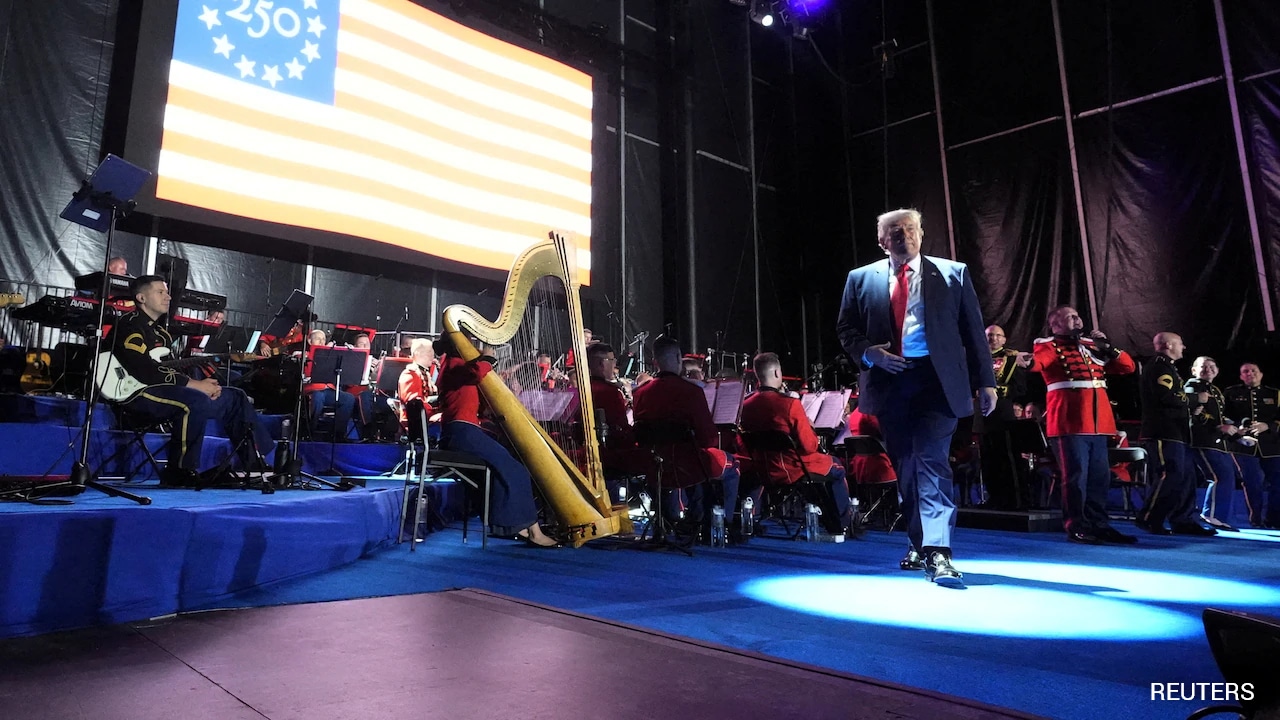
On a humid Wednesday night on the National Mall, the opening notes of a sixteen-day birthday party signaled more than just a chronological milestone. President Donald Trump took the stage behind an expansive wall of protective glass, declaring that the United States had reclaimed its position on the world stage just ten days before the official July 4, 2026 anniversary. The launch of the Great American State Fair marked the beginning of a massive celebration of the American semiquincentennial. Beneath the bright lights, the Ferris wheel, and the flyovers, this event laid bare the deep fractures and fierce political battles that define modern America.
The gathering was designed to project absolute strength. Thousands cheered as the president linked his policy victories, including a recent ceasefire agreement with Iran and the passage of tax legislation, to the revolutionary spirit of 1776. Yet behind the carnivalesque atmosphere of state pavilions, nostalgic fair rides, and record-breaking pyrotechnics lies a messy reality of deep polarization, commercial disputes, and logistical friction. This is the story of how a national birthday became the ultimate political stage.
A Tale of Two Anniversaries
Planning a celebration for 350 million citizens was never going to be easy. What emerged instead was a striking division between two competing visions of the country's milestone. On one side stands the official congressional entity, America250, which spent years organizing decentralized grassroots initiatives, block parties, and benefit concerts like the one featuring Chris Stapleton at the Los Angeles Memorial Coliseum. On the other side is Freedom 250, the highly centralized White House initiative driven by Task Force 250.
The tension between these two efforts reflects a wider national dispute over who owns the American story. The congressional effort attempted a broad, inclusive approach that often struggled to find a single, compelling narrative. The White House effort chose an unapologetic, traditionalist spectacle centered squarely on Washington. This top-down control transformed the National Mall into an arena where patriotism is explicitly tied to executive authority.
The Shrinking Lineup on the Mall
The friction behind the scenes became undeniable when looking at the entertainment roster. A celebration of this scale usually attracts a wide array of cultural figures. This time, the booking process became a minefield. Early plans boasted a varied lineup of classic rock and pop icons, but several mainstream musical acts quietly withdrew as the event drew closer. Performers worried about appearing to endorse a highly partisan rally rather than a neutral civic ceremony.
The final lineup shifted to a narrower selection of reliable performers, including Lee Greenwood and opera singer Christopher Macchio, supported heavily by military bands. This retreat by mainstream artists exposed the difficulty of staging a unifying event in an environment where even a birthday party requires choosing a side. The stage design itself, dominated by heavy branding and secure enclosures, felt less like a public festival and more like a tightly controlled political convention.
Corporate Dollars and Cultural Friction
Funding and organizing a sixteen-day fair on federal parkland created massive logistical headaches. The administration pointed toward trillions of dollars in private investments and economic strength as proof of national revival, yet the corporate backing of the celebration itself faced challenges. Major brands found themselves caught between the desire to participate in a historic marketing opportunity and the fear of alienating large segments of the consumer base.
The physical transformations of the National Mall drew sharp criticism from historical preservationists. Workers modified areas around the Lincoln Memorial Reflecting Pool and installed a 110-foot Ferris wheel right in front of historic monuments. To critics, these additions turned a sacred civic space into a cheap amusement park. To supporters, the fair elements brought a populist energy that resonated with ordinary Americans who felt excluded by traditional museum exhibits.
The Policy Pitch Under the Fireworks
The president did not limit his remarks to historical reflections. He utilized the massive television audience to campaign on his recent achievements, specifically comparing the One Big Beautiful Bill Act to the original colonial tax revolts. By explicitly linking the modern elimination of taxes on tips to the Boston Tea Party, the administration successfully turned a historical commemoration into a live policy pitch.
This merging of history and governance extended to foreign policy. The crowd cheered at mentions of international strength, showing how the event served as a victory lap for an administration that views global standing as a zero-sum game. The celebration was not just about remembering the past. It was about validating the current political order.
What Happens When the Smoke Clears
The upcoming July 4 spectacular promises a fireworks show 100 times larger than a standard display, a literal attempt to break world records on the national stage. Other upcoming events include high school athletic competitions dubbed the Patriot Games and a grand prix racing event through the streets of the capital. These events are designed to keep the momentum going through the rest of the year.
The true legacy of the semiquincentennial will not be measured by the size of the pyrotechnics or the height of the rides. It will be found in whether an event built on intense division can leave any lasting sense of shared identity. When the state pavilions are dismantled and the Ferris wheel is packed away, the nation will still face the same fundamental disagreements that shadowed its 250th birthday. The grand fair on the National Mall showed that while America can still throw the loudest party on earth, it no longer agrees on what, exactly, it is celebrating.