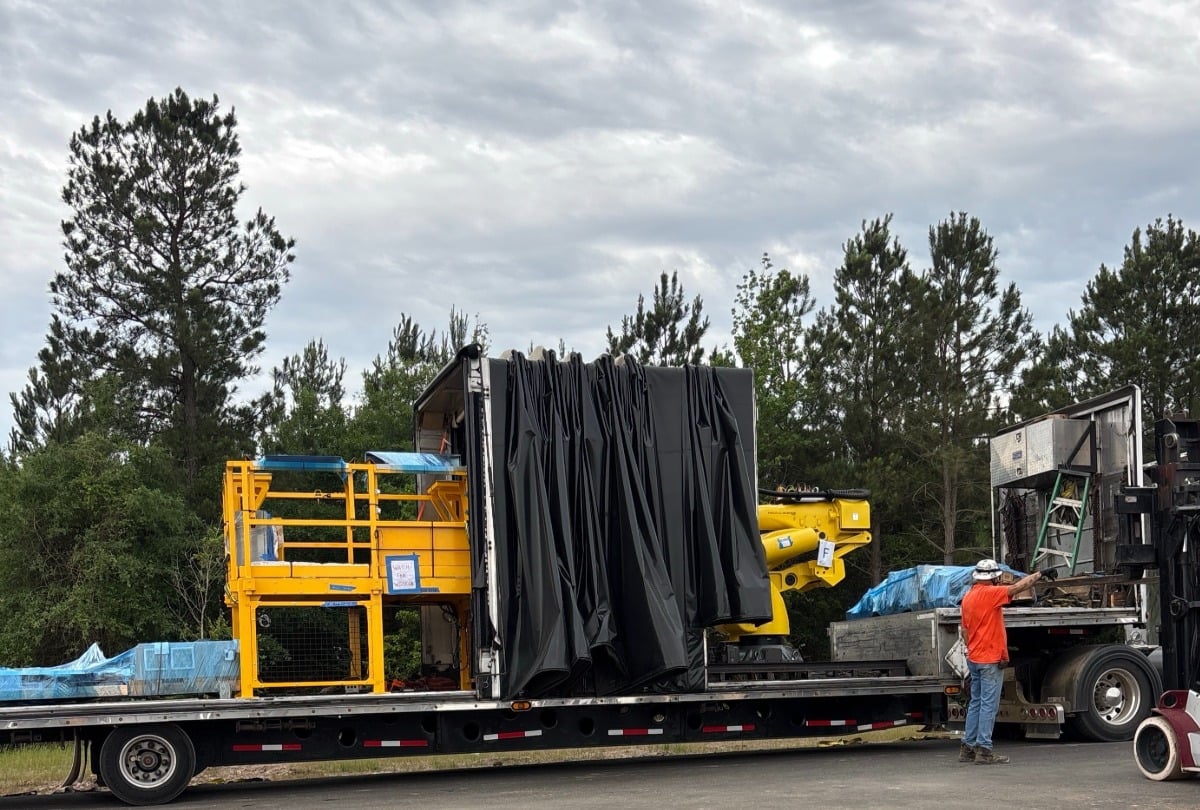
The defense industrial base is suffering from a severe ammunition shortage, and the bottleneck is not raw steel or microchips. It is the solid rocket motor. For years, the Pentagon has watched stockpiles of the Guided Multiple Launch Rocket System, or GMLRS, deplete faster than the industrial base could replenish them. To solve this, defense prime L3Harris has begun integrating advanced robotics into its freshly constructed 60,000-square-foot facility in Camden, Arkansas. The automation push aims to increase annual GMLRS production capacity by over 30 percent, moving manufacturing out of fragmented, legacy buildings and under a single, highly automated roof.
This localized automation effort is only a superficial fix for a deeper structural crisis. While installing robotic arms to handle volatile chemical propellants fixes immediate safety and repeatability issues, the broader defense apparatus remains trapped in a brittle, consolidated supply chain that cannot instantly ramp up to meet the demands of prolonged modern conflict.
The Chemistry of Compromise
Building a solid rocket motor is an exercise in managed danger. The process requires mixing highly combustible chemical propellants, grinding down materials, and casting the resulting energetic slurry into high-strength casing structures. Historically, this meant moving sensitive components across multiple disconnected facilities, exposing the materials to atmospheric shifts and introducing significant logistical friction.
In the old manufacturing setup, GMLRS motors traveled miles across three separate buildings during the casting and assembly phases. The newly operational Camden facility consolidates these volatile steps under one roof, slashing total material transit distance by 80 percent.
The introduction of specialized robotic flex cells addresses a critical human vulnerability in defense manufacturing. Handling live energetics is inherently dangerous, slow, and heavily restricted by strict safety protocols. By replacing manual pouring, scraping, and positioning with automated hardware, the plant achieves a level of precision that manual labor cannot match. Robots do not get tired, nor do they trigger safety shutdowns due to handling fatigue.
The technological upgrades extend beyond the assembly line.
- Automated Progressive Casting: Ensures the chemical propellant cures uniformly without structural micro-fissures, reducing the risk of catastrophic motor failure during flight.
- Autonomous Guided Vehicles: Move completed, highly explosive motor chassis through the facility corridors without risking human operators.
- Digital Inspection Suites: Employ real-time monitoring and predictive analytics to scan internal motor geometries for microscopic voids that could alter thrust trajectory.
This results in a predictable, repeatable manufacturing loop. For an industry that measures quality assurance in parts per million, automation provides an undeniable boost to factory-level output.
The Monopsony Trap
The factory floor updates mask a deeper industrial vulnerability. The true bottleneck is not the speed of the assembly arm; it is the structural instability of the sub-tier supply chain.
For decades, the Department of Defense allowed intense consolidation among defense contractors. This corporate consolidation left the entire U.S. military reliant on just two major domestic suppliers for solid rocket motors: Aerojet Rocketdyne and Northrop Grumman. When L3Harris finalized its acquisition of Aerojet Rocketdyne, it inherited an aging infrastructure that had starved for capital expenditure for a generation.
[Chemical Raw Materials] -> [Sub-Tier Suppliers] -> [L3Harris / Northrop] -> [Lockheed Martin] -> [DoD Stockpile]
                                   ^
                           CRITICAL BOTTLENECK
Even if the automated lines in Arkansas function flawlessly, they remain tethered to an fragile ecosystem of sub-tier suppliers. The advanced graphite composite cases, specialized nozzles, aft closures, and chemical precursors required for GMLRS production come from specialized, often single-source vendors. Recognizing this weakness, L3Harris has quietly injected over $250 million in advanced funding and $30 million in direct modernization capital into its sub-tier vendors just to keep the input lines moving.
If a single supplier of specialized insulation material or ammonium perchlorate faces a chemical mishap or a labor strike, the automated assembly lines in Arkansas will sit idle, regardless of how advanced their robotics are.
Scaling Up Beyond Camden
The Camden project is not an isolated experiment. It is the initial blueprint for a multi-billion-dollar domestic overhaul. L3Harris is attempting to duplicate this automated manufacturing architecture across its entire corporate footprint to support its upcoming corporate spinoff of its Missile Solutions division.
In Orange County, Virginia, the company is investing $1.27 billion to construct the Virginia Advanced Propulsion Facilities. This massive expansion will more than double its local footprint, shifting energetic work for programs like the Javelin anti-tank missile out of Arkansas to free up further capacity for GMLRS. Simultaneously, a $25 million expansion at the Advanced Manufacturing Facility-South in Huntsville, Alabama, adds 130,000 square feet of floor space focused entirely on machining the inert metal and composite components that feed the casting plants.
The goal across all three hubs—Camden, Orange County, and Huntsville—is to eventually push solid rocket motor production rates to four times their pre-expansion levels.
The Reality of Munitions Replenishment
The Department of Defense recently issued a follow-on production contract to L3Harris valued at up to $200 million for GMLRS Insensitive Munition propulsion units. This represents the single largest 12-month GMLRS order the company has received from prime contractor Lockheed Martin. The financial backing is secured, the physical footprints are expanding, and the robots are actively spinning propellant.
True industrial resiliency cannot be achieved simply by replacing a machinist with a robotic arm. The United States is attempting to pivot from a just-in-time peace-time production model back to a high-rate wartime manufacturing footing. This transition requires a deep pool of skilled labor—including composite technicians, CNC machinists, and quality engineers—that cannot be automated away and remains in short supply across the American manufacturing sector.
The new robots in Arkansas will successfully stabilize immediate production yields and fulfill current Pentagon contracts. However, true security will depend on whether the defense sector can rebuild its underlying material supply chains as fast as it upgrades its factory floors.