Some objects carry weight far beyond their physical dimensions. A rusted key. A worn wedding band. A folded piece of cotton, bright red, patterned with a familiar white paisley.
On the morning of September 11, 2001, Welles Crowther slipped that red bandanna into his pocket before heading to his office on the 104th floor of the South Tower. He was twenty-four years old. An equities trader by day, a former Boston College lacrosse player, a volunteer firefighter by instinct. He was someone who looked at a burning building not with a desire to run away, but with the quiet, terrifying compulsion to run toward it.
When the world shifted on its axis that Tuesday, Welles did not panic. He descended.
Smoke choked the stairwells. Darkness pressed against the walls like a physical weight. Panic threatened to swallow the living whole. And then, through the ash and the terrifying confusion, a voice cut through the gloom. A voice directing people to safety. A voice anchored by a red bandanna pulled tight across a nose and mouth.
He became a beacon. Over and over again, Welles climbed up into the burning labyrinth, ignoring his own safety, carrying the wounded, guiding survivors to the sky lobby where rescue workers waited. He saved lives. Then he went back in. He was last seen helping firefighters before the tower collapsed.
Months later, survivors came forward. They spoke of a mysterious man in a red bandanna. They didn't know his name. They only knew that when they were certain they were going to die, a stranger appeared, took control, and led them out of the dark.
That bandanna became a symbol. Not just of a hero, but of a choice.
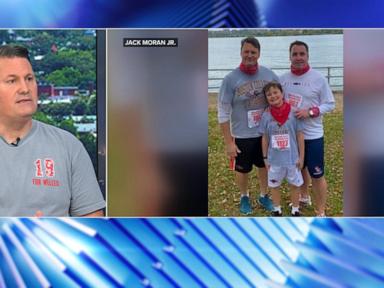
Every year, friends, family, and strangers gather to honor that choice. They run. They walk. They wear red bandannas tied around their wrists, tucked into pockets, or knotted onto the laces of running shoes. They do this because memory is a fragile thing, easily eroded by the relentless march of time, unless we actively choose to anchor it.
Consider what happens when a generation passes. Children born after that Tuesday are now adults. To them, the towers falling are chapters in a history textbook, black-and-white images flickering on a screen. But history is not just a collection of dates. It is human behavior under extreme pressure. It is the texture of a cotton bandanna worn smooth by sweat and grit.
When Welles's mother, Alison Crowther, speaks of her son, she does not speak in abstractions. She talks about his laugh, his discipline, the way he collected fire trucks as a boy, the stubborn streak that made him volunteer at his local firehouse at age sixteen. She speaks of a young man who understood a fundamental truth about human existence: we are measured by what we do when everything else is stripping away.
The Welles Crowther Charitable Trust was born from this understanding. It provides scholarships, supports youth hockey, and aids humanitarian relief efforts—keeping the ethos of service alive in the most practical ways possible. It ensures that his legacy is not locked behind glass in a museum, but walking the streets, coaching kids, and helping neighbors.
We live in an era obsessed with the ephemeral. Trends cycle in days. Digital footprints vanish with a server update. Yet, human courage remains stubbornly permanent. It defies the digital noise.
When you see a runner crossing a finish line with a red bandanna tied to their wrist, you are witnessing an invisible contract. A promise that those we lose are never truly gone as long as someone is willing to carry their torch. Or, in this case, wear their colors.
The dust settled long ago over Lower Manhattan. The footprint of the towers became a pair of reflecting pools, drawing the eye downward into quiet, fathomless depths. But the sky above remains vast.
Welles knew the layout of those towers. He knew the exits. But more importantly, he knew the contents of his own character.
He didn't have to go back in. No one would have blamed him for running straight down and out into the Manhattan sunlight. But he stayed. He climbed. He guided.
The red bandanna did not stop the smoke. It did not hold up the steel and concrete. But it did something far more enduring. It gave people something to follow when the lights went out. And long after the runners cross the finish line and the crowds disperse, that flash of crimson remains, stitched permanently into the conscience of a nation.


