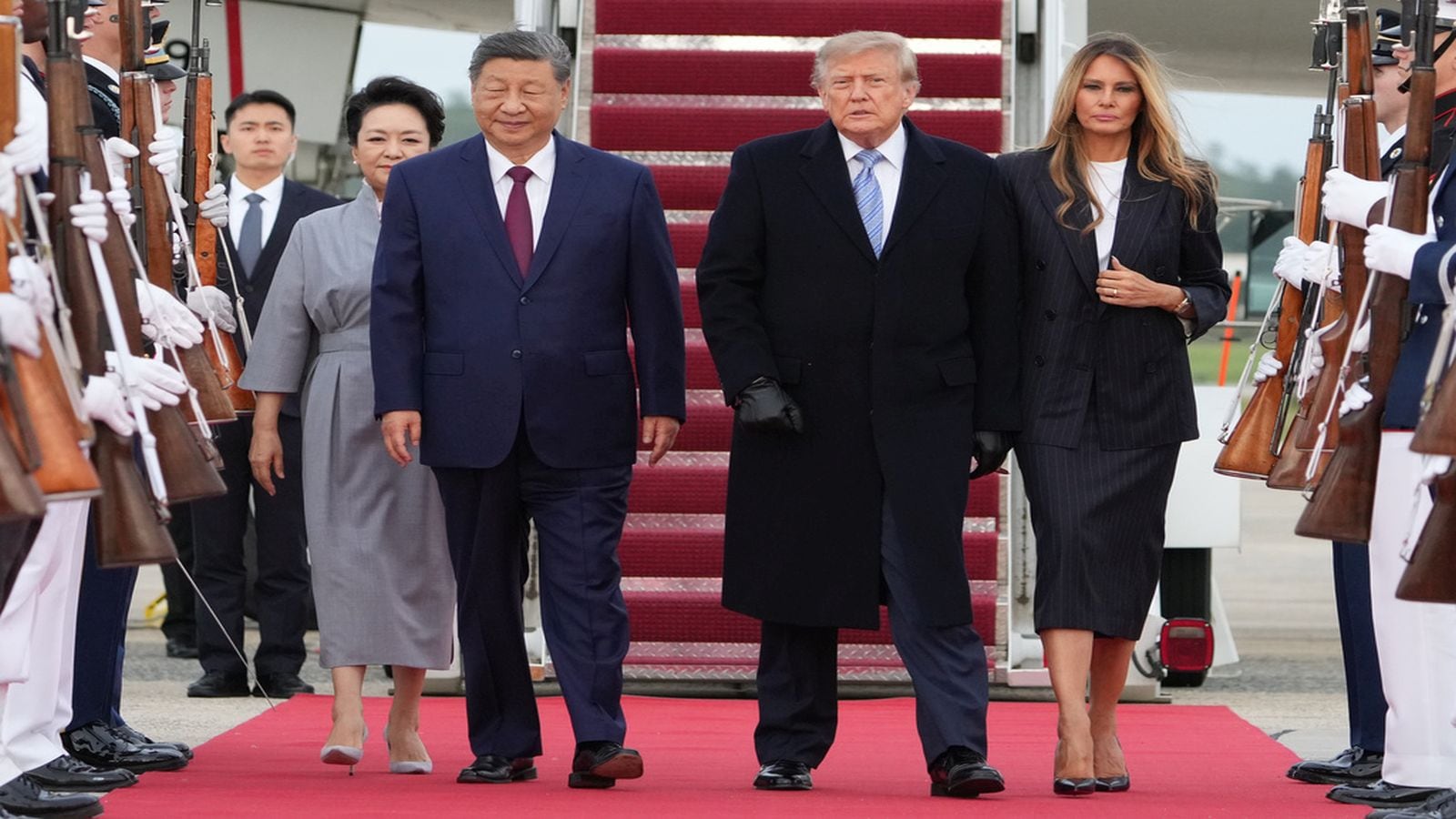
A red carpet does not merely cover the floor. It silences the ground beneath it.
Step onto it, and the sound of gravel vanishes. The friction of daily life disappears under plush wool. When Donald Trump welcomed Xi Jinping with full military honors at a United States military base—an extraordinary break from conventional diplomatic protocol that usually reserves such pageantry for state visits in Washington—the world watched through camera lenses that flattened the scene into pixels. But on the tarmac, the physics of power were entirely tactile. Boots struck concrete in unison. Brass instruments caught the afternoon sun, throwing sharp beams across the fuselage of an Air Force jet.
Silence is heavy when two men who hold the keys to the global economy stand face to face.
We forget how rare this is. We consume news as a flat stream of headlines, a continuous ticker tape of meetings, communiques, and strained handshakes. We treat diplomacy like an office job conducted in high-ceilinged rooms with bottled water and uncomfortable chairs. But history is written in rooms where the air is thin, and on concrete runways where the wind whips relentlessly against the faces of men whose decisions ripple across billions of lives.
Consider the setting. A military base. Not the manicured lawns of the White House, where diplomacy is cushioned by architecture designed to project democratic permanence. A military base is functional. It is concrete, steel, fuel lines, and hangars. It is an institution built for war, repurposed for a moment of fragile peace. Choosing this backdrop sent a message that required no translation. It acknowledged power with power.
Xi stepped down the stairs of his aircraft. The red carpet waited.
To understand the weight of that moment, you have to look past the political theatre and into the psychological architecture of modern superpowers. China and the United States are locked in a strange, unprecedented dance. They are economic Siamese twins, bound together by debt, supply chains, manufacturing, and mutual necessity, yet separated by a vast ideological gulf and a rising tide of strategic competition. Every gesture is weighed. Every smile is parsed by intelligence analysts in Langley and Beijing.
When a foreign leader—especially the leader of America's primary geopolitical competitor—receives a military base welcome, it bypasses the bureaucratic insulation of the State Department. It brings the guest directly into the machinery of American defense. It is an unorthodox embrace. It says: We see you. We respect your weight. And we are large enough to look you in the eye where our weapons are kept.
Trump understood the theatricality of politics long before he entered public office. For him, staging is substance. A traditional arrival at Andrews Air Force Base or the South Lawn follows a script written over decades by anonymous diplomats. Breaking that script is a power move. It destabilizes the expected rhythm. It forces the other side to improvise.
And Xi, a leader who has methodically consolidated power at home with a quiet, unyielding discipline, knows how to read these signals. He did not blink. He walked the carpet with the measured, deliberate pace of a man who views time on a civilizational scale, rather than an election cycle.
In Beijing, history is measured in dynasties. In Washington, it is measured in terms. That fundamental mismatch creates a constant friction in US-China relations. American presidents come and go like weather fronts, each bringing a new doctrine, a new set of advisors, and a fresh impulse to reinvent foreign policy. Chinese leadership provides a steady, unchanging horizon. When Xi stood on that American tarmac, he was not just representing himself; he was embodying a continuous line of statecraft that stretches back millennia, meeting a leader driven by instinct, personality, and the immediacy of the present moment.
The contrast was staggering. On one side, the leader of a democratic republic buffeted by domestic dissent, media scrutiny, and the chaotic churn of a polarized electorate. On the other, the paramount leader of a party-state that exercises near-total control over its narrative, its economy, and its populace.
Yet, for a few hours, the structural differences faded into the background hum of jet engines.
Why does this matter to the person sitting in a kitchen thousands of miles away, paying off a mortgage, worrying about grocery prices, or watching the cost of electronics tick upward? Because these theatrical summits are the shock absorbers of global stability. When superpowers stop talking—when the red carpets are rolled up and the military bases are closed to dialogue—the alternative is not isolation. The alternative is miscalculation.
History teaches us that major conflicts rarely begin with a sudden explosion out of nowhere. They begin in the quiet spaces of misunderstanding. They begin when leaders misread each other's intentions, when economic competition hardens into absolute hostility, and when domestic pressures make compromise look like treason. A handshake on a runway, no matter how performative, keeps the channels open. It buys time. And in geopolitics, time is the most precious commodity of all.
We live in an era that desperately wants simple answers. We want heroes and villains, total victory or total defeat, clean lines drawn across a complex map. But the relationship between Washington and Beijing defies simple categorization. It is a marriage of convenience between two global goliaths who cannot live with each other and cannot afford to live apart.
When the military honors concluded and the motorcades rolled away, the red carpet was packed up. The concrete returned to its normal function: servicing aircraft designed to project power across oceans. The cameras clicked off. The analysts retreated to their spreadsheets and memos to dissect every micro-expression, every translated word, every subtle shift in posture.
Did it change the course of history? Not overnight. Red carpets do not dismantle tariffs, resolve territorial disputes, or bridge ideological chasms. But they do something equally vital. They humanize the adversaries. They remind the men at the top that the vast, abstract machinery of empire is ultimately driven by human choices.
And that is the quiet terror and the quiet hope of it all. The fate of the world rests not on impersonal economic forces alone, but on the shifting moods, calculations, and moments of theatrical diplomacy between mortals standing on a patch of concrete, far away from the rest of us, waiting to see who will blink first.


