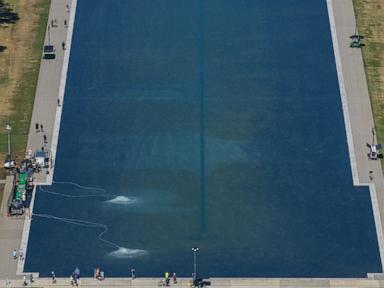
The US Park Police are hunting for a new suspect on the National Mall. On Wednesday, investigators dropped a blurry, distant video showing someone reaching into the Lincoln Memorial Reflecting Pool and pulling something out. They want the public to help identify this person for "destruction of government property."
It sounds like a straightforward crime story. But if you look closer at what's actually happening on the ground in Washington, D.C., the narrative completely falls apart.
This isn't just about a single trespasser. It's the latest flashpoint in a bizarre political drama involving a $16 million renovation, peeling paint, a massive algae bloom, and claims of "sabotage" that scientists say defy the laws of nature.
The Official Story Versus the Blurry Video
According to the US Park Police, the incident caught on camera happened at 3:36 p.m. on Friday, June 19. The footage shows an individual interacting with the water, allegedly peeling away part of the pool's new lining. This bulletin follows a wave of law enforcement action at the site, including five arrests and five federal citations for property destruction.
But look at who they're arresting.
One of the people swept up in this crackdown was David Hearn, a 67-year-old former Olympic canoe racer from Bethesda, Maryland. Hearn wasn't a midnight saboteur carrying a toolkit. He was on a 64-mile bike ride, spotted the pool, and stopped out of sheer citizen curiosity.
"I reached down to see what it felt like," Hearn said after being detained for five hours by National Guard troops and Park Police. "It was very rubbery." Hearn noticed the new blue coating on the bottom of the pool was already peeling off and floating. He touched a loose chunk that was still attached, got yelled at by a park worker, and let go. Now he's looking for a defense lawyer for a July court date.
If curious cyclists touching loose paint counts as "gruesome vandalism," we need to talk about why the paint was loose in the first place.
The $16 Million Coat of Paint
The Reflecting Pool recently went through a massive, fast-tracked rehabilitation project. The price tag ballooned from an initial $2 million estimate to more than $14 million, eventually hitting around $16 million. A Virginia-based contractor secured the no-bid project, which aimed to beautify the century-old monument before upcoming national celebrations.
A central piece of this project was draining the pool and coating the bottom in a specific shade of paint dubbed "American flag blue."
Almost immediately after the water returned, things went sideways. Rips appeared in the surface. Strips of the blue coating began delaminating—fancy talk for peeling off—and floating to the top.
The official line from the administration is that "sick people" and "thugs" violently cut the pool. In a court document filed as part of a lawsuit by a nonprofit trying to halt the project, Frank Lands, the National Park Service deputy director of operations, noted that a foam sealant liner had been sliced with a knife or razor. Officials also claimed someone hacked a 350-foot gash from one end of the pool to the other, threw 70 fence post tops into the water, and poured corrosive chemicals into the pool to destroy the facade.
Reporters on the scene haven't found evidence of a massive 350-foot slit. The company behind the project and the Park Service haven't blamed a blade for the widespread peeling either.
The Science of a Neon Green Disaster
Even if a rogue actor sliced a piece of the liner, it doesn't explain the other glaring issue staring visitors in the face. The Reflecting Pool is currently a thick, fluorescent, soup-like neon green.
The administration argues that vandals used chemicals similar to those allegedly deployed on the National Mall lawns to poison the water.
Aquatic ecologists and pool specialists laugh at this theory. The green tint isn't a chemical weapon. It's a massive bloom of natural algae from the genus Desmodesmus.
When you drain a massive, shallow pool, scrub it, repaint it, and fill it back up with fresh water under the hot June sun, you create a perfect biological storm. The sun beats down on the shallow water, warming it up instantly. The new paint and construction disturbance alter the nutrient balance. Algae loves this. It grows exponentially.
To combat the bloom, crews have been spotted dumping massive bottles of hydrogen peroxide into the water and using heavy-duty vacuums to suck the green sludge off the bottom. The federal government even paid an Ohio-based company roughly $1.7 million to deploy specialized nanobubble ozone technology to treat the water.
Algae doesn't care about politics. It cares about sunlight and nutrients. The idea that political dissidents sneaked past National Mall security to plant microscopic algae spores is scientifically absurd.
What Happens Next on the National Mall
If you're planning to visit the Lincoln Memorial for the Fourth of July, don't expect a pristine view. The administration has already confirmed that the Reflecting Pool will likely have to be drained yet again for "permanent repairs" right around the holiday.
The entire project is also tangled up in a legal battle. The Cultural Landscape Foundation, a historic preservation nonprofit, sued the federal government in May, arguing the rush job bypassed mandatory historic preservation reviews. A federal judge hadn't even ruled on the case before the administration pushed the project through to completion.
If you find yourself walking past the National Mall over the next few weeks, keep your hands to yourself. Security is incredibly tight, National Guard troops are watching, and the Park Police are actively trying to make examples out of anyone who gets too close to the water. Don't let curiosity land you a federal property destruction charge. Watch the unfolding drama from behind the security barriers, keep an eye out for the real court dates where this "vandalism proof" is supposed to surface, and let the ecologists handle the algae.