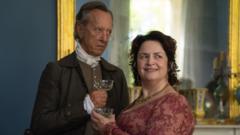
We all know the feeling of standing in a room where the air belongs entirely to someone else.
You stand near the punch bowl. Your dress feels slightly wrong. You have spent three hours preparing a sentence that you hope sounds both intelligent and effortless, but when the moment comes to speak, the conversation moves like a school of fish, darting beautifully away from your clumsy net. You are left holding empty air.
For over two centuries, Mary Bennet has been the undisputed patron saint of that specific, agonizing silence.
In Jane Austen’s universe, Mary is the punchline. She is the middle sister who plays the piano badly and speaks in heavy, unprompted moral platitudes while her elder sisters command the hearts of wealthy gentlemen and her younger sisters cause military scandals in Brighton. We are trained to laugh at her. We laugh when her father cuts her off at the Netherfield ball. We laugh at her pedantic bookishness.
But a quiet rebellion has been brewing beneath the surface of the Austen fandom, and it is about to culminate in a major television event this holiday season. The adaptation of Janice Hadlow’s acclaimed novel, charting Mary’s journey out of the shadows, is officially returning to anchor the festive broadcasting schedule.
This is not just another costume drama extension. It is a reckoning.
The Weight of Being Ordinary
To understand why a Christmas special centered entirely on the least popular Bennet sister matters so deeply, we have to look at the architectural cruelty of the traditional romance.
Classic drawing-room fiction operates on a currency of exceptionalism. Jane is breathtakingly beautiful. Elizabeth is blindingly witty. Lydia is fiercely, dangerously vibrant. They possess the kind of traits that pull the camera toward them by sheer gravity.
Then there is Mary.
Mary has bad skin. Mary lacks the easy grace that makes a simple walk through a muddy field look like an act of romantic defiance. In a world that demands women be either a masterpiece or a cautionary tale, Mary is simply ordinary.
Think about the psychological toll of that existence. Imagine growing up in a house where your mother views your face as a financial liability. Mrs. Bennet does not plot for Mary’s future because Mrs. Bennet does not believe Mary has the raw materials required to manufacture a happy ending.
The upcoming holiday production strips away the satirical armor Austen originally gave the character. It asks a terrifyingly modern question. What happens to the person who realizes they are the background character in their own family's story?
The answers are uncomfortable. They involve long hours spent staring at a pianoforte, trying to master a skill not for the joy of music, but for the desperate hope that someone might look up from their tea and notice that you exist.
Why the Holidays Belong to the Left Out
There is a brilliant, deliberate irony in scheduling this specific narrative for a Christmas special.
December broadcasting is traditionally the playground of the triumphant. We expect stories of grand family reunions, glittering ballrooms, and snow falling perfectly on the shoulders of lovers who have finally overcome their misunderstandings. We want the cinematic equivalent of a warm blanket.
But Christmas is also the most brutal mirror of the year.
For anyone who does not fit neatly into the postcard image of familial bliss, the holidays are a period of high endurance. It is the season where the seating arrangement dictates your worth. It is the time when the aunt you see once a year asks why you are still single, or why your career looks a bit stagnant compared to your cousin’s meteoric rise.
By placing Mary Bennet at the heart of the festive schedule, the creators are shifting the lens.
They are offering a sanctuary for the people who sit at the edge of the sofa during family gatherings, watching the more charismatic members of the household hold court. The special promises to lean heavily into the winter atmosphere of the English countryside, using the cold, stark landscape as a physical manifestation of Mary’s isolation before her eventual thawing.
The Evolution of the Plain Sister
The television industry is currently obsessed with IP expansion, but this return feels different from a standard cash-in. It taps into a profound cultural shift in how we view historical narratives.
For decades, costume dramas focused exclusively on the winners of history. We wanted the duchesses, the heiresses, the women whose wit could bring an empire to its knees. We wanted to escape into a world where every glance across a crowded ballroom carried the weight of destiny.
But perfection is exhausting.
We have reached a point of saturation with the effortless heroine. There is a growing, fierce appetite for the characters who have to work for their dignity. Mary’s story resonates because it is built on failure. She tries too hard. She says the wrong thing. She quotes essays when she should be offering sympathy.
Consider the reality of her situation.
When Lydia runs away with Wickham, the family is plunged into disgrace. But while Elizabeth walks the grounds of Longbourn in poetic despair, Mary is left to contemplate the practical ruin of their lives. She is the one who stays behind, the one who bears the daily, grinding reality of her mother’s hysterics without the luxury of a wealthy suitor waiting in Derbyshire to fix everything.
The upcoming special treats this resilience not as a tragic consolation prize, but as a quiet form of heroism.
Breaking the Austen Mold
The production team has signaled that this adaptation will diverge significantly from the bright, comedic tone of traditional Austen adaptations.
Instead, the visuals are rooted in a softer, more grounded realism. The costumes are repeated. The rooms look lived-in and slightly chilly. The lighting relies on the weak, golden glow of winter candles rather than the idealized sunshine of a studio backlot.
This stylistic choice mirrors Mary’s internal world.
Her journey is not about a sudden, magical transformation. There is no scene where she removes her spectacles and is suddenly revealed to be a conventional beauty. That trope is cheap, and it insults the intelligence of the audience.
Instead, the narrative arc tracks something far more difficult: the slow, painful acquisition of self-worth.
It is the moment a person stops looking at their family members for validation and starts looking at the world outside the front gate. For Mary, that means finding a purpose that does not depend on being courted or praised. It means realizing that books are not just shields to hide behind, but windows into a larger, kinder reality.
The Small Stakes Are the Only Stakes
In the grand scheme of television drama, nothing massive happens in this story. No kingdoms fall. No one is murdered in a dark alley. The fate of the world does not hang in the balance.
Yet, the tension is agonizing.
Will Mary speak up during dinner? Will she venture out into the town on her own? Will she allow herself to accept a gesture of genuine kindness from a stranger, or will her defensive walls, built over a lifetime of ridicule, cause her to pull away?
These are the invisible stakes that define most human lives.
We do not live in the high-stakes world of political thrillers. We live in the small, quiet spaces of our own insecurities. We live in the hesitation before we send a text, the panic when a conversation stalls, the deep ache of feeling fundamentally misunderstood by the people who share our last name.
That is why this Christmas special is a quiet triumph before it even airs.
It validates the small struggles. It takes the girl who was written off as a footnote in one of the greatest love stories ever told and grants her the full dignity of her own perspective. It reminds us that the people who do not shine brightly in the ballroom still have a story worth telling when the music stops and the candles are snuffed out.
When the special airs this December, look past the main couples dancing under the mistletoe. Look for the girl standing quietly by the window, watching the snow fall, finally realizing that she does not need an invitation to the dance to belong to the world.