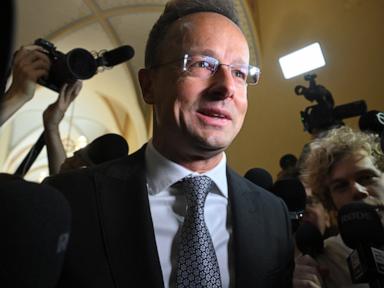
Ink dries quickly on government stationery in Budapest. One morning, a high-ranking official stands at a mahogany podium, defending state policy with the practiced gravity of a seasoned diplomat. He speaks of national sovereignty, of keeping foreign interests at arm's length, of guarding the borders of Hungarian industry against external tides.
A few months later, the suit changes. The podium is gone, replaced by the sleek, minimalist glass-and-steel boardroom of a multinational giant. The man who once regulated the flow of foreign capital is now employed by the very foreign automaker he used to court, negotiate with, and defend.
Nobody screams. No sirens wail in the streets of the capital. Instead, there is a quiet, collective nod—the kind born of long exposure to a system where power rarely leaves the room; it merely changes seats.
To understand why a foreign minister stepping into the payroll of a Chinese electric vehicle manufacturer matters to anyone outside of Central Europe, you have to look past the dry transcripts of parliamentary hearings. You have to look at the speed of modern ambition and the blurry line between serving a public mandate and securing a private fortune.
Power has a gravitational pull. In modern governance, the pull is rarely ideological anymore; it is transactional.
Consider the mechanics of how modern states court industrial giants. When a massive battery plant or assembly line needs a home, it does not land in a vacuum. It requires
The Revolving Door That Built the Modern Highway
news, business
Category: news, business
Power rarely wears a disguise. It does not need one. When a minister steps out of a government office and into the boardroom of the very multinational corporation they spent years negotiating with, the transition is rarely marked by sudden explosions or dramatic midnight whispers. It happens over coffee. It happens with a handshake, a quiet sigh of relief, and the turning of a page in a ledger that most citizens never get to read.
Consider what happens in a small European nation when the state opens its arms wide to foreign capital. The billboards tell a story of modernization. They speak of electric dreams, cleaner air, and assembly lines humming with the relentless energy of the twenty-first century. But behind the glossy PR campaigns lies a quieter, more intimate choreography. It is the dance between politicians who hold the keys to the regulatory kingdom and the corporate giants seeking to bypass every gate.
When a former foreign minister takes a seat at the table of a massive Chinese automotive company—a titan reshaping the global electric vehicle market—the boundary line between public service and private reward dissolves entirely.
Let us be entirely clear about the facts. In Hungary, the intersection of political power and Chinese industrial investment has transformed from a matter of diplomatic strategy into the very backbone of the national economic model. For years, the administration steered the country toward becoming a manufacturing hub for battery production and electric vehicles, courting billions in foreign direct investment from the East while standing at constant, noisy loggerheads with Brussels.
Then the minister steps down. And soon after, the minister steps inside the corporate fold.
The public grilling that follows is ritualistic. Lawmakers press, journalists probe, and television cameras capture the furrowed brows of officials defending the undefendable. They call it expertise. They talk about the value of deep institutional knowledge, international relations, and the seamless continuity of cross-border cooperation.
Nobody buys it. Not entirely. Because the human mind is wired to recognize a quid pro quo when it smells one.
Imagine standing on the floor of a newly built battery plant outside Debrecen. The air is thick with the scent of fresh concrete and industrial solvent. Gigantic robotic arms slice through the air with terrifying precision, welding aluminum and assembling cells that will soon power cars driving down the streets of Munich, Paris, and Rome. A local worker, let us call him Zsolt, stands by the line with a wrench in his hand, earning a wage that keeps his family afloat but leaves him acutely aware of who truly pulls the levers of his destiny.
Zsolt does not care much about the intricacies of international trade law. He cares about rent. He cares about whether the town he grew up in will still look like home in ten years, or if it will belong entirely to overseas conglomerates operating under agreements negotiated in smoke-filled rooms by men who now work for the very companies they once regulated.
When politicians cash in their political capital for corporate board seats, the betrayal is not just ethical; it is gravitational. It pulls trust down into the dirt.
For decades, political scientists have studied the phenomenon of regulatory capture, but textbooks fail to capture the visceral sting of it. We are told that globalization requires fluidity, that the movement of capital and political elites creates a stabilizing bridge between nations. Yet, when the bridge is built entirely of personal exits for former officials, it stops looking like diplomacy and starts looking like an exit strategy.
The strategy is simple: legislate the incentives, clear the environmental hurdles, dismiss the local protests, and secure your retirement package.
Hungary’s embrace of the Chinese electric vehicle wave is not an isolated gamble. It is a calculated pivot. As Western economies stall and trade tensions rise, Budapest has leaned heavily into becoming Beijing’s primary gateway to the European Union market. Battery factories sprout across the fertile plains like concrete mushrooms. Billions pour into the economy, boosting GDP figures just in time for the next election cycle.
Yet every single factory comes with strings attached. Environmental permits are streamlined. Public consultations are muted. Labor standards are viewed through the cynical lens of competitiveness. And when citizens ask questions about water usage, hazardous waste, or the long-term sovereignty of their local communities, they are met with a wall of institutional indifference.
Then, the architect of those very policies walks out of government and straight into the corporate hierarchy.
The public grilling in the legislature is loud, but it is theater. The questions are lobbed like softballs across a net of complicity. The defense is rehearsed, pointing to the undeniable need for economic growth, modernization, and jobs. They lean heavily on the idea that without these factories, the nation would wither on the vine of European periphery.
There is a kernel of truth in that defense, which is precisely why it works. Small nations navigating the brutal currents of global capitalism often feel they have no good choices, only desperate ones. They must sell their labor, their land, or their regulatory leniency to the highest bidder just to stay relevant.
But there is a vast gulf between national survival and personal enrichment.
When the people running the state treat the state as an incubator for their private sector careers, the social contract fractures. It teaches the next generation of leaders a very specific, poisonous lesson: public service is not a duty; it is an internship for lobbying.
Think about the psychological toll this takes on a society. Cynicism becomes the default civic posture. When news breaks of another high-ranking official sliding smoothly from a government ministry into a multinational corporation, nobody gasps. They nod. They roll their eyes. They expect nothing better. And that loss of expectation—that quiet, creeping despair over the integrity of public institutions—is far more damaging than any corporate scandal or trade imbalance.
The electric vehicle revolution is coming whether we like it or not. The world is desperate to transition away from fossil fuels, and the supply chains required to build that future are staggeringly complex. Nations will partner with giants. Deals will be struck across ideological divides.
But the integrity of those deals depends entirely on who is sitting at the table and whose interests they truly serve.
When the boundaries vanish, when the regulator becomes the regulated, the public is left holding an empty bag of promises. The factories will hum. The cars will roll off the lines. The GDP numbers will tick upward on bureaucratic spreadsheets. But the foundational trust that holds a democratic society together will quietly erode, grain by grain, until nothing is left standing beneath the weight of our own compromises.
The door opens. Another official steps through. And the highway stretches out into the distance, smooth, fast, and toll-free for the few who built it.


