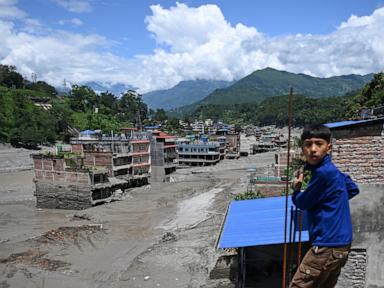
The air in the high valleys of the Himalayas always smells of woodsmoke and crushed pine. Or at least it did, before the water came.
Water at that altitude is usually a slow thing. It trickles from ancient ice, carves thin silver veins through slate, and sings a cold, clear song over rounded stones. You learn to trust it. You build your stone houses close to its banks, plant your terraced crops in its reach, and watch your children skip flat pebbles across its surface during the long, amber afternoons of late summer. The river is a neighbor. Until it becomes an executioner.
Hundreds are dead. Nearly a thousand remain missing.
Those are the numbers flashing across silent screens in distant capitals, reduced to pixels and scrolling tickers. But numbers do not capture the weight of mud. They do not describe the terrifying, sudden roar of a mountain pass turning into a liquid avalanche, carrying entire villages, livestock, and centuries of human memory down into the churning gorges of Nepal and Tibet.
I have stood in the wake of such fury. You never forget the silence that follows. Not peace, but the hollow stillness of a world stripped bare.
Consider what happens when a glacier lake bursts its seams high above the clouds.
To understand the scale of the catastrophe unfolding across the roof of the world, we have to look past the abstract geography and into the specific geography of survival. High-altitude floods are not like the rising tides of coastal plains. They are vertical assaults. Gravity becomes a weapon. When a sudden breach unleashes millions of cubic meters of icy sludge, it does not gently overflow its banks. It accelerates. It gathers mass, tearing away ancient forests, crushing concrete bridges like dry twigs, and swallowing stone-built hamlets before the inhabitants even have time to look up from their morning tea.
Down in the valleys, the warnings arrive too late, if they arrive at all.
Meet Tenzing, a hypothetical name for a very real face in these remote highlands. Imagine him stepping out onto his wooden porch, a tin cup of butter tea warming his palms. The morning mist is clinging to the pine trees across the gorge. The river sounds different today. Not the familiar rush of snowmelt, but a deep, subterranean growl, like an engine turning over beneath the earth. He frowns. He turns to call his wife.
And then the wall of black water hits.
There is no time for heroism. There is only the frantic scramble for high ground, the desperate grab for a child's hand, and the terrifying realization that the earth beneath your feet has dissolved.
The immediate aftermath is a logistical nightmare wrapped in profound grief. Roads that took decades to carve into sheer cliff faces have vanished, replaced by jagged drop-offs of red dirt and pulverized stone. Helicopters can only do so much against the brutal winds and narrow canyons of the Himalayan frontier. Rescuers wade through waist-deep, gray soup, searching for makeshift markers—a scrap of bright blue cloth caught in a thorn bush, a child's shoe half-buried in silt—hoping against hope for signs of life among the missing.
Yet, this tragedy is not merely an act of capricious nature. We are watching the collision of human vulnerability and a rapidly warming planet.
For years, scientists have warned about the hidden ticking clocks scattered across the high mountains. Glacial lakes, dammed only by fragile walls of loose rock and ice known as moraines, are swelling as temperatures climb. When these natural dams fail—triggered by sudden cloudbursts, seismic shifts, or simply the relentless pressure of melting ice—the result is a catastrophic outburst flood.
We got the timeline backward. We assumed we had decades to adapt, to install early warning sensors, to move vulnerable communities away from historical floodplains. We treated climate change as an economic debate or a political talking point, something to be negotiated in air-conditioned rooms thousands of miles from the nearest glacier.
The river does not negotiate.
The human cost of this delay is now being tallied in body bags and empty doorways. Whole generations wiped out in minutes. Grandparents who remember the old ways, parents who built the new roads, and children who were just beginning to learn the names of the mountain peaks—all swept away into the transboundary river systems that feed millions across South Asia.
The search parties will eventually pack up their gear. The international headlines will shift to the next crisis. But in the steep, shadowed valleys of Nepal and Tibet, the real work of living among ghosts is only just beginning.
Look closely at the mud caked on the remaining doorframes. That is where history is written now. Not in the ledgers of governments, but in the silence of those who are left behind, listening to a river that will never sound the same again.

