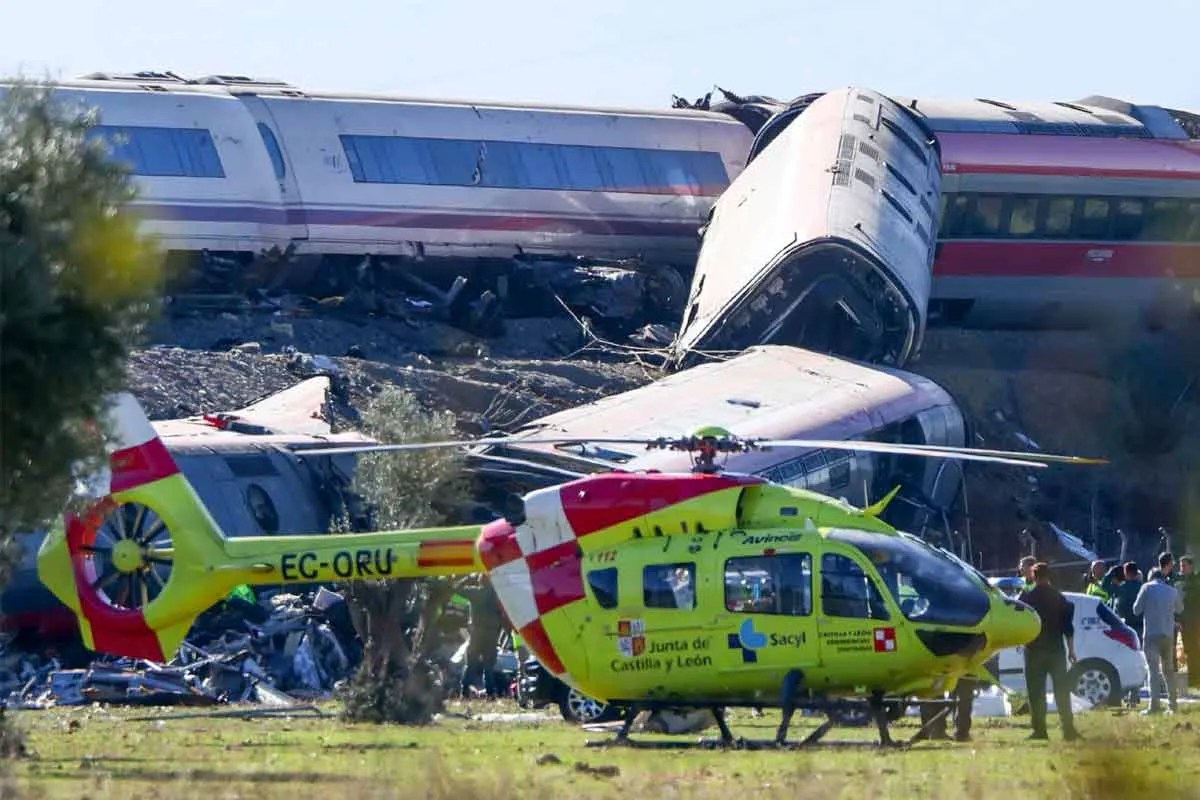
Blaming a red light for a train crash is like blaming a smoke alarm for a house fire. Lazy. Predictable. Completely backward.
Whenever a train runs a red signal in Spain—or any high-speed rail corridor—the media playbook runs on autopilot. Pull up the eighty-year archive of Spanish rail disasters. Count the dead. Point to 2026 and act shocked that a train blew past a stop aspect yet again. Run the headline about red signals and fear. Job done.
That coverage gives readers a comforting illusion of understanding while missing the real engineering problem. A red signal is a warning light on a pole or a cab display. It does not hold a hundred-ton steel consist in place with friction. It does not bend the laws of physics. If a driver misses a signal, misreads a route, suffers a sudden medical episode, or operates under bad situational awareness, a glowing red light cannot stop forty million kilograms of momentum by sheer willpower.
Ask the wrong question, and you get useless answers. People type into search bars: Why do trains run red signals in Spain? How many major train accidents has Spain had in eighty years? Are Spain's trains safe in 2026? Those questions treat every derailment or collision as a fresh freak anomaly caused by a single blown light or a bad decade. They aren't. They are symptoms of how complex, high-speed rail networks behave when human cognition, legacy infrastructure, and train-protection systems collide.
I have spent years working around heavy rail operations, safety audits, and signaling architecture across European corridors. I have seen transit authorities blow millions of euros on flashy display upgrades and public-relations audits while ignoring the messy interface between driver workload, track geometry, and automatic train control. When a crash happens, the easiest target is human error or a single signal aspect. The hardest target—and the one that actually saves lives—is system design under failure.
The Lazy Consensus Around Red Signals and Eighty-Year Timelines
Look closely at what standard coverage does when it lumps eighty years of rail history into one breathless fear loop. Eighty years takes us back to the aftermath of World War II—an era of steam and early diesel traction, heavy wooden rolling stock, mechanical block instruments, single-track bottlenecks, and operating rules written for speeds that today's commuter trains laugh at.
Equating a mid-twentieth-century mechanical-signaling wreck with a modern high-speed or suburban incident flattens history into a cheap scare tactic. Spain's rail network changed radically over those decades: the shift from conventional Iberian gauge bottlenecks to dedicated high-speed lines, the rollout of modern interlocking, and the gradual expansion of cab-signaling systems. Pulling a giant historical tally to prove "2026 scared us again" confuses chronological accumulation with a rising hazard rate.
In safety engineering, raw counts without exposure data are noise. If a network runs millions more train-kilometers at higher speeds with denser timetables than it did decades ago, raw incident headlines tell you almost nothing unless you normalize by exposure, line class, and protection fitment. Treating an eighty-year list as a single unbroken trend is lazy journalism dressed up as historical depth.
More importantly, obsessing over the red signal itself mislocates where safety actually lives. A signal is part of signaling and train control, not the whole safety barrier. In modern rail engineering, we distinguish between:
- Lineside or cab signaling: Tells the driver (or onboard computer) what the authority ahead permits—proceed, caution, or stop.
- Train protection (such as ATP or ETCS): Enforces speed limits and braking curves automatically if the train exceeds what is safe or passes a stop point without authority.
- Interlocking: Ensures points (switches) and signals are locked in safe, non-conflicting states so two routes cannot legally cross.
When a train runs a red signal, the failure isn't just "the light was red." The critical engineering question is: What happened after the signal was passed? Did an automatic braking system intervene cleanly, or was the train running on a line or mode without full continuous enforcement? Was a switch set against the train? Was visibility compromised, or was a driver dealing with fatigue, cognitive overload, or confusing route indications?
Why "Signal Passed at Danger" Is a Symptom, Not a Root Cause
In the rail world, passing a stop signal without authority is formally known as a SPAD (Signal Passed at Danger). Outsiders hear "red signal" and picture a driver casually flooring the throttle past a bright crimson lamp like a teenager blowing through a city crosswalk.
Reality is far uglier and far more nuanced.
Drivers operate in dynamic environments. A signal gantry might sit against complex background clutter, low sun glare, or curved approach geometry. A driver might be transitioning between lines with different rules, dealing with degraded timetable recovery after an earlier delay, or experiencing micro-sleep or sudden incapacitation. Sometimes a signal clears and drops, or a sequence of aspects creates expectation bias—when your brain predicts green because the last six signals were green.
Calling that "running a red signal" as if it explains the accident is like calling a plane crash "descending into the ground." Yes, that happened. No, it does not explain why the aircraft reached that state or why recovery failed.
Let's test this with a clear thought experiment. Imagine a scenario where a high-speed or regional corridor relies purely on lineside signals and driver vigilance, with no continuous automatic braking intervention enforcing a target speed curve before a red aspect. One afternoon, a driver suffers a sudden, brief cognitive lapse on a curved approach. The red signal glows brightly. Nobody pulls the brake. Now compare that with a corridor equipped with continuous supervision where the onboard system tracks distance to the stopping point, calculates a braking curve, and applies service or emergency brakes automatically if the train is not slowing down on schedule. In the second case, the signal may still be passed or approached too fast, yet the system catches the drift before disaster strikes.
That is why heavy hitters in rail safety—from European rail safety bodies and accident investigation boards to human-factors researchers like James Reason, famous for the Swiss cheese model of system accidents—insist on looking at layered defenses rather than single-point blame. Catastrophic accidents rarely happen because one hole lined up; they happen because multiple defensive layers—training, route knowledge, clear signals, automatic train protection, crashworthiness, and emergency response—had holes align at the same moment.
Dismantling the "People Also Ask" Traps
When people read about rail tragedies, their follow-up questions usually follow the same predictable script. Every single one of those common questions contains a trap if you answer it superficially.
"Why do trains still run red signals even with modern technology?"
Because "modern technology" is not a magic forcefield slapped evenly across every meter of track, every train class, and every fallback mode.
Rail networks are patchwork systems. Even countries with world-class high-speed infrastructure operate mixed fleets and legacy segments alongside modern corridors. Systems degrade. Temporary speed restrictions get imposed after weather or track work. Drivers switch between operating regimes or handle degraded operations when equipment fails. Whenever humans interact with automated systems—especially during edge cases or mode transitions—automation surprises and mode confusion can occur. Technology reduces risk dramatically when properly engineered and maintained; it does not repeal human fallibility or mechanical wear.
"How can we stop trains from ignoring red signals?"
Stop treating driver punishment or generic "be more careful" campaigns as a technical fix. If a human can make an error under foreseeable operational conditions, blaming the human after the fact guarantees the error will repeat somewhere else.
Real prevention requires engineering out catastrophic consequences when a signal is missed:
- Enforce braking curves automatically: Relying on a human eye to judge braking distance at high speed over complex gradients is poor system design when continuous train protection can supervise speed and stop points directly.
- Design signals and cab displays for human perception: Eliminate ambiguous sightlines, conflicting visual cues, and high-workload cab interfaces where critical alerts get buried in routine noise.
- Audit degraded and non-standard modes: Most dangerous edge cases happen outside normal textbook running—during possessions, engineering work, single-line working, or radio/signaling faults. Test how the system behaves when things go sideways.
- Invest in rolling stock crashworthiness: Even with the best prevention, physics occasionally wins. Structural energy absorption, interior restraint, and fire/evacuation standards determine whether an incident is survivable or fatal.
"Does a cluster of accidents mean the whole rail system is collapsing?"
No—and assuming it does leads to panicky, bad policy. Two serious events in a single year like 2026 will understandably rattle passengers and dominate news cycles. Fear is human. Still, two data points do not automatically prove systemic collapse across an entire national network carrying hundreds of millions of passenger journeys.
What two major events should trigger is a ruthless, non-defensive audit of common denominators. Were they on similar infrastructure? Did they involve similar train protection standards, operational pressures, or maintenance practices? If there is a shared thread, fix it aggressively. If they stem from distinct failure mechanisms, treat each root cause on its own merits instead of slapping a lazy label on the entire network.
Battle Scars From Inside Rail Safety
I've seen rail operators and oversight bodies waste fortunes on theater after a high-profile scare. One agency I worked alongside poured budget into high-visibility posters and retraining workshops telling crews to "stay sharp at every signal," while leaving outdated cab warning logic untouched for years because changing the software required cross-border approval and vendor negotiation. Predictably, morale dipped, crews felt blamed for systemic design flaws, and the underlying technical gap sat right where it was.
I've also seen the opposite mistake: throwing expensive hardware at a problem without fixing operational rules or maintenance discipline. Installing advanced protection on paper means very little if degraded modes allow workarounds, if trackside assets aren't maintained to spec, or if timetable padding is so tight that recovery forces drivers into constant stress.
Where My Contrarian Take Can Backfire
Being contrarian feels great until reality pushes back, so let's be honest about the downside of downplaying the "red signal" narrative.
First, if you argue that signals aren't the whole story, bad actors or complacent managers can twist that into excusing genuine rule-breaking or sloppy operational discipline. Rules exist for a reason. A red signal is a clear legal and operational boundary; crossing it without authority is never benign.
Second, shifting focus toward complex train-control systems and human factors can sound abstract to grieving families or anxious commuters who want a straight answer about who made the mistake and why a train wasn't stopped. Overly technical explanations can come across as cold or evasive if not paired with plain accountability and transparent investigation.
Third, pushing for sweeping system upgrades across an entire network runs straight into capital constraints, legacy compatibility headaches, and years of disruption. You cannot rip and replace every signal, interlocking relay, and onboard computer overnight without paralyzing daily transport.
What Actually Matters Next
Forget counting eighty years of headlines to feed your dread. Watch what investigators uncover about train protection intervention, route and switch integrity, human-machine interface design, and how degraded operations were handled in the specific incidents that shook people in 2026.
Demand engineering specifics, not emotional slogans. A glowing red lamp only warns; real safety stops the train before metal meets metal.