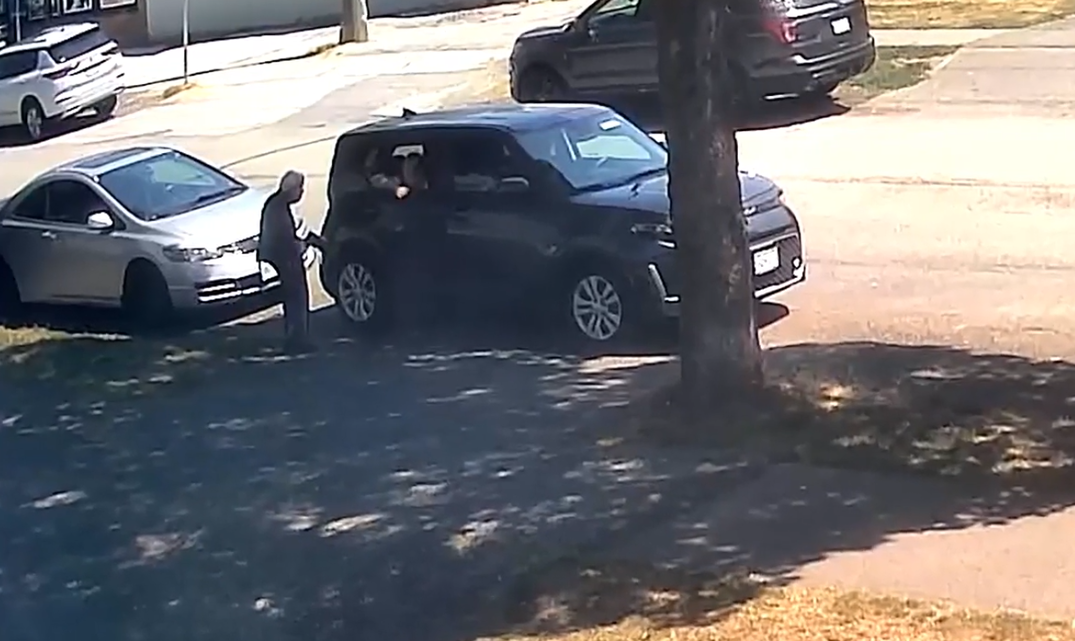
The footage is predictably infuriating. An 88-year-old woman, standing outside her home in East Vancouver selling parking spaces for the Pacific National Exhibition (PNE), is approached by a dark-coloured Kia Soul. A passenger in the back seat pretends to ask for help, grabs the elderly woman’s wrist, and swaps her real gold and jade necklaces for cheap, fake jewelry. Within hours, the media cycle kicks in with its standard script: a flurry of police warnings, a collective gasp of public outrage, and the inevitable, patronizing advice telling our oldest citizens to lock their doors, ignore strangers, and withdraw from the world.
This response is a catastrophic failure of common sense.
By treating this distraction theft as an isolated criminal anomaly that can be solved with higher security gates and a culture of paranoia, we are actively setting up our senior population for more exploitation. The traditional "safety theater" pushed by local police departments and parroted by news outlets does not protect vulnerable people. It isolates them, strips them of their independence, and turns them into soft targets.
If we want to stop distraction thefts, we have to stop telling seniors to hide.
The Surveillance Placebo
Whenever a crime like this occurs, the authorities instantly plead for dash-cam and closed-circuit television (CCTV) footage. They treat these grainy, low-resolution clips like a shield against future attacks.
Let's be completely honest about what surveillance cameras actually do. They do not stop crime. They record it.
Cameras are a post-mortem tool for insurance claims and police press releases. In this East Vancouver case, the suspect vehicle was caught on camera, complete with a clear description of the occupants, including two children sitting in the back seat. Yet the theft still happened. The presence of cameras did not make the suspect hesitate for a single second.
Relying on digital eyes to protect our neighborhoods is a lazy cop-out. It creates a false sense of security while letting the real infrastructure of community safety rot. We have replaced active, physical neighborhood engagement with passive, digital pacifiers. When you rely on a lens mounted under your gutter to watch your street, you have already conceded that your neighborhood is empty, unmonitored, and ripe for exploitation.
The Crime of Forced Isolation
The victim in this theft was not sitting passively on her porch waiting to be targeted. She was actively participating in a decades-long East Vancouver tradition: selling private parking spaces during the PNE.
This micro-enterprise is exactly what a healthy, active neighborhood looks like. It is an 88-year-old woman maintaining her cognitive sharpness, exercising financial independence, and interacting with her community. It is a masterclass in aging with dignity.
Yet, the predictable, risk-averse advice from armchair safety experts is always the same: Seniors shouldn't be out on the street. They shouldn't talk to drivers. They should let younger relatives handle these things.
This is victim-blaming masquerading as care.
When you tell an 88-year-old to stop engaging with the public, you are prescribing a slow, agonizing decline. Social isolation is a well-documented driver of cognitive deterioration, depression, and physical frailty in older adults. Forcing seniors into isolation under the guise of "protecting" them does far more damage to their health and longevity than the threat of petty theft ever could.
Furthermore, an empty street is a dangerous street. The classic urban planning principle of "eyes on the street"—made famous by Jane Jacobs—proves that safety is maintained by an active, visible web of people occupying public spaces. When we pressure seniors to retreat indoors, we clear the sidewalks for predators. We hand them the turf.
Dismantling the Myth of the Hyper-Vigilant Senior
Police departments love to issue warnings telling people to "stay alert" and "be aware of your surroundings."
This advice is useless. It assumes that human beings can operate in a state of high-alert combat readiness twenty-four hours a day. It is physically and mentally impossible, especially for older adults who may have sensory or cognitive declines.
Distraction theft relies entirely on social conditioning. The human brain is hardwired to respond to social cues. When someone rolls down a window and looks distressed, our natural, prosocial instinct is to step closer and help. This is not a weakness; it is the foundation of civilized society.
The suspects in Vancouver systematically weaponized this decency. In another incident reported just days prior, a suspect approached a 76-year-old woman, claimed she looked "just like her mother," and hugged her while stealing her necklace.
[Social Cue: Distress/Affection] ──> [Decency Response: Step Closer] ──> [Physical Contact: Theft]
Telling seniors to simply ignore these social cues is a fantasy. You cannot train the humanity out of a person who has spent eight decades being a neighborly, empathetic human being.
Instead of demanding that seniors become cold, paranoid security guards, we need to design our physical and social environments to limit the opportunity for these physical interactions.
Rebuilding the Physical Barrier
If we want to protect seniors, we need to look at physical geography, not moralistic safety lectures.
Distraction thefts of this nature almost always involve vehicles. A car pulls up to the curb, a window rolled down, and a victim is lured off their property and into the "strike zone" of the vehicle's passenger window.
The car acts as a getaway tank. It allows the thief to remain partially concealed, maintain control over a heavy piece of machinery, and escape instantly once the physical swap is made.
Our current suburban and urban layouts make this incredibly easy. We build wide, uninterrupted curbsides that allow vehicles to pull up directly alongside pedestrians.
To break this cycle, we need to change how we organize our front yards and walkways:
- Designate a "No-Contact" Boundary: Seniors selling items or parking should have a physical barrier—like a small gate, a sturdy table, or a raised garden bed—between themselves and the street. They should never have to walk directly up to a car door to interact with a driver.
- Move the Transaction: If cash or information needs to be exchanged, it should happen at a designated station set back from the curb. If a driver wants to buy parking, they should be required to park, turn off their engine, and step out of the vehicle to negotiate.
- The Two-Meter Rule: We must teach seniors a simple, physical rule of thumb: never get within arm's reach of a vehicle window. If a driver cannot speak loud enough for you to hear them from two meters away, let them drive off.
This is not paranoia; it is simple spatial management. It places the burden of physical security on the landscape, rather than the senior’s reaction time.
The Failure of the Single-Family Fortress
The real driver behind the vulnerability of our elderly population is the isolation inherent in our modern housing design.
In many North American suburbs and gentrified urban neighborhoods, we have built single-family homes that act as isolated fortresses. Neighbors do not know each other. Front porches are purely decorative. The street is treated merely as a thoroughfare for cars, not a shared community space.
When an 88-year-old woman is standing outside her house alone, she is an easy target because the thieves know nobody is watching. They know the houses next door are empty during the day, or that the neighbors are inside with their blinds drawn, staring at screens.
We have traded community networks for individual security systems. We spend thousands of dollars on Ring doorbells and smart locks, while neglecting the simple act of introducing ourselves to the person living next door.
I have spent years studying community safety and urban resilience. The neighborhoods with the lowest rates of crime against seniors are not the ones with the highest concentration of security cameras. They are the ones with the highest density of human eyes. They are the blocks where neighbors sit on front porches, where local shops spill out onto the sidewalks, and where people notice when a strange vehicle is lingering at the curb.
If you want to protect your elderly neighbors, stop recommending security tech. Go outside. Stand on the street. Buy a parking spot from them. Make your presence known.
The only true deterrent to a criminal of opportunity is the certainty that they are being watched by living, breathing human beings who are ready to step in. Everything else is just a digital recording of a tragedy that we were too lazy to prevent.