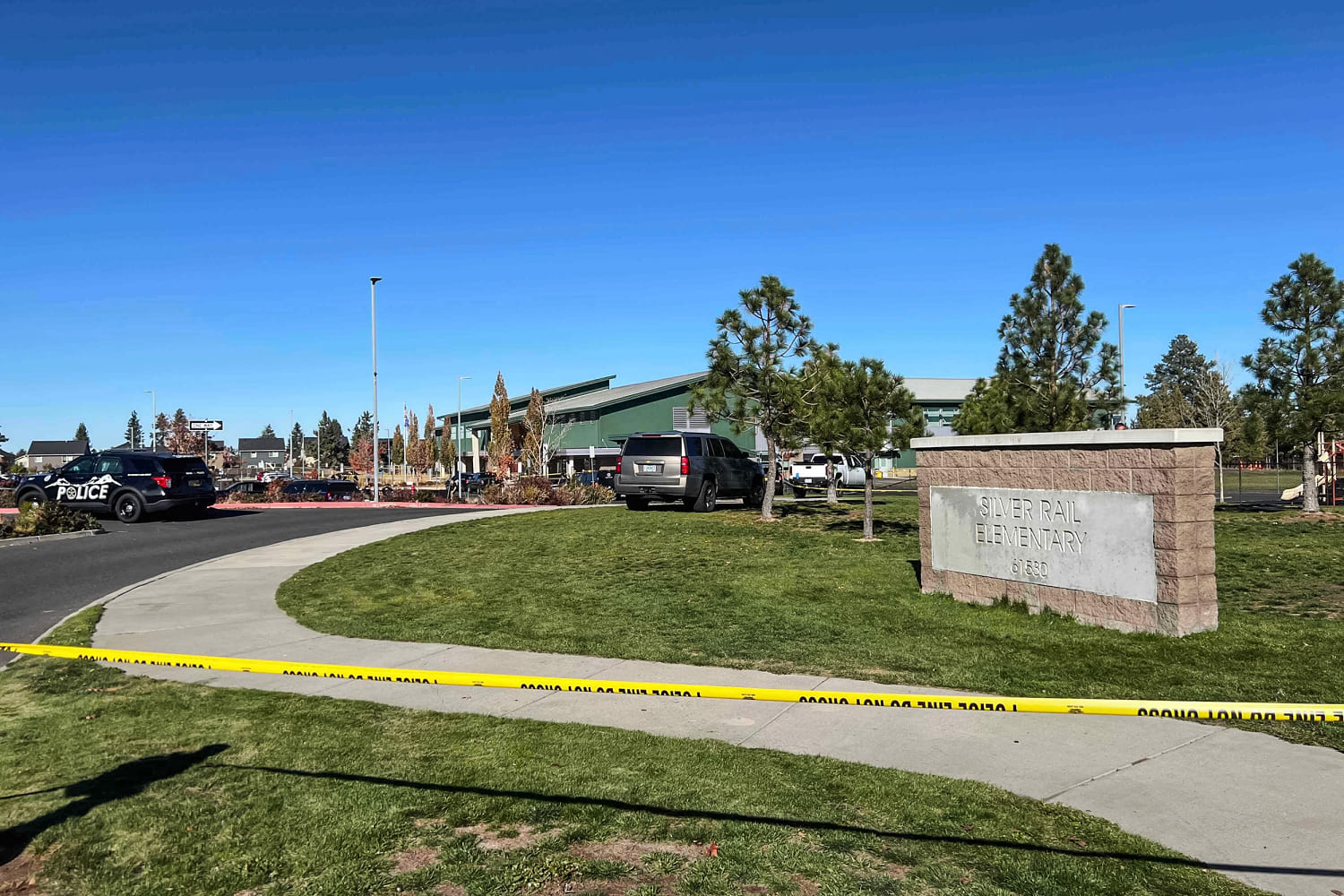
Four dead in Bend, Oregon. Three children—ages five, eight, and eleven—and a twenty-five-year-old teacher named Meghan Lambert. A sixteen-year-old former student armed with a twelve-gauge shotgun forced his way through glass doors into a special education classroom at Silver Rail Elementary School before a parent with a concealed carry permit fatally shot him.
Standard breaking news coverage treats a tragedy like this as a static police blotter. Count the victims. Name the suspect. Mention the bystander who stopped him. Move on to the next headline. Learn more on a connected topic: this related article.
That lazy consensus misses the entire operational failure underneath it.
Silver Rail Elementary wasn't an unguarded, forgotten building from the 1970s. Built in 2015, it had secure vestibules, electronic visitor check-ins, security cameras, post-Uvalde switch-activated classroom locks, and district-wide armed school resource officers. By every conventional metric used by school boards and security consultants, the building was "hardened." More analysis by The Guardian highlights similar perspectives on the subject.
And a kid with a shotgun still blew through the glass panels of locked doors in roughly a minute.
The Comfort Theater of "Hardened" Schools
Ask any school board member what makes a campus safe, and you'll hear the same five buzzwords: vestibules, buzzers, cameras, badges, lock hardware. We treat physical security like a compliance audit. Check the box. Buy the hardware. Tell parents the building is locked down.
I've watched school districts and corporate campuses pour millions into access-control theater while ignoring how violent actors actually move through space. Glass doors with buzzers stop honest visitors and confused delivery drivers. They do not stop a determined assailant carrying a firearm. A thin pane of tempered or standard safety glass next to a locking mechanism is a speed bump, not a barrier, unless that glazing is actually rated to delay forced entry and ballistic impact.
Look closely at what happened at Silver Rail. The attacker shot out glass panels on locked doors to get inside and went straight for a special education classroom where four adults and five children were present. Teaching assistant Becky Drury tried to shut the door behind her and was shot at close range. Teacher Cassidy Schutz tackled the gunman and threw her phone at him. Meanwhile, law enforcement arrived within two minutes—at 1:02 p.m., following the 1:00 p.m. calls about the shooter entering the building.
Two minutes is fast by almost any historical standard. Yet four people were already dead or fatally wounded by the time the gunman was stopped moments later by Kaylub Giamanco, a father whose two daughters were inside.
That math is the uncomfortable truth nobody wants to confront: response time measured in minutes is a post-mortem metric when an attacker is already inside a room with children.
The Hero Myth vs. System Design
Whenever an armed civilian stops an attacker, the public narrative splits into two predictable camps. One camp treats the armed bystander as a universal blueprint—proof that more guns everywhere solve everything. The other camp treats any civilian intervention as reckless vigilante chaos.
Both camps are arguing past the real issue.
In Bend, Giamanco was already outside, saw the shooter firing in the parking lot, called 911, crawled past the blown-out glass doors, located the threat through a window, and fired his handgun. His actions saved lives in that classroom. Pretending otherwise would be dishonest.
At the same time, building a safety strategy around hoping a parent happens to drive by with a legally stored handgun in their vehicle is not a system. It's a coin flip. Imagine a scenario where Giamanco had been stuck in traffic ten minutes away, or where his handgun had been locked in a trunk rather than accessible, or where he had been misidentified by arriving officers seconds later. High-stress environments punish improvisation and reward engineered layers of delay, detection, and compartmentalization.
Security researchers who study active violence—professionals like Pete Blair at the ALERRT Center at Texas State University and former Secret Service threat assessment specialists—have emphasized for years that time and distance are the primary variables in survival. If an attacker cannot breach the perimeter quickly, or cannot move freely from room to room, the clock shifts in favor of the people inside.
Why Special Populations Face Compounded Risk
Most coverage of the Oregon shooting notes that three children and a teacher died. Far less attention goes to the fact that the attack hit a special education classroom.
Standard lockdown drills assume a baseline of mobility, sensory tolerance, and rapid compliance. Quietly hiding under desks or moving briskly to a blind spot works differently when a classroom includes young children—ages five, eight, and eleven—some of whom may have cognitive, developmental, or mobility challenges, or may experience severe distress during loud sirens and gunfire.
Generic, one-size-fits-all emergency plans fail these rooms first. When an educator has to manage multiple children who cannot independently lock a door, stay silent, or evacuate on command, a single breach at the threshold becomes catastrophic.
Answering the Questions People Actually Search For
Did school security measures fail in Oregon?
They failed to stop initial entry because glass doors were shot out. Calling that a total failure is lazy; calling it a success is delusional. Any physical barrier that can be bypassed in seconds by shooting glass is a notification system, not a hard stop.
Do armed guards and resource officers stop school shootings?
Not automatically. Presence alone doesn't erase geography, timing, or line of sight. A large elementary campus has dozens of doors, windows, and hallways. An officer stationed in one part of a building—or arriving minutes after an initial breach—cannot physically occupy every room simultaneously.
What actually works better than buying more gadgets?
Stop treating safety as a shopping list and start treating it as time management.
- Upgrade glazing at vulnerable entry points where laminated security or ballistic-rated glass can slow forced entry long enough for staff to barricade and alert responders.
- Design room-specific contingency plans for special education, early childhood, and medical rooms instead of forcing every classroom into a rigid drill script.
- Drill realistic decision-making, not robotic compliance. Staff need clear, practiced options—barricade, evade, or counter—tailored to sightlines and room layout, rather than freezing while waiting for an all-clear.
Where This Contrarian Approach Can Go Wrong
Pushing for harder entry barriers, room-level adaptations, and realistic readiness isn't free, and pretending there are no trade-offs would make me just another vendor selling fear.
Over-fortifying schools can turn learning environments into prisons, sparking legitimate pushback from parents, students, and educators who don't want kids walking through checkpoints every morning. Poorly designed drills can traumatize anxious children without actually improving their odds in a crisis. And budgets are real: a small Oregon district doesn't have infinite cash to retrofit every pane of glass or hire endless specialists.
Those are real constraints. Ignoring them doesn't make security better; it just makes budgets blow up on flashy gear that sits idle.
Stop Admiring the Locks and Fix the Minutes
We don't need another round of solemn press conferences reciting victim counts and praising "stronger together" slogans while leaving glass doors and generic drills untouched. Four people lost their lives in Bend. Honor that by ripping apart the comfortable myths about campus safety, auditing every weak point before the next crisis hits, and buying the one thing that actually saves lives when seconds vanish: time.
Oregon police say four victims dead, including three children, in
This video provides the initial police briefing from Bend authorities confirming the four fatalities—including three children and a teacher—following the elementary school shooting.