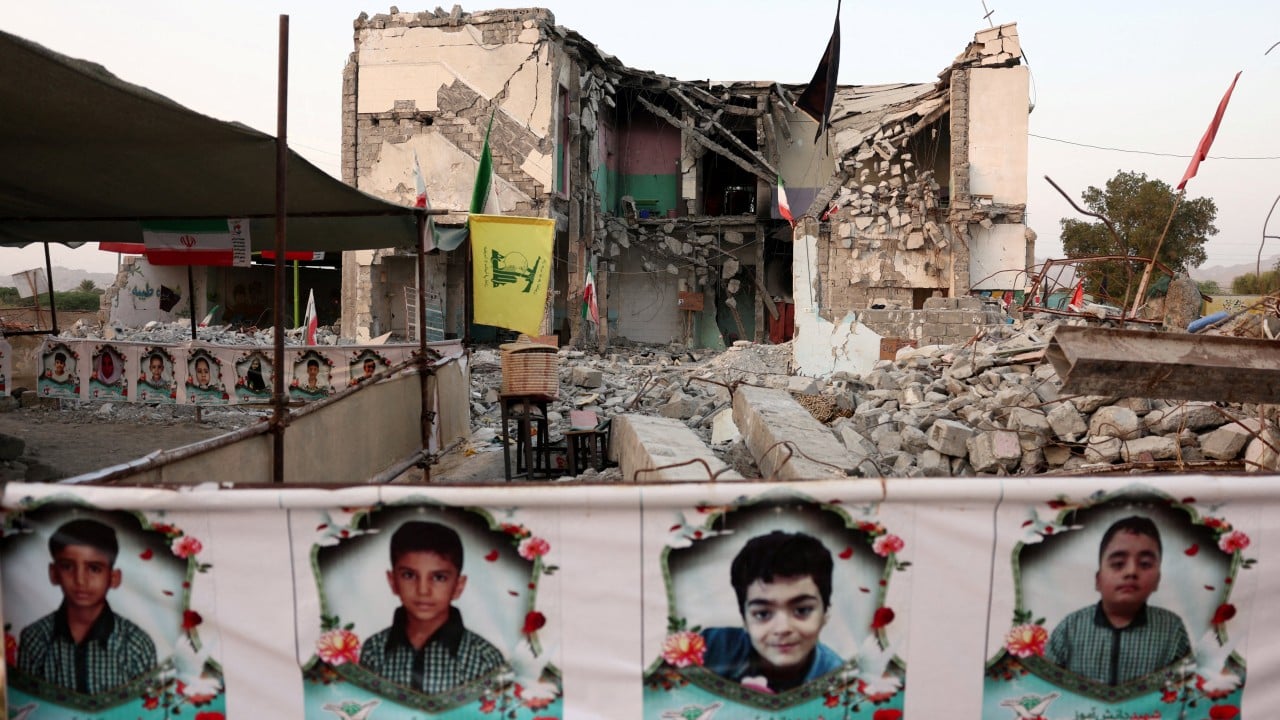
International inquiries move slowly. The machinery of accountability often grinds to a halt while forensic investigators sift through blast radiuses, recover shrapnel fragments, and cross-reference flight logs with military tasking orders. Yet the recent United Nations findings regarding United States military strikes on an Iranian school, resulting in the deaths of over 150 civilians, primarily children, demand an immediate unvarnished accounting. This is not merely a statistical tragedy buried in the daily casualty counts of expanding regional conflicts. It represents a systemic stress test of international humanitarian law, highlighting a widening chasm between stated rules of engagement and the harsh realities of remote-controlled kinetic operations.
Military spokespersons frequently invoke precision guidance systems and rigorous collateral damage estimates to defend complex aerial campaigns. The public narrative relies on the comforting fiction that modern munitions possess moral agency, capable of distinguishing between legitimate military assets and protected civilian infrastructure. Experience in conflict zones from the Balkans to the Middle East proves otherwise. When a facility explicitly designated for education transforms into a mass casualty site, the technical rationale offered by command centers demands rigorous external verification, not automatic acceptance. Meanwhile, you can read related events here: Why The UN Sanctions Panel Collapse on Iran is Actually Good News For Global Stability.
The Mechanics of Targeting Failure
Understanding how a school becomes a designated target requires examining the architecture of modern military intelligence. Analysts process vast streams of signals intelligence, drone feeds, and human reporting, often under extreme time compression. Confirmation bias routinely infects this analytical pipeline. If an intelligence cell suspects that an opposition force is utilizing a civilian structure for command, storage, or transit, subsequent observations tend to interpret ambiguous indicators—such as civilian vehicle movement or communication patterns—as confirmation of hostile intent.
The threshold for establishing military necessity under the Geneva Conventions is exceptionally high. Educational institutions enjoy explicit special protection under international law, losing that protected status only if they are being actively used for military operations in a manner that contributes effectively to military action. Even in such disputed scenarios, the principle of proportionality mandates that the expected military advantage must outweigh the anticipated civilian loss of life. When over 150 non-combatants perish in a single strike on a school, the mathematical balance of proportionality collapses entirely. To understand the complete picture, we recommend the excellent report by Associated Press.
Commanders are legally required to suspend or cancel an attack if it becomes apparent that the objective is civilian or that the civilian toll will be disproportionate. The persistence of the strike raises urgent questions regarding operational oversight. Did the reconnaissance assets fail to identify the occupants, or was the presence of civilians categorized as acceptable collateral risk within an automated targeting matrix?
The Institutional Impasse
The United Nations condemnation highlights a persistent structural flaw in global conflict resolution. International bodies possess investigative mandates and moral authority, but they lack coercive enforcement mechanisms. When a permanent member of the UN Security Council or its close allies face credible accusations of war crimes, diplomatic shielding routinely neuters formal punitive measures. Resolutions face vetoes, inquiries are delayed, and accountability devolves into a war of words between rival geopolitical blocs.
This diplomatic impunity corrodes the entire framework of the international order. If major powers exempt themselves from the legal prohibitions against targeting schools, hospitals, and refugee centers, smaller nations and non-state actors take note. The global consensus protecting non-combatants erodes into a cynical race to the bottom, where atrocity is rationalized as the inevitable byproduct of modern warfare.
Furthermore, domestic accountability mechanisms within the striking nations frequently fall short. Military investigations conducted internally tend to prioritize command protection over transparency. Files are classified under national security exemptions, evidence is withheld from independent human rights monitors, and administrative reprimands replace criminal prosecutions. The families of the deceased receive neither legal redress nor a public accounting of the decisions that extinguished their children's lives.
The Broader Strategic Cost
Beyond the humanitarian catastrophe and the legal violations, attacks on educational facilities inflict generational trauma that directly undermines long-term security objectives. Children represent the demographic foundation of any future civil society. Eradicating them within the very walls designed for their intellectual development creates an enduring legacy of rage and alienation.
Insurgent and extremist networks rely on this exact dynamic for recruitment. When formal justice systems and international bodies fail to deliver consequences for civilian slaughter, affected populations turn elsewhere for protection and vengeance. Military strategists who authorize high-risk strikes on protected civilian sites often focus exclusively on immediate tactical objectives, remaining willfully blind to the strategic blowback that follows.
The investigation into the school strike must not be allowed to fade into the background noise of persistent geopolitical crises. The evidence compiled by international observers requires independent judicial scrutiny, transparent disclosure of targeting logs, and a reaffirmation by the global community that educational institutions are inviolable sanctuaries. Without these measures, the laws of war become entirely theoretical, and the protection of civilians degrades into an empty rhetorical exercise.


