For years, the math of electric vehicle ownership was sold as a clean, predictable ledger. You paid a premium at the dealership, swallowed the higher sticker price, and clawed that capital back through cheap home charging and the total elimination of oil changes, spark plugs, and timing belts.
It was a beautiful equation on paper. In reality, a silent line item has systematically disrupted these calculations, shocking buyers exactly one month after they drive off the lot. You might also find this related story insightful: The Economics of H1B Visa Arbitrage and Regulatory Enforcement.
Electric vehicles cost an average of 42% more to insure than their internal combustion counterparts. Data from multi-million quote aggregates reveals that the national average for full coverage on an electric vehicle sits at roughly $3,159 annually, compared to $2,218 for a gasoline vehicle. This is not a rounding error. It is an operational penalty of nearly $1,000 every single year, effectively neutralizing a massive chunk of the expected fuel savings.
The mainstream automotive press has treated this purely as a symptom of luxury sticker prices or minor tech snags. That diagnosis is wrong. The true driver of the electric vehicle insurance crisis is an industry-wide collision between legacy insurance actuary models and radical structural engineering. As discussed in latest articles by CNBC, the results are significant.
The Totaled Over a Scratch Dilemma
To understand why carriers are terrified of electric cars, look beneath the floorboards. In a traditional vehicle, a minor fender bender involves crumple zones, radiator brackets, and bolt-on panels. If a structural rail deforms, a certified body shop pulls it back into alignment or welds in a replacement section.
Electric cars are not built like traditional cars. They are essentially rolling consumer electronics built around structural battery packs and massive single-piece aluminum castings.
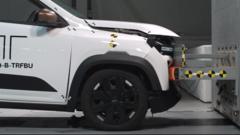
When a multi-ton electric vehicle absorbs an impact, the energy travels directly along the chassis. If that energy deforms the protective casing of the lithium-ion battery pack by even a few millimeters, the entire component is structurally compromised. Because these modules are tightly integrated into the vehicle’s floor pan—and sometimes form the literal floor of the passenger cabin—repairing them is structurally impossible.
A tiny dent on a rocker panel can write off the entire vehicle. Insurance companies do not total these cars because they are lazy. They total them because an imperfectly repaired lithium-ion pack carries a non-zero risk of thermal runaway, a violent, self-sustaining chemical fire that burns at thousands of degrees and cannot be extinguished by conventional means. Confronted with the choice between a $20,000 battery replacement bill on a $45,000 car or writing a total-loss check, underwriters consistently choose the write-off.
The Closed Ecosystem Monopoly
Legacy automakers survived for a century by fostering a massive ecosystem of third-party parts manufacturers and independent mechanics. If you dent the bumper of a Ford F-150, an insurance adjuster can source an aftermarket panel, a recycled part from a salvage yard, or an original equipment manufacturer component from a highly competitive distribution network.
Newer electric vehicle manufacturers operate like Silicon Valley software monopolies. They treat their parts catalog, diagnostic software, and repair networks as tightly guarded proprietary secrets.
- Zero aftermarket alternative: Third-party companies do not manufacture alternative structural components or battery modules for proprietary electric vehicle architectures.
- Salvage restrictions: Carriers cannot easily source used parts from salvage yards because many manufacturers restrict or remotely deactivate vehicles that have been logged as salvage assets.
- Diagnostic gatekeeping: Independent garages are locked out of the vehicle’s operating system, meaning an insurance company must send the vehicle exclusively to a manufacturer-authorized service center.
This lack of competition breaks the traditional insurance claim model. When a single entity controls the parts supply, the labor certification, and the diagnostic clearance, they dictate the price. Mechanical labor hours for specialized electric platforms routinely double the cost of standard shop rates, driving the overall cost of claims into the stratosphere.
The Weight and Torque Formula
Actuaries do not care about environmental metrics. They care about kinetic energy and risk. From a pure physics standpoint, electric vehicles present a uniquely hazardous profile for underwriting teams.
They are incredibly heavy. A mid-sized electric SUV regularly weighs between 5,000 and 6,000 pounds, roughly 30% more than an equivalent gasoline vehicle, due to the immense mass of the battery pack. When that vehicle hits an object, the kinetic energy transferred is vastly superior. The damage inflicted upon third-party property, other vehicles, and human bodies is proportionally higher, meaning the liability exposure for the insurer climbs every time an electric vehicle takes to the road.
Compounding this mass is instant torque. Unlike internal combustion engines that must build revolutions per minute to reach peak power, electric motors deliver maximum torque at zero revolutions. Drivers unaccustomed to this immediate acceleration frequently misjudge low-speed maneuvers in parking lots and intersections. The data shows a distinct spike in low-speed, high-cost property damage claims directly linked to this performance profile.
Geography and the Great Divide
The insurance penalty is not distributed equally across the map. It behaves like a hyper-localized tax that punishes drivers in dense urban environments while giving rural operators a pass.
In states like New York and Massachusetts, dense traffic, high labor rates, and strict regulatory environments create a worst-case scenario for insurers. A newer electric vehicle in New York commands an annual premium of roughly $4,531, representing a 45% surcharge over a gas vehicle. In Massachusetts, that premium penalty jumps to 54%.
Yet, travel to Montana, West Virginia, or Nebraska, and the premium gap completely vanishes. In those states, electric vehicles are occasionally cheaper to insure than internal combustion vehicles by a small margin. The explanation is simple: wide-open spaces, lower collision frequencies, and a distinct lack of gridlock mean cars rarely hit each other at low speeds, neutralizing the specific risk profile that terrifies urban actuaries.
The Architecture Correction
The industry is beginning to realize that building unrepairable vehicles is bad for sales. If a consumer realizes that their insurance premium will cost more than their loan interest, they leave the segment entirely.
Engineers are quietly shifting away from structural battery packs toward modular cell-to-pack architectures. The goal is to design battery enclosures with explicit crumple zones that isolate collision impacts away from the cells. If a crash occurs, technicians can drop individual modules out of the chassis and replace them for a fraction of the cost of a full pack replacement.
Concurrently, the premium gap for brand-new models is narrowing. For vehicles from the 2024 model year and newer, the insurance cost disparity has dropped to roughly 18% nationwide. This correction is happening because traditional automakers are integrating advanced driver assistance systems across their entire fleets, standardizing safety features and slowly bringing repair workflows back into standard, competitive dealership networks.
The era of the cheap EV operating credit is officially over. Buyers stepping into the market must calculate their total cost of ownership using real-world actuary math, not the idealized projections found on dealership brochures.