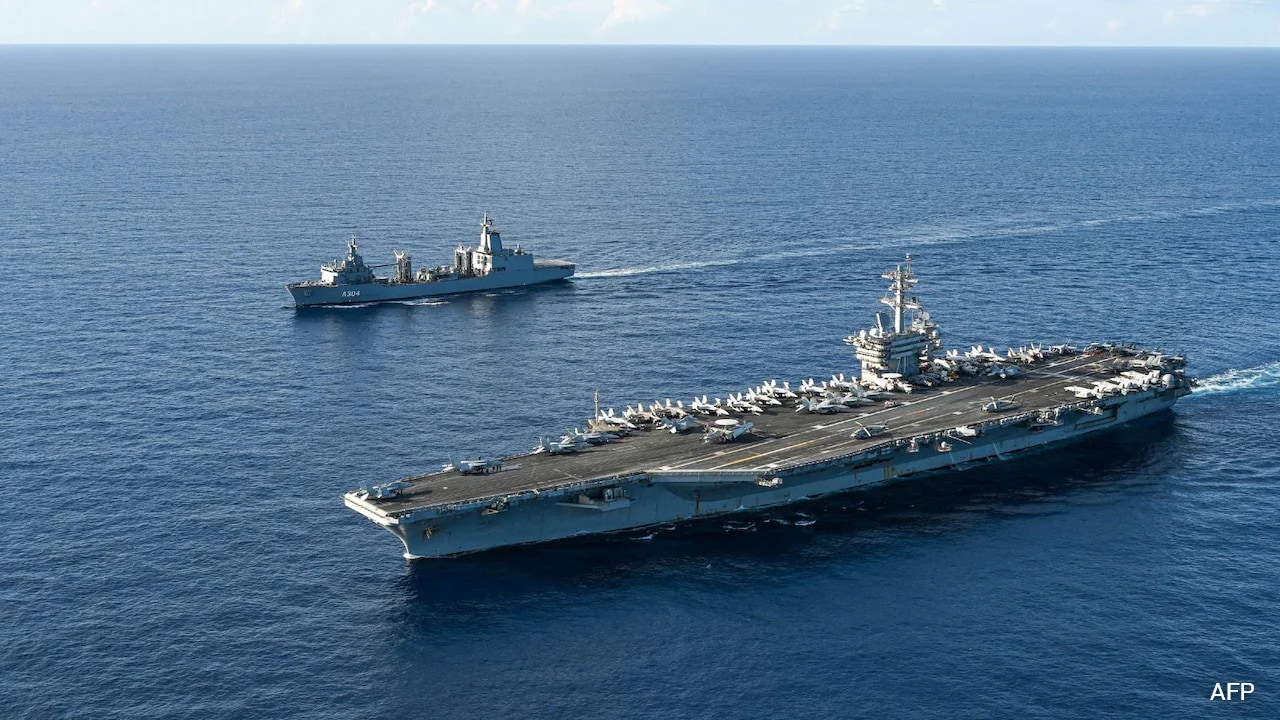
Mainstream defense coverage treats every carrier deployment like a chessboard checkmate. One headline screams that Washington just dispatched a third aircraft carrier to the Middle East following Iranian strikes on Bahrain, and suddenly every cable news panelist nods in unison about "unmatched American firepower" and "restoring deterrence."
That consensus is lazy. Worse, it is dangerously outdated.
Dispatching a third carrier strike group into the confined waters of the Persian Gulf or the Arabian Sea after an escalation is not a masterstroke of modern warfare. It is an expensive, predictable reflex rooted in 20th-century naval doctrine—one that hands asymmetric adversaries exact coordinates for high-value targets while draining the United States Navy's global readiness.
The Carrier Math Nobody Wants to Do
To understand why a three-carrier posture in the Middle East is an operational liability, look at basic fleet mechanics rather than press releases.
The U.S. Navy maintains 11 nuclear-powered aircraft carriers. At any given moment, roughly a third are in deep maintenance or refueling, a third are in training and workups, and only a third are actually deployed or ready for immediate surge. Concentrating three carriers in a single theater means committing nearly 100 percent of the nation’s immediately deployable carrier fleet to one body of water.
Defense analysts at the Center for Strategic and International Studies (CSIS) and the U.S. Naval Institute have warned for years about the "tyranny of distance" and fleet exhaustion. Every extra month a carrier spends dodging drones in the Red Sea or patrolling the Gulf of Oman is a month stolen from Indo-Pacific deterrence, shipyard maintenance schedules, and sailor retention.
- Maintenance backlogs compound exponentially. Extending deployments pushes dry-dock schedules back by years, creating readiness valleys down the road.
- Escort hulls are stretched thin. Each carrier requires at least three to four Arleigh Burke-class destroyers for air and missile defense—the exact ships burning through multi-million-dollar SM-2 and SM-6 interceptors to shoot down cheap one-way attack drones.
- The Pacific goes unguarded. While three flat-tops sit off the coast of Iran, the Western Pacific experiences prolonged "carrier gaps," leaving regional allies to wonder what happens if a crisis erupts in the Taiwan Strait simultaneously.
Geography Turns Superweapons Into Sitting Ducks
In the open ocean, a Nimitz- or Ford-class carrier moving at 30 knots is an elusive, moving fortress. Inside the Persian Gulf—or even the constricted northern Arabian Sea—that mobility vanishes.
The Strait of Hormuz is 21 nautical miles wide at its narrowest point. The Persian Gulf itself is barely 200 miles across. Putting a 100,000-ton nuclear warship inside or adjacent to that bathtub after strikes on Bahrain is like parking a Ferrari inside a crowded alley to intimidate a guy holding a brick.
Iranian military planners—specifically the Islamic Revolutionary Guard Corps Navy (IRGCN)—have spent four decades optimizing their entire force structure for this exact geography. They do not try to match American blue-water tonnage. They rely on coastal anti-ship ballistic missiles, subterranean drone bunkers, fast-attack swarm boats, and sea mines.
Military theorists call this Anti-Access/Area Denial (A2/AD). In plain English, it means turning a narrow waterway into a kill box where the defender holds every geographic advantage. When a carrier operates within range of shore-based radar and mobile missile launchers, its air wing spends half its sorties just flying defensive combat air patrols to protect the ship itself rather than projecting offensive power.
The Cost-Exchange Trap
Watch the economics of modern naval engagement in the Middle East. They are completely upside down.
Over the past two years of Red Sea and regional skirmishes, U.S. destroyers and carrier-based fighters have routinely fired interceptors costing between $2 million and $4 million apiece to destroy Iranian-designed drones and ballistic missiles that cost less than $50,000 to assemble.
Adding a third carrier does not solve this cost-exchange ratio. It multiplies it.
More hulls in theater mean more floating real estate that requires continuous, 24/7 layered air defense. Every incoming salvo forces American commanders into a losing financial equation: expend scarce, slow-to-manufacture vertical launch cells today, or risk a single leaker hitting a billion-dollar deck. Defense industrial base reports from the Pentagon itself acknowledge that replenishing expended naval interceptors takes years, not weeks.
What Deterrence Actually Looks Like in 2026
If you ask defense pundits why the Pentagon sends a third carrier, they will tell you it sends an "unmistakable signal."
Signals do not stop ballistic missiles. Deterrence is not built on visibility; it is built on ambiguity, lethality, and survivability.
Notice what actually keeps adversaries awake at night. It is not the 4.5-acre floating airfield whose exact position is tracked daily by commercial satellites and open-source intelligence accounts on social media. It is the assets they cannot see and cannot target:
- Guided-missile submarines (SSGNs). An Ohio-class SSGN carries up to 154 Tomahawk cruise missiles beneath the surface, invisible to coastal radar and immune to drone swarms.
- Long-range strategic bombers. B-2 and B-1B bombers launching from continental bases or hardened airfields like Diego Garcia can deliver massive standoff payloads without putting 5,000 sailors inside coastal missile range.
- Distributed maritime operations. Dispersing smaller surface combatants, unmanned surface vessels, and land-based long-range precision fires forces an adversary to divide their intelligence and targeting resources across dozens of moving vectors instead of three giant targets.
The Honest Counterargument
To be fair to Pentagon planners, there is a political reality that pure military logic ignores.
Aircraft carriers remain the ultimate diplomatic currency for reassuring nervous regional partners. When Bahrain comes under fire, Gulf monarchs do not feel comforted by an invisible submarine sitting 400 feet underwater—they want to see an American flag flying off their coast. Furthermore, a carrier air wing provides unmatched, sovereign airfield capacity that does not depend on host-nation diplomatic permissions, which Arab capitals frequently restrict when domestic politics heat up.
That political utility is real. Pretending otherwise would be dishonest.
Stop Confusing Presence With Power
The fatal flaw in contemporary defense reporting is treating military deployment as an end in itself. Moving ships around a map creates the illusion of decisive action while masking strategic paralysis.
True deterrence requires keeping forces unpredictable, preserving high-end munitions for peer conflicts, and refusing to let regional adversaries dictate where the U.S. Navy parks its most expensive assets. Every time Washington responds to an asymmetric provocation by crowding another carrier into the Middle East, Tehran learns the exact same lesson: a handful of cheap rockets is all it takes to tie down the world’s most expensive navy.
Keep the carriers in open water where they belong, put the submarines to work, and stop fighting 21st-century missile wars with 20th-century photo ops.