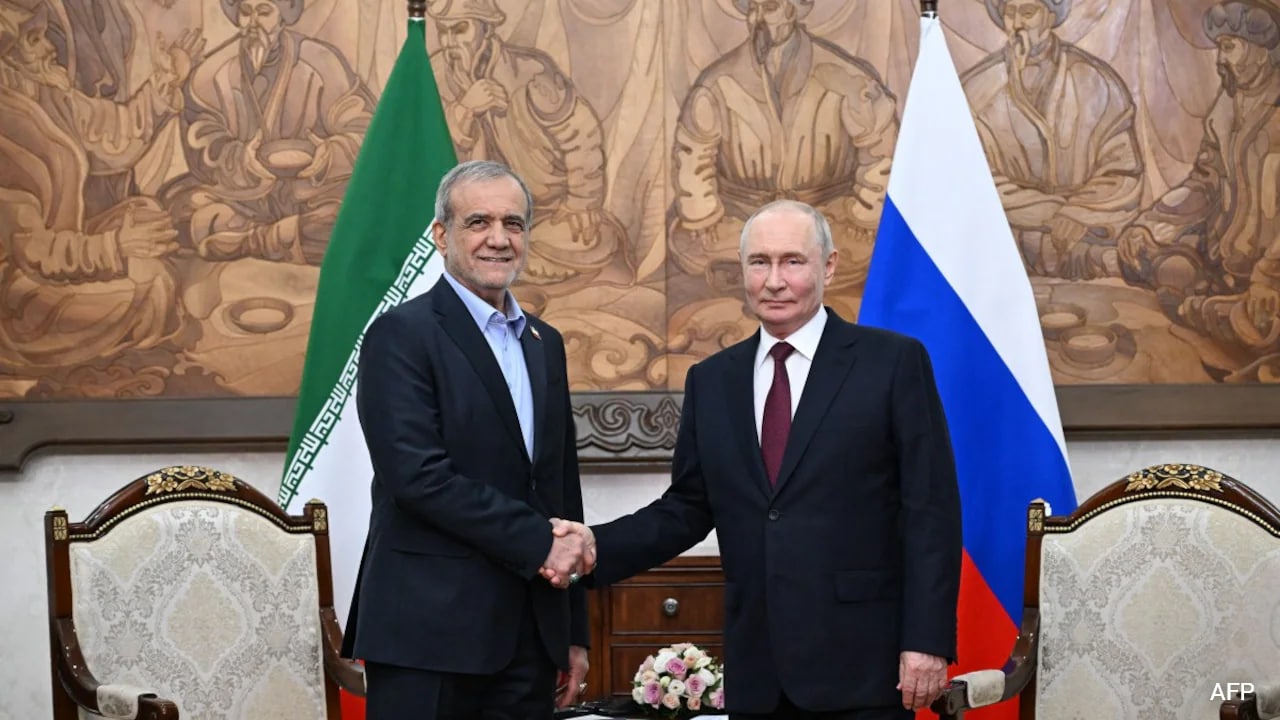
The Cold Table in Moscow
Step into a room where maps are drawn with heavy ink and altered borders. The mahogany is polished to a mirror shine, reflecting crystal chandeliers that have witnessed empires rise, fracture, and fall into the dust of archives. Here, air does not circulate freely. It is heavy with the scent of old paper, filtered smoke, and the quiet calculation of men who measure human lives in tonnage and geography.
Vladimir Putin sits at the head of that vast expanse of wood, his expression smooth, practiced, and entirely unreadable. Across from him sits Masoud Pezeshkian, newly vaulted into the presidency of Iran, carrying the weight of a nation bruised by economic strangulation and internal unrest. They are not merely shaking hands. They are binding two distinct orbits of isolation into a single, defiant arc.
When Putin looks across the polished expanse and offers to do "everything" to help end the spiraling wars fracturing the Middle East, the sentence hangs in the air like smoke. It sounds noble. It sounds like statesmanship. But language in high-stakes diplomacy is a mask. Beneath the silk of the promise lies the iron armature of mutual survival. Tehran is burning at the edges, choked by sanctions and battered by the constant, thrumming threat of regional escalation. Moscow is bogged down in the black mud of European steppes, draining its treasury and its youth.
They need each other. And desperation has a way of making strange, heavy bedfellows.
The Calculus of Endurance
Consider what happens when a government finds its back pressed against the absolute wall of economic collapse. The choices narrow until only survival remains. Pezeshkian did not walk into the Kremlin as a conquering hero; he walked in as a strategist seeking shelter from an incoming storm. The Iranian economy is a patient on life support, monitored by a populace whose patience wore thin years ago in the university courtyards and bazaars.
For months, the regional chessboard has shifted with terrifying speed. Every drone launched, every proxy mobilized, every missile intercepted costs treasure that neither Tehran nor its partners can indefinitely replenish without consequence. The rhetoric of resistance plays well to domestic hardliners, but empty stomachs do not care for ideological purity.
Putin understands this intimately. Russia has spent years writing the textbook on surviving under the crushing weight of global isolation. They have learned how to route oil through phantom tankers, how to trade microchips for artillery shells, and how to turn every international reprimand into a badge of honor. Moscow offers Iran not just diplomatic cover at the United Nations, but a blueprint for endurance. A manual for how to stay standing while the rest of the world locks the doors.
Yet, this partnership is not built on affection. Empires do not love; they calculate. When Moscow promises total assistance, it does so with an eye on its own eastern flank, its own logistical nightmares, and its desperate need for reliable supply chains that bypass Western financial systems. Every gesture of solidarity is an investment in a shared front against a common adversary.
The Human Cost in the Dust
Step away from the mahogany and the polished leather. Walk instead through the alleys of a provincial town where the rial buys less with every rising sun, or through the shattered concrete of a borderland where families sleep with their boots near the door.
Abstract politics have flesh and bone. When leaders bargain over strategic depth and security pacts, they are spending the futures of children who have never known a morning without the shadow of sirens or the quiet dread of inflation. A mother in Tehran calculating whether to buy medicine or meat does not care about the geopolitical realignment of Eurasia. She cares about the price of bread. A conscript in a uniform three sizes too large does not care about the balance of power; he cares about the winter chill settling into his bones.
This is the hidden cost of grand alliances forged in crisis. When governments tie their fates together to withstand external pressure, the burden invariably trickles down to the individual. The citizen becomes a shock absorber for state ambition. Every diplomatic handshake in a gilded hall translates into tighter belts, fewer choices, and deeper anxiety on the streets below.
Putin's pledge of total support is designed to project strength, to signal to Washington and Brussels that isolating one pariah only drives them into the arms of another. But for the ordinary people caught in the slipstream of these colliding superpowers, the promise feels less like a shield and more like an anchor.
The Unseen Frontier
Look closely at the map between the Caspian Sea and the Persian Gulf. A new iron corridor is quietly taking shape. Railways are being laid, trade routes are being secured away from the prying eyes of Western regulators, and financial pipelines are being hammered together in the dark.
This is the quiet war beneath the war. While headlines focus on the immediate flashpoints—the missile exchanges, the naval maneuvers, the fiery speeches at international summits—the real transformation is structural. Moscow and Tehran are attempting to build an alternative ecosystem, a parallel economy immune to the financial weapons wielded by the West.
If they succeed, the architecture of global influence will fracture permanently. The old levers of power—sanctions, SWIFT codes, diplomatic excommunication—will lose their bite. If they fail, the economic gravity of their isolation will crush them from within, long before any external adversary fires a shot.
The stakes could not be higher. And the margin for error is razor-thin.
When Pezeshkian boards his aircraft to return to Tehran, the cold Moscow air will follow him up the steps. He leaves with promises, intelligence-sharing frameworks, and mutual reassurances. But he also leaves with a heavier burden than the one he brought. He has hitched his nation's wagon to a bear that is fighting for its own life in a very different theater of war.
The engines whine. The cabin seals. Down on the tarmac, guards stand at rigid attention, their breath pluming white in the freezing dusk. Somewhere beneath that vast, darkening sky, millions of people wait to see what those promises will actually cost them when the bill finally comes due.


