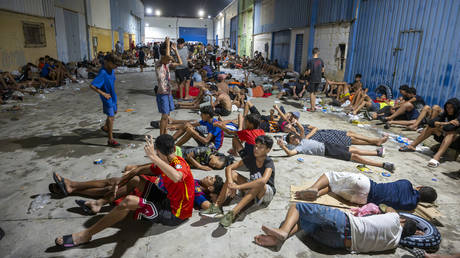
The wind off the Strait of Gibraltar does not care about your politics. It carries the smell of salt, damp stone, and diesel exhaust up the cliff faces, battering the perimeter fences of Europe's southernmost doorstep.
Ceuta. A slice of Spain pressed hard against the northern coast of Africa.
To look at a map, it is a geographic quirk, a colonial leftover of fortifications and concrete. To live there, or to walk its steep, narrow stairwells after midnight, is to inhabit a pressurized chamber where geopolitical desperation meets municipal breakdown.
Statistics arrive in cold increments. Fifteen. That is the number stamped onto police blotters and rushed agency dispatches regarding sexual assaults reported within a single enclave over a concentrated span. A number. A tally mark scratched into a digital spreadsheet.
Strip away the administrative distance of that number, and you find something entirely different. You find the smell of fear in a poorly lit stairwell. You find the heavy silence of a municipal police station at three in the morning, where translation apps stutter through harrowing testimonies.
Consider what happens when a border town swells beyond its structural capacity.
Imagine a young woman—let us call her Elena, though she represents a composite of experiences gathered from local neighborhood associations and precinct reports—walking home along the outer avenues of El Tarajal. The streetlamps buzz with a tired, yellow hum. The shadows cast by the corrugated metal warehouses stretch long and distorted.
Elena knows the rhythm of her city. She knows which alleyways to avoid, which bus stops empty out too quickly, and how to keep her keys threaded between her knuckles like a clumsy brass knuckleduster. But familiarity offers no immunity when the baseline safety of a community shifts beneath its feet.
Over the past year, the holding centers and makeshift encampments fringing the Spanish enclaves of Ceuta and Melilla have strained under waves of arrivals. Minors, young men, transient drifters slipping through fractured surveillance networks—they sleep rough in abandoned construction sites, under highway overpasses, and in the scrubland flanking the border fences.
Desperation is a corrosive element. When hundreds of young men live in systemic limbo—unemployed, undocumented, alienated from any social fabric, and legally stranded between a continent they fled and a fortress that rejects them—the social contract frays.
Crime is rarely born in a vacuum. It festers in the stagnant air of neglect.
Local advocacy groups have spent months waving red flags, shouting into the bureaucratic wind. They point to the thinning ranks of the Guardia Civil. They point to the crumbling infrastructure of reception centers that were built for temporary processing, not permanent encampments of forgotten souls.
Yet, the response from continental capitals often reduces the crisis to immigration management metrics. Officials speak of border enforcement protocols, bilateral treaties with Rabat, and repatriation flights. They treat human beings as logistical widgets to be sorted, detained, or deported.
They miss the human cost. Both ways.
The victims in these reports are ordinary residents—shopkeepers, students, nurses—whose daily lives have become exercises in hyper-vigilance. They are women who now check the backseats of their cars before unlocking the doors. They are parents who forbid their teenagers from walking home after dark.
And the perpetrators? Often young men whose own lives have been ground down by the grinding gears of global inequality, turning up on European shores only to find themselves cast into a stateless purgatory where lawlessness becomes a default survival mechanism.
When a society fails to integrate or manage the sheer volume of human transit crossing its borders, it ceases to protect anyone. Not the citizen walking home from a late shift. Not the migrant sleeping cold beneath a concrete bridge.
The friction generates heat. Then, it generates fire.
Local police unions in Ceuta are exhausted. Their radios crackle continuously with calls for backup that never arrives in time. The precinct desks are buried under paperwork that flows faster than ink can dry. Officers talk privately about a pervasive sense of abandonment. Madrid feels distant, a place of polished marble corridors where the reality of a midnight assault in a border alleyway is smoothed down into a quarterly threat-assessment report.
We must look past the partisan shouting matches that instantly latch onto these headlines. One side weaponizes these crimes to demand total border shutdowns, painting every arrival with the same broad brush of criminality. The other side minimizes the local fallout, fearful that acknowledging the breakdown of public safety will fuel xenophobia.
Both reactions are moral failures.
Truth requires holding two heavy thoughts in your hands at the exact same time. First, that a sovereign community has an absolute, non-negotiable right to public safety and the rule of law. Second, that desperate migration management cannot be solved by simply building higher fences while ignoring the human wreckage piling up at the gates.
When fifteen women in a compact enclave report the ultimate violation of their bodily autonomy, it is not merely a localized crime statistic. It is an alarm bell ringing in the dark. It is a symptom of a systemic collapse where the state fails to project authority, leaving its most vulnerable residents to fend for themselves in the gloom.
The sea breeze picks up again outside. Down by the harbor, the silhouette of a patrol boat cuts a lonely line across the dark water. The fence stands tall against the horizon, unyielding, yet utterly porous to the human tide washing up against its feet.
The lights of the city flicker, and the shadows lengthen across the stones.