The departure board at Abha International Airport does not register geopolitics. It registers time, delays, and destinations. But on a sweltering July afternoon in southwestern Saudi Arabia, the pixels on those screens froze.
Flight FZ815 to Dubai. Cancelled.
Flight G9195 to Sharjah. Cancelled.
A single line of red text across a digital monitor has a strange way of shrinking the world. To a businessman checking his watch, or a mother trying to soothe a restless child on her way to Riyadh, the sudden stillness of an airport terminal is an immediate, intimate crisis. They are not thinking about the broader chess match of the Middle East, nor are they calculating the distance between the runway and the Yemeni border. They are looking at their luggage, realizing they are trapped.
The peace that had quietly settled over the southern ridge of the Arabian Peninsula over the last four years did not break with a whimper. It broke with the unmistakable roar of air defense systems clawing at the sky.
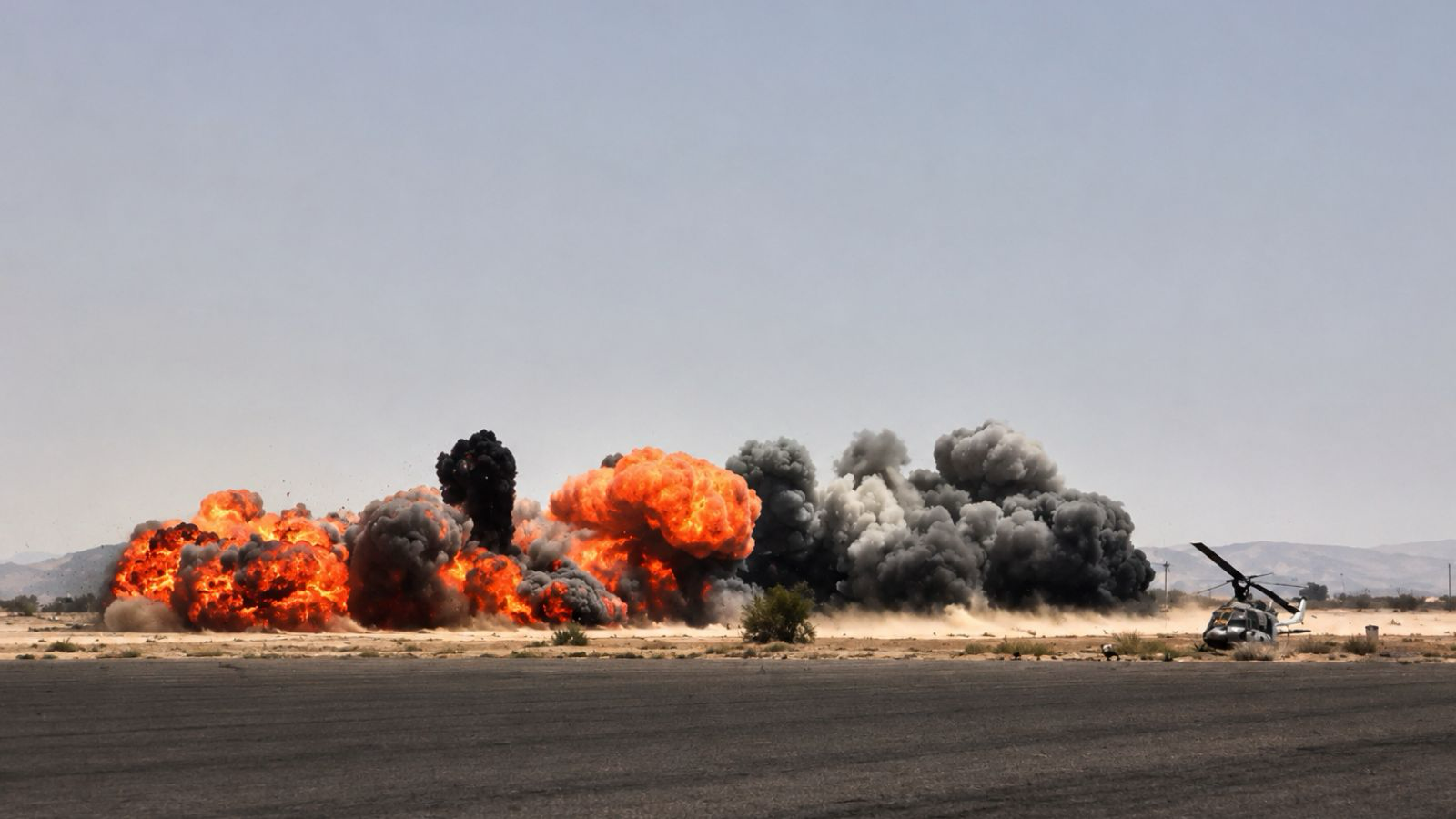
When the Houthi movement launched a coordinated salvo of ballistic missiles and explosive drones at Abha’s civilian airport, the physical damage was contained. Saudi anti-missile batteries intercepted the incoming steel, leaving nothing but trailing smoke and a field of invisible tension. No lives were lost that day. Yet, the true weight of a missile attack cannot be measured solely by a body count or crater depth. The real casualty was the fragile illusion of distance.
The Tit-for-Tat of Airspace
To understand why a terminal in a mountain resort city suddenly went quiet, you have to look across the border, where another runway lies scarred.
Hours before the first drone hummed toward Abha, the tarmac at Sanaa International Airport in Yemen was hit by airstrikes. The internationally recognized, Saudi-backed Yemeni government took credit, stating they had to crater the runway to prevent an unsanctioned Iranian aircraft from landing—a plane reportedly carrying a Houthi political delegation back from a high-profile funeral in Tehran.
The response from the Houthi leadership in the north was swift, public, and personal. They viewed the grounding of flights in Sanaa as a choking blockade on humanitarian access. Their retaliation target was chosen not for its military value, but for its exact symmetry: if Sanaa cannot fly, Abha will not fly.
Consider a hypothetical traveler named Tariq, a civil engineer who frequently moves between the United Arab Emirates and southern Saudi Arabia. For nearly four years, Tariq’s biggest travel concerns were standard delays or misplaced bags. The informal truce signed in 2022 had transformed the region's airspace from a combat zone into a normal transit corridor. But as the news of the Abha attack broke, Tariq, along with thousands of others, watched a routine business trip dissolve into a flurry of urgent text messages and scrambling airline agents.
The disruption spilled rapidly into the next day. Eleven major departures vanished from Abha’s schedule on Wednesday alone, compounding the ten cancellations from the day before. Major regional carriers like Saudia, flyadeal, flydubai, and Air Arabia pulled their aircraft back. Air travel relies entirely on predictability, and predictability evaporates the moment an airport becomes a retaliatory punchline.
The Paper Wall of Warnings
As the airlines pulled out, Western capitals began moving their bureaucratic machinery. The language of diplomacy is cold, but the message it sends to ordinary citizens is dripping with anxiety.
First came Canada, shifting its travel advisory to urge a high degree of caution throughout Saudi Arabia, specifically blacklisting Abha International Airport for non-essential travel. Then the United Kingdom sharpened its stance, drawing a literal line on the map: do not travel within 10 kilometers of the Yemen border, and avoid everything but the most essential journeys up to 80 kilometers deep.
The United States maintained its stern Level 3 advisory, explicitly telling its citizens to "reconsider travel" to the kingdom. The American advisory added a chilling detail that most travelers never think about until it is too late: the danger of falling debris from perfectly successful missile interceptions.
These government notices read like dry legal disclaimers, but their real-world impact is immediate. They mean insurance policies become invalid the moment you step off the plane. They mean a corporate traveler is ordered home by human resources. They mean a family vacation to the Asir mountains is abruptly replaced by a frantic rebooking session in a crowded lobby.
The Houthis did not stop at launching drones; they launched a rhetorical threat aimed directly at the global aviation industry. In a televised address, military spokesperson Yahya Saree issued an explicit warning to every international airline operating in the region: stay out of Saudi airspace entirely until the restrictions on Sanaa are lifted.
It is a terrifying calculation for an airline executive. Do you trust the defense systems of a host nation, or do you reroute millions of dollars of daily flights around an entire peninsula?
The Shifting Ground
For the people sitting on their suitcases in Abha, watching the flight status boards flicker from "Delayed" to "Cancelled," the regional politics matter far less than the immediate logistics of survival. The modern world is built on the assumption that we can always leave. We buy tickets, we pass through security, we board tubes of metal, and we conquer geography.
But when geopolitics intrudes upon the civilian routine, geography fights back. The mountain air of Abha, usually a refuge from the blistering heat of the lowlands, suddenly feels heavy, isolated, and far too close to a border that had spent four years pretending to be asleep.
The truce is broken, the skies are contested, and the departure lounge is empty. The silence left behind by a cancelled flight is the loudest warning of all.



:max_bytes(150000):strip_icc()/how-travel-will-enhance-your-life-1458533_CS-FINAL-5c38b6a746e0fb0001b53129.png)