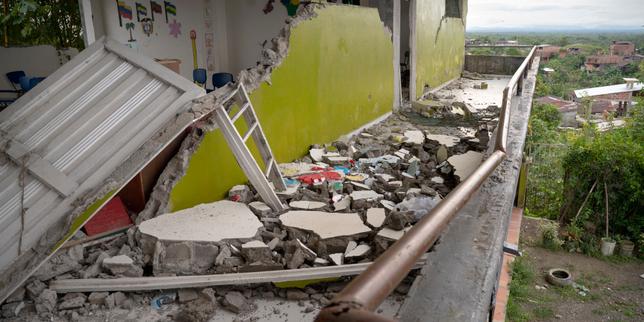
The earth does not merely shake; it remembers. Long after the dust settles into the stagnant air of the Chocó department in western Colombia, the tremors linger not in the bedrock, but in the marrow of the people who survived them.
Thirty days. Exactly one month has passed since the ground violently heaved, tearing open roads, swallowing homes, and transforming a region already defined by its profound isolation into an archipelago of stranded grief. Yet, the physical wounds of the seismic fracture are almost secondary to a more insidious decay. The absolute, suffocating realization that when nature strips away everything, the hands that are supposed to catch you are tied miles away in the capital.
The Geography of Abandonment
To understand the Chocó is to understand a paradox. This is a land weeping with abundance. Emerald jungles bleed into winding rivers, and the earth beneath holds treasures that empires have fought over for centuries. Gold. Platinum. Timber. Yet, the people walking this soil live in houses stitched together from weathered planks and corrugated tin, vulnerable to every caprice of the weather, and now, to the shifting bones of the planet.
When the earthquake struck a month ago, it did not discriminate, but the aftermath certainly did. In places with paved arteries and political clout, a disaster is met with immediate, roaring machinery. Here, in the dense green folds of Colombia's Pacific coast, the disaster was met with silence.
Consider a hypothetical morning in a village tucked along the swollen banks of the Atrato River—let us call him Mateo, though he represents a thousand faces etched with the same fatigue. Mateo woke to a world that smelled of wet clay and pulverized concrete. His kitchen wall had dissolved into the mud. His neighbors were shouting names across the debris, their voices thin against the vast, indifferent canopy of the jungle.
In the first hours, survival was a solo act. Neighbors dug through rubble with bare hands and rusted machetes. They pulled children from the wreckage not because an emergency response team was timing their efficiency, but because no one else was coming.
The Trap of Waiting
Time moves differently in a crisis, but it congeals entirely when dependency becomes the only institutional architecture left standing.
Today, one month on, walk through these improvised settlements and you will hear a phrase repeated with a heavy, hollow sigh: « Ici, les personnes dépendent de l’Etat » Here, people depend on the state.
It sounds innocuous on paper. In a modern republic, citizens rely on governmental infrastructure during catastrophes. But in the Chocó, that dependency is a cage. It is a slow, grinding process where survival has been outsourced to distant bureaucrats who view the region through spreadsheets and security briefs rather than human coordinates.
The relief supplies do arrive, eventually. They come in the form of meager rations dropped from helicopters or ferried up muddy waterways—bags of rice, bottles of water, plastic sheeting. But every delivery reinforces a demoralizing dynamic. The inhabitants are no longer active agents of their own recovery; they are petitioners standing in endless lines, holding out cardboard cards, waiting for permission to eat, waiting for permission to rebuild, waiting for a distant government to decide how much their grief costs.
This is the hidden cost of centralization. When the state takes thirty days merely to assess the structural integrity of remote bridges, it communicates a quiet message: your geography determines your value.
The Anatomy of Resilience
And yet, human dignity is stubbornly persistent. It refuses to be buried under bureaucratic red tape.
Watch the women of the community. Even as they queue for government aid, they are organizing. They have established communal kitchens beneath tarps strung between surviving mango trees. They pool their meager remaining ingredients—a handful of plantains, a single catfish caught from the murky current—and stretch them to feed the orphans, the elderly, the injured.
This is not the resilience praised by politicians in air-conditioned auditoriums in Bogotá. This is a raw, bleeding resilience born of historical abandonment. The people of the Chocó have survived centuries of neglect—colonial extraction, armed conflict, systemic poverty—long before the earth decided to crack open beneath their feet. The earthquake was merely the latest chapter in a long, unbroken volume of trial.
To walk among them now is to experience a strange emotional dissonance. There is laughter amidst the ruins. Children kick a deflated football across cracked asphalt. Old men sit on plastic crates, playing dominoes with a furious concentration that seems entirely detached from the chaos around them. But look into their eyes when the conversation turns to the future. The laughter vanishes instantly, replaced by a heavy, opaque dread.
What happens when the international media pack leaves? What happens when the government agencies declare the emergency officially over, close their ledgers, and redirect their attention elsewhere?
The cracks in the earth will still be there. The houses will still be held up by rotting timber. And the psychological trauma—the sudden, terrifying vertigo of realizing that the ground beneath your feet can turn into an enemy in a fraction of a second—will remain etched into the silence of the night.
The Unfinished Tremor
We trick ourselves into believing that natural disasters have an expiration date. We look at calendars, mark thirty days, six months, a year, and assume the ledger is balanced.
But trauma has no respect for chronology. In the Chocó, the earthquake is not an event that happened thirty days ago; it is the air the people are breathing right now. It is the sudden tightening of a mother's chest every time a heavy truck rumbles down the temporary road. It is the child who refuses to sleep indoors, pulling his blanket onto the damp earth because the sky feels safer than a ceiling.
The state can rebuild a bridge. It can pour concrete, pave asphalt, and hand out bags of rice. But it cannot easily repair the invisible fracture that occurs when a population realizes that, in the grand calculus of national priority, they are situated at the very bottom of the page.
Night falls quickly in the jungle. There is no twilight, only the sudden, heavy drop of a velvet curtain studded with indifferent stars. In the distance, the river murmurs its ancient, relentless song, carving away at the banks, indifferent to the fragile lives clinging to its edges. Mateo sits outside his makeshift shelter, smoking a cheap cigarette, watching the ember glow in the dark. The earth is quiet tonight. But beneath the surface, the tectonic plates are still slowly, inevitably grinding against one another, waiting for the exact right moment to remind everyone who was really in charge all along.


