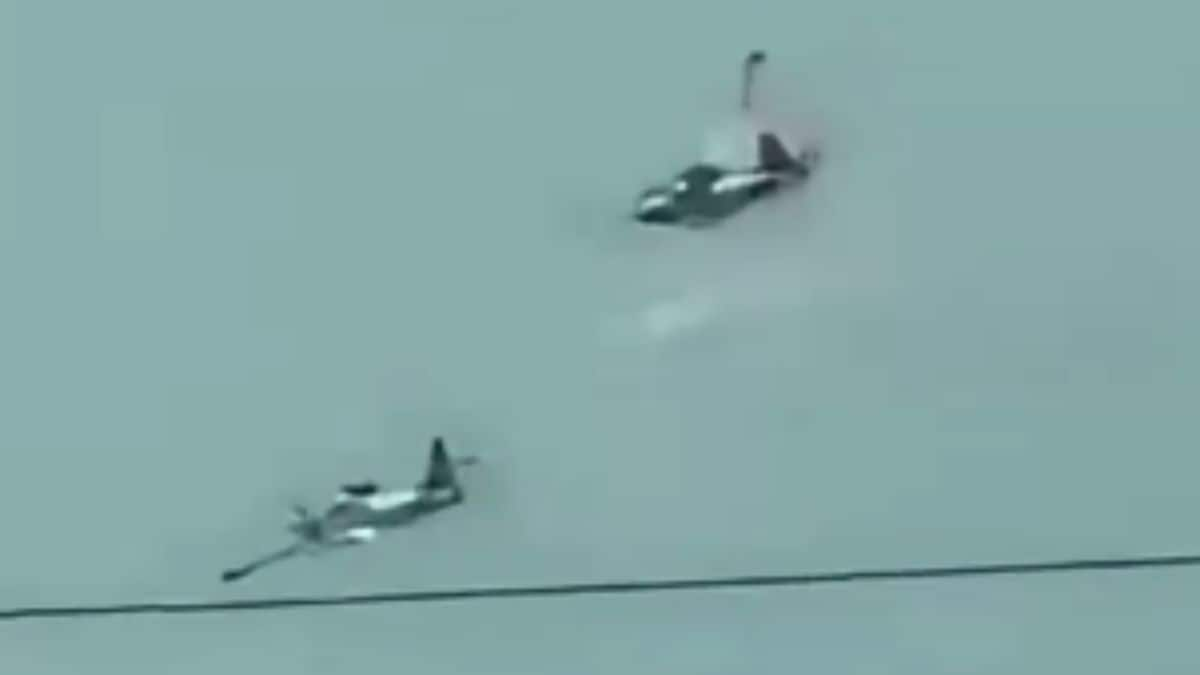
Two hundred feet above the chop of Manila Bay, time does not move in seconds. It moves in airspeed, pitch angles, and the metallic vibration of an aging airframe straining against humid tropical air.
When two Philippine Air Force trainer aircraft vanished from radar during a routine training flight over the waters off Cavite and Bataan, the official dispatches were clinical. Four pilots dead. Two SF.260 planes down. An investigation launched. For the average commuter stuck in EDSA traffic, it was a grim headline on a morning radio broadcast, a brief interruption between weather reports and celebrity gossip before the day resumed its frantic pace. For a different look, read: this related article.
Four.
Just four lives, reduced to a single digit in a press release. Related coverage regarding this has been published by TIME.
Yet if you have ever stood on the tarmac at Fernando Air Base in Lipa City at five in the morning, smelling the sharp, sweet tang of aviation fuel mixing with wet grass, you know that four is not a small number. In a country whose entire air defense relies on a razor-thin roster of skilled aviators, four pilots represent years of grueling selection, millions of pesos in scarce training resources, and the irreplaceable institutional memory of an air force constantly asked to do too much with too little.
To understand what actually died over the water that morning, you have to step away from the cold language of military communiqués and step inside the cramped, tandem cockpit of an SF.260 trainer.
The Anatomy of a Flying Classroom
Consider a hypothetical scenario—a composite drawn from the documented realities of Philippine Air Force flight school—to grasp the daily gamble these aviators take. Picture a twenty-four-year-old lieutenant, fresh from the Philippine Military Academy, strapped into the front seat. Behind him sits his instructor, a captain with twelve hundred flight hours and a quiet, weathered confidence earned through monsoon patrols over the West Philippine Sea.
They are flying the SIAI-Marchetti SF.260, an Italian-designed, single-engine piston aircraft that has served as the backbone of Philippine primary flight training since the early 1970s. It is nimble, responsive, and notoriously unforgiving of sloppy technique. Unlike modern fly-by-wire jets that use computers to smooth out human error, the SF.260 is a mechanical truth-teller. Pull too hard on the stick, and the wing stalls violently. Misjudge a turn at low altitude, and gravity collects its debt before the altimeter can even unwind.
There are no ejection seats in this cockpit.
Let that sink in. If a catastrophic mechanical failure strikes or a mid-air collision occurs at low altitude over open water, a pilot cannot simply pull a yellow handle between their knees and rocket to safety. Their only escape requires unbuckling a multi-point harness, sliding back a manual canopy against hundreds of knots of wind blast, and climbing out of a spinning metal tube while wearing a bulky parachute.
Why do they fly them? Because this is the crucible where raw cadets are forged into fighter and transport pilots. Formation flying—the exact discipline often practiced when two trainers take to the sky together—requires two aircraft to slice through the air separated by mere meters. The wingman does not look at the horizon; he locks his eyes onto the lead plane’s wingtip, trusting his instructor and his partner with his life while making micro-adjustments to the throttle every fraction of a second.
It is an aerial ballet performed without a net.
The Invisible Weight of Aging Wings
When tragedy strikes a military training wing, the public inevitably asks the same blunt questions: Was it pilot error, or did the machine fail?
The truth, as any veteran aviation safety investigator will tell you, rarely fits into a neat binary. Accidents are almost always the final link in a long, quiet chain of systemic pressure.
Look at the broader picture of Philippine military aviation over the last two decades. While neighboring nations in Southeast Asia rapidly modernized their fleets with fourth-generation fighters and computerized simulators, the Philippine Air Force spent years nursing legacy aircraft well past their intended lifespans. Mechanics in Cavite and Pampanga became masters of improvisation, keeping 1970s-era trainers and Vietnam-era helicopters airworthy through sheer grit and meticulous handiwork.
Even when the Philippine Air Force acquired upgraded variants like the SF.260FH in the early 2010s, the operational tempo remained relentless. The archipelago faces constant territorial pressures in the South China Sea, domestic security demands, and recurring natural disasters that require immediate aerial reconnaissance. Every pilot in the pipeline is urgently needed on the front lines.
This urgency creates an invisible, suffocating pressure on the training command. You cannot pause the weather. You cannot conjure spare parts out of thin air when global supply chains stall. And you cannot simulate the visceral terror of a real aerodynamic stall in a classroom. Cadets must go up. Instructors must take them.
I remember speaking years ago with a retired Air Force colonel who had survived an engine flameout over Luzon in the late nineties. His hands didn't shake when he told the story, though his voice dropped an octave. He described the sudden, deafening silence when a piston engine dies—the way the wind whistling over the canopy suddenly becomes the loudest sound in the universe. "You don't think about glory," he told me, staring into a cup of cold coffee. "You think about the checklist. You think about the weight of the aircraft. And you pray the maintenance crew didn't miss a hairline crack on a bolt that should have been replaced five years ago."
That vulnerability—that quiet acknowledgment that human skill is always tethered to mechanical integrity—is the unspoken pact every military aviator signs before climbing onto the wing.
What Happens When the Radio Goes Quiet
When two aircraft are flying in tandem during a training exercise and both go down simultaneously, aviation experts immediately look at two primary possibilities: a mid-air collision during close-formation maneuvers, or sudden, disorienting environmental hazards like spatial disorientation over glassy water.
Manila Bay and the adjacent waters off Bataan present a deceptive visual trap known in aviation circles as the "black hole" or "glassy water" effect. When haze hangs low over calm sea water, the horizon disappears. The pale gray of the sky blends seamlessly into the pale gray of the bay. Without clear visual references, the human inner ear—an organ evolved for walking on solid ground, not banking at two hundred miles per hour—lies to the brain. A pilot can feel as though they are flying perfectly level while the aircraft is actually locked in a steep, descending spiral toward the waves.
In close formation, if the lead aircraft encounters an unexpected downdraft or suffers a sudden spatial illusion, the wingman—whose eyes are glued to the lead plane rather than his own instruments—can follow him straight into danger before either crew realizes the altitude has vanished.
Search and rescue teams from the Philippine Coast Guard, the Navy, and local fishermen scrambled immediately after radar contact was lost, combing the choppy waters with patrol boats and helicopters. In the first hours after a crash, hope clings to the smallest details: an oil slick, a floating seat cushion, the faint ping of an emergency locator transmitter.
Then come the recoveries.
First, debris. A twisted piece of aluminum painted in the familiar gray and blue of the Air Force. Then, the quiet arrival of ambulances at the pier, draped in solemnity, confirming what every military family dreads whenever a loved one leaves for a morning sortie.
The Cost Measured in Empty Chairs
Standard news reports treat military crashes as isolated operational mishaps. They quote a spokesperson promising a "thorough investigation" and a temporary grounding of the fleet—standard protocol to inspect every remaining airframe before flights resume.
But grounding a fleet does not heal the rupture left behind.
In a force as tight-knit as the Philippine Air Force, four pilots are not strangers. They are the upperclassman who helped a nervous plebe shine his boots at the academy. They are the young father who promised his daughter he would be home before dinner. They are the seasoned instructor who patiently walked dozens of terrified beginners through their first solo landings, turning shaking hands into steady aviators.
The loss ripples outward in concentric circles. First, it devastates four families who must now navigate a future stripped of their brightest light. Next, it hollows out the squadron itself; surviving instructors must swallow their grief, inspect the remaining planes, and climb back into the exact same type of cockpit weeks later to teach the next class of cadets how not to die. Finally, it weakens the nation's defense posture in ways no budget sheet can quantify. You can buy a new aircraft in two years if you have the funds. It takes nearly a decade to grow a seasoned flight instructor.
Beyond the Press Release
Every time a military trainer goes down, there is a brief flurry of calls for modernization, followed quickly by collective amnesia once the headlines fade. The public moves on, comforted by the assumption that flying military aircraft is inherently dangerous and that those who sign up know the risks.
They do know the risks. Every pilot who buckles into an SF.260 knows the plane has no ejection seat. They know the weather over Luzon can turn violent in minutes. They know the machines they fly are older than they are.
Knowing the risk, however, does not make the sacrifice cheap.
When we reduce four dead aviators to a fleeting news ticker, we absolve ourselves of asking harder questions about how we equip, fund, and protect the men and women tasked with guarding Philippine skies. Modernization is not an abstract geopolitical buzzword debated in Senate hearings; it is the difference between an aging airframe with analog gauges and a modern trainer equipped with collision-avoidance systems, real-time telemetry, and survivability features that give young pilots a fighting chance when things go wrong.
Out on the flight line in Lipa, the ground crews eventually roll the hangar doors shut. The flight logs are closed, stamped, and filed away in Manila while investigators piece together fractured metal pulled from the salt water.
Somewhere in a quiet barracks room, four flight helmets sit on a wooden shelf, visors wiped clean, waiting for owners who are never coming back from their morning sortie.