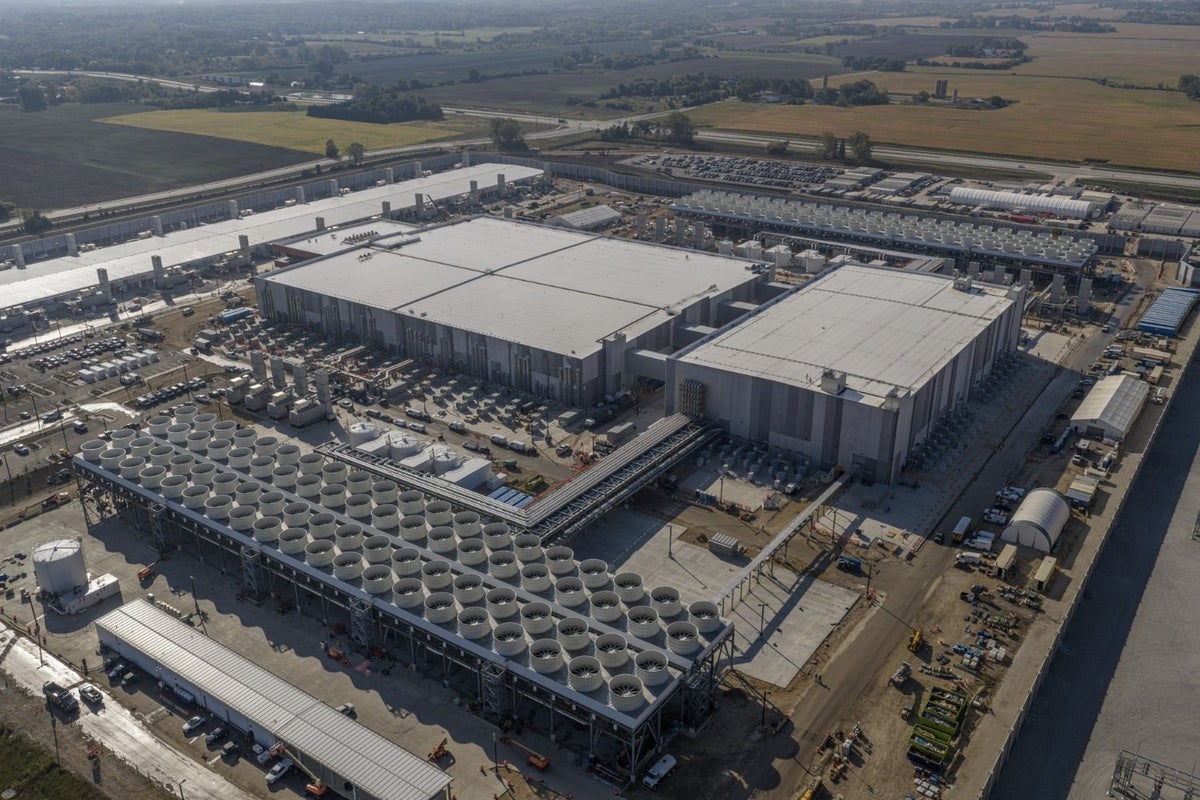
Mount Pleasant, Wisconsin, was promised a digital renaissance. Instead, it got a relentless, low-frequency hum that is driving local residents to the courts. A group of neighbors living adjacent to Microsoft’s massive new data center campus has filed a lawsuit, alleging that the constant noise from the facility's cooling systems has shattered their quality of life, cratered their property values, and caused sleep deprivation. This clash is not an isolated local dispute. It is the opening salvo in a national conflict over the physical footprint of artificial intelligence.
For years, the tech industry marketed the cloud as an ethereal, weightless concept. The reality is hyper-physical. AI demands immense computational power, which generates blistering heat. To keep thousands of servers from melting down, data centers rely on massive industrial chillers, cooling towers, and exhaust fans that run 24 hours a day, seven days a week. When these complexes are built near residential zones, the resulting acoustic output can turn quiet neighborhoods into industrial echo chambers.
The Physics of the Hum
To understand why data center noise is so uniquely disruptive, you have to look at acoustic frequency. Traditional noise complaints usually involve sharp, intermittent sounds like traffic or construction. Data centers produce a continuous, low-frequency drone.
The sound is produced by two primary sources. First, the massive fan arrays moving millions of cubic feet of air per hour through the buildings. Second, the liquid cooling chillers required for high-density AI chips.
Low-frequency noise travels farther than high-frequency sound. It penetrates standard residential insulation, vinyl siding, and double-pane glass with ease. While a brick wall might block the high-pitched whine of a lawnmower, it does very little to stop a 60-hertz rumble.
Residents often describe the sensation not just as something they hear, but as something they feel in their chests. It vibrates through drywall and floors. This constant exposure can trigger a chronic stress response in the human body, leading to elevated cortisol levels and long-term sleep disruption.
The Zoning Blindspot
Local governments are completely unprepared for this specific type of industrial intrusion. Most municipal noise ordinances were written decades ago. They measure sound using the A-weighted decibel scale ($dBA$).
The $dBA$ scale mimics the human ear's sensitivity to mid-to-high frequency sounds. It intentionally de-emphasizes low frequencies. A data center can easily comply with a local 60 $dBA$ nighttime noise limit while still emitting a low-frequency hum that makes sleep impossible for anyone living within a half-mile radius.
+-------------------------------------------------------------+
| Typical Municipal Noise Ordinance (Uses dBA)                |
| -> Measures mid-to-high frequencies                         |
| -> Shows data center is "in compliance"                     |
+-------------------------------------------------------------+
                           VS
+-------------------------------------------------------------+
| Actual Low-Frequency Sound Profile (Requires dBC)           |
| -> Measures heavy, rumbling frequencies                     |
| -> Reveals severe structural penetration & sleep disruption |
+-------------------------------------------------------------+
Tech giants exploit this regulatory loophole. When choosing sites, they prioritize proximity to high-voltage power lines and fiber-optic trunks. These infrastructure nodes are frequently located near existing suburban developments. By the time local planning boards realize that a data center operates more like a heavy manufacturing plant than a quiet office park, the concrete has been poured.
The Cost of Retrofitting Silence
Fixing an acoustic engineering blunder after a facility is operational is astronomically expensive. Tech companies usually attempt to solve the issue by building massive sound deflection walls or installing silencers on exhaust stacks.
These band-aids have mixed results. Sound walls must be incredibly dense and tall to block low-frequency waves, which tend to bend over obstacles. If the barrier is not designed perfectly, it can create a megaphone effect, reflecting the sound toward a different set of homes.
The alternative is transitioning from air cooling to liquid-to-chip cooling systems. Liquid cooling is inherently quieter because it relies on fluid circulation rather than high-velocity air movement to pull heat away from the silicon. However, retrofitting an existing air-cooled data center hall requires ripping out the entire server infrastructure. It costs millions of dollars per megawatt of capacity. Companies rarely choose this route unless forced by a judge's injunction.
The Gridlock of Shared Incentives
Local politicians are hesitant to crack down on these tech campuses because they are addicted to the economic benefits. Data centers inject hundreds of millions of dollars into local tax bases, funding schools and roads without adding hundreds of children to the school district or cars to the morning commute.
This creates a power imbalance. A handful of affected homeowners must fight a multi-trillion-dollar corporation and their own municipal government simultaneously. The Wisconsin lawsuit represents a shifting strategy, bypassing local zoning boards entirely to seek relief through civil courts under common-law nuisance claims.
The tech industry's expansion plans show no signs of slowing down. As long as the demand for AI computation doubles every few months, the pressure to build these facilities will intensify. The industry must accept that the cloud requires a social license to operate on the ground, and that license cannot be bought solely with tax revenue while neighboring families are kept awake by the sound of the internet processing data.