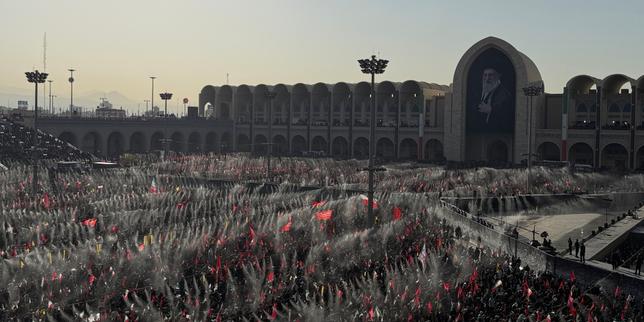
The public rituals of state grief in Tehran always mask a deeper, more volatile reality. When the Islamic Republic faces the inevitable transition of its supreme leadership, the prayers and official processions broadcast to the world are merely a facade. Behind the heavy curtains of the regime, a fierce and calculated restructuring of power takes place. This is not a simple transfer of spiritual authority. It is a high-stakes corporate takeover of a nation, executed by military commanders and security officials who have spent decades preparing for this exact moment. The future of the country is being decided not by divine mandate, or by the theological consensus of elderly clerics, but by the cold institutional weight of the Islamic Revolutionary Guard Corps.
For years, international observers focused heavily on the Assembly of Experts, the official body of clerics tasked with choosing the Supreme Leader. This focus was a mistake. The formal constitutional process is a rubber stamp for decisions made long before the voting begins. To understand the true mechanics of Iranian power, one must look at the economic empires, the intelligence networks, and the internal security apparatus that keep the regime afloat. The traditional clerical elite is losing its grip, replaced by a younger, more technocratic, and fiercely nationalistic military class that views the preservation of the state through the lens of survival and economic dominance.
The Clerical Decline and the Rise of the Security State
The founding generation of the 1979 revolution built a system dependent on a unique form of religious authority. That authority has eroded. Decades of economic mismanagement, widespread corruption, and violent crackdowns on civil dissent have alienated the vast majority of the Iranian population. The religious seminaries of Qom no longer command the absolute loyalty they once did. Instead, the regime relies almost entirely on coercion to maintain order.
This shift altered the internal balance of power. The clerics still hold the formal positions of authority, but they lack the practical means to enforce their will without the military. The Revolutionary Guard took advantage of this dependency, expanding its reach into every sector of Iranian society. They control major construction companies, telecommunications networks, shipping ports, and shadow banking systems used to evade international sanctions. They are no longer just a military branch. They are the primary stakeholders in the state.
The Financial Empires of the Bureaucrats
Money drives the political alignments in Tehran. The execution of state policy relies on a network of multi-billion-dollar bonyads, or religious charitable foundations. These entities operate outside government oversight, reporting directly to the office of the Supreme Leader. They tax exempt and control vast holdings in real estate, agriculture, and manufacturing.
Over the past decade, military commanders systematically placed their allies at the head of these foundations. By controlling the capital, the security apparatus effectively secured a veto over the political succession. Any candidate for the highest office must reach an accommodation with these economic cartels, ensuring that the financial interests of the military elite remain untouched.
The Succession Blueprint and the Shadow Candidates
The question of who follows a Supreme Leader involves intense factional engineering. For a long time, the political establishment floated specific names to gauge public and institutional reactions. Mojtaba Khamenei, the influential son of the current leader, has long operated in the shadows of the security apparatus, managing connections between the intelligence services and the office of the leader.
However, a hereditary succession presents significant ideological risks for a regime that overthrew a monarchy. It creates friction among traditionalists who believe the office should be earned through religious scholarship rather than lineage. This tension forces the security state to consider alternative paths, such as a governing council or a weak, compliant cleric who can serve as a legitimate front for military rule.
The Mechanics of the Assembly of Experts
The eighty-eight members of the Assembly of Experts are technically responsible for the selection. They are elderly men, thoroughly vetted by the Guardian Council to eliminate any reformist or independent voices. Their meetings are secretive, and their deliberations are heavily monitored by the Ministry of Intelligence.
The assembly does not debate philosophy during a crisis. They react to power dynamics established outside their chambers. The true selection happens in small, unrecorded meetings between the heads of the judiciary, the speaker of the parliament, and the top commanders of the armed forces. Once a consensus is forced among these factions, the assembly is called to ratify the decision, presenting an illusion of unity to the public.
+-------------------------------------------------------+
|             THE TRUE POWER STRUCTURE                  |
+-------------------------------------------------------+
|  [Military & IRGC Commanders]   [Shadow Capitalists]  |
|         \                              /              |
|          \                            /               |
|           v                          v                |
|             [The Core Decision Makers]                |
|                         |                             |
|                         v                             |
|             [Assembly of Experts]                     |
|               (Formal Approval)                       |
|                         |                             |
|                         v                             |
|                [Supreme Leader]                       |
+-------------------------------------------------------+
Regional Proxies and the Threat of External Instability
A transition period in Tehran is a moment of profound vulnerability on the global stage. The network of regional proxies, stretching from Lebanon to Yemen, depends on the continuity of command and financial support from the Quds Force, the external operations arm of the military. A sudden perception of weakness or division at the core could cause these groups to act independently, risking an unwanted conflict with regional adversaries.
To prevent this, the military establishment typically intensifies its aggressive rhetoric during internal transitions. They use the threat of foreign intervention to demand absolute domestic unity, treating any internal criticism or protest as acts of treason. The regional proxy network serves as a defensive shield, signaling to Washington and Tel Aviv that any attempt to exploit the transition will result in widespread chaos across the Middle East.
The Sanctions Inoculation
The economic isolation of Iran did not weaken the security state; it consolidated its power. Sanctions destroyed the independent middle class and the private merchants who historically funded moderate political movements. In their place, a black-market economy emerged, entirely controlled by the security forces and their preferred smugglers.
This shadow economy generates billions of dollars that do not appear on any official budget. It funds the repression of domestic protests and ensures that the security forces receive their salaries and benefits even during severe economic crises. The elite have successfully insulated themselves from the financial pain felt by ordinary citizens, making them highly resilient against external diplomatic pressure.
The Domestic Powder Keg
The greatest threat to the regime during a transition does not come from foreign intelligence agencies or regional rivals. It comes from the Iranian people. The country has experienced waves of intense, widespread protests driven by economic despair, social repression, and a total lack of political freedom. These demonstrations are leaderless, spontaneous, and increasingly angry.
The security forces understand that a visible fracture at the top of the government could serve as the catalyst for a massive popular uprising. If the population senses that the security apparatus is divided over the succession, the fear that keeps people off the streets could evaporate instantly. Therefore, the primary objective of the elite during any transition is the absolute projection of force and unity, regardless of the internal arguments occurring behind closed doors.
The Strategy of Total Information Control
During moments of state crisis, the first action of the security apparatus is the restriction of communication. The government routinely shuts down internet access, blocks messaging applications, and jams satellite broadcasts to prevent coordination among protestors. They flood the information space with state-sanctioned grief and nationalistic propaganda, attempting to monopolize the narrative both domestically and internationally.
This information isolation makes accurate reporting incredibly difficult. Independent journalists face immediate arrest, and foreign correspondents are restricted to tightly managed tours of official events. The images of crowds chanting in the streets of Tehran are real, but they are carefully staged events, populated by state employees, military families, and individuals dependent on government rations. They do not represent the broader sentiment of a nation waiting for a chance to change its destiny.
The transition of power in Iran is a managed crisis. The prayers and rituals are the public performance required to maintain the myth of the Islamic Republic's spiritual legitimacy. Beneath that performance lies a rigid, militarized corporate state determined to survive at any cost. The clerics may hold the titles, but the men with the weapons and the bank accounts are the ones writing the next chapter of Iranian history.