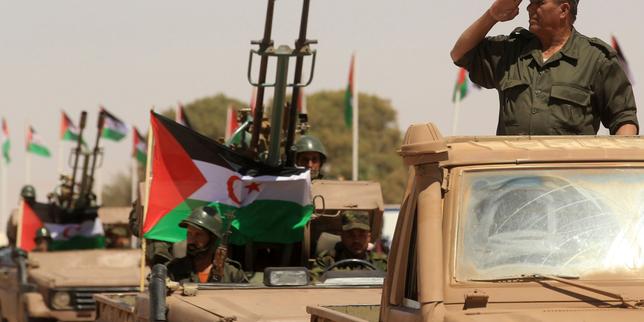
The desert does not care about borders. To the untrained eye, the vast stretch of the Western Sahara is a monotonous expanse of yellow and blinding white heat. But to those who fight over it, every ridge, every dry riverbed, and every shifting dune is a chess square in a war that has quietly smoldered for half a century.
On a Tuesday like any other, the silence above the sands of Mahbes was broken by a sound that has become the modern soundtrack of geopolitical reckoning. A high-pitched, mechanical whine. A flash. Then, the shattering roar of an explosion.
When the smoke cleared, Abouba Ali Bouali lay dead.
He was a field commander for the Front Polisario, a high-ranking military official whose life was defined by the harsh reality of a frozen conflict. To his followers in the Tindouf camps, he was a veteran strategist, a man who carried the heavy mantle of a decades-old dream of independence. To the authorities in Rabat, Morocco, he was a dangerous insurgent, a target whose elimination represents a calculated strike against a guerrilla force attempting to change the status quo.
The death of a commander in the middle of nowhere is not just a tactical update on a military map. It is a window into a shadow war that the world largely ignores, but one that threatens to ignite the entire North African region.
The Long Memory of the Sand
To understand why a drone strike in a remote desert outpost matters, you have to look back to the moment the modern map of this region was drawn. When Spain packed up and left its Western Sahara colony in 1975, it left behind a vacuum. Morocco claimed historical sovereignty over the territory. The Polisario Front, backed heavily by Algeria, demanded an independent state for the indigenous Sahrawi people.
What followed was fifteen years of brutal, grinding desert warfare. Imagine young men, barely out of adolescence, living in subterranean trenches, surviving on meager rations, and driving modified Toyota pickup trucks through minefields.
The UN stepped in with a ceasefire in 1991, promising a referendum on self-determination that never materialized. For thirty years, the conflict was frozen. A massive sand wall, the Berm, built by Morocco, split the territory in two. On one side, the vast majority of the land, developed and secured by Morocco. On the other side, a narrow, barren strip of "liberated zone" controlled by the Polisario, backed into the corner where the borders of Morocco, Algeria, and Mauritania collide.
Then, in late 2020, the truce shattered.
The catalyst was a choke point called Guerguerat, a crucial economic artery connecting Morocco to West Africa. When Polisario protesters blocked the road, Moroccan forces moved in to clear it. The Polisario declared the ceasefire dead and resumed "low-intensity" warfare.
But the desert of 2020 was vastly different from the desert of 1991. The rules of engagement had changed completely.
The Algorithmic Eye in the Sky
Abouba Ali Bouali grew up in an era of guerrilla tactics where survival meant knowing how to hide behind a rock formation or camouflage a Land Cruiser with local mud. In the old days, if you knew the terrain, you could survive.
Now, the terrain belongs to the algorithms.
Morocco has spent the last several years quietly building one of the most sophisticated aerial surveillance and strike networks on the African continent. This is not a secret, though the specifics are closely guarded. Through strategic alliances and defense contracts, Rabat acquired advanced unmanned aerial vehicles (UAVs) from Israel, Turkey, and the United States.
Consider the terrifying reality of modern drone warfare from the ground. You cannot see the drone. You cannot hear it until it is too late. It sits miles above the clouds, a cold piece of engineering tracking heat signatures, analyzing movement patterns, and waiting for the precise moment to strike.
When Bouali and his team entered the militarized sector of Mahbes, near the Algerian border, they weren't just fighting Moroccan soldiers. They were fighting an invisible network of satellites, thermal optics, and precision-guided munitions.
The strike was clinical. Reports filtering out from regional intelligence sources indicate that Bouali was traveling in a convoy when the missile struck. It was a clear demonstration of Morocco's zero-tolerance policy regarding any infiltration into the buffer zones east of the sand wall. For Rabat, the message is unambiguous: the buffer zone is no longer a safe haven for guerrilla maneuvers.
The Human Toll Behind the Heavy Politics
It is easy to get lost in the talk of drone models, border coordinates, and diplomatic communiqués. But look closer at what this conflict actually produces.
Step into the Tindouf refugee camps across the border in southwestern Algeria. Here, generations of Sahrawis have been born, raised, and buried in some of the most inhospitable terrain on earth. The mud-brick houses and canvas tents house people who are tired. The older generation clings to the memory of a homeland many of the youth have never even seen.
For the young men in these camps, the death of a commander like Bouali is a polarizing event. To some, it is a sobering reminder of the asymmetry of this war. How do you fight a missile with an aging assault rifle? To others, it is fuel for the fire. It breeds a desperate desire to escalate, to move beyond sporadic mortar fire and attempt something that forces the international community to look their way.
On the other side of the wall, inside the Moroccan-controlled territory, the perspective shifts entirely. In cities like Laayoune and Dakhla, billions of dollars have been poured into infrastructure, ports, and green energy projects. For the people living there, and for the Moroccan public at large, the sovereignty of the Sahara is a non-negotiable national truth.
Every soldier stationed along the thousands of miles of the Berm is someone's son, standing watch in the freezing desert nights and blistering day heat, waiting for a mortar round to drop from the dark. From the Moroccan viewpoint, neutralizing a commander like Bouali is an act of defense, an essential measure to ensure that the economic stability and safety of these growing southern provinces are never compromised.
The Dangerous Geometry of a Regional Powder Keg
The real danger of the strike in Mahbes is that it does not happen in a vacuum. The Western Sahara is the primary fault line in a much larger, much more dangerous rivalry between North Africa's two titans: Morocco and Algeria.
The relationship between Rabat and Algiers is currently at its lowest point in decades. Diplomatic ties are severed. Airspace is closed. The language coming out of both capitals is laced with the rhetoric of pre-war mobilization.
Algeria views the Polisario as a legitimate liberation movement and provides them with sanctuary, weapons, and diplomatic backing. Morocco views the Polisario as a proxy group used by Algeria to weaken Moroccan territorial integrity and secure an Atlantic port.
When a Moroccan drone kills a Polisario commander near the Algerian border, the room for error shrinks to nothing. A missile that strays a few kilometers off course, a drone that misidentifies a target near an Algerian military outpost, or a retaliatory strike that kills Algerian personnel could instantly transform this localized insurgency into a full-scale conventional war between two heavily armed nations.
The international community watches with a mixture of fatigue and anxiety. Europe, heavily reliant on North African pipelines for gas and desperate to curb irregular migration flows, cannot afford a war on its southern doorstep. Yet, the UN mission in the region, MINURSO, remains largely toothless, confined to monitoring a peace that no longer exists.
The Desert Wind Continues to Blow
The death of Abouba Ali Bouali will not change the course of the war overnight. The Polisario Front will appoint a new commander to oversee the Mahbes sector. Moroccan drones will continue to loiter in the thin desert air, their cameras scanning the vast, empty landscapes for signs of life.
The tragedy of the Western Sahara is its permanence. It is a conflict where the geography itself seems to resist a solution. The sand swallows the blood, the wind erases the tire tracks of the convoys, and the political stances on both sides remain as rigid as the rocky plateaus that define the land.
As night falls over the Berm, the heat radiates back into the sky, leaving the desert bitterly cold. Somewhere out there, a young man sits in a trench, looking up at the stars, listening carefully to the wind, wondering if the next sound he hears will be the whisper of a drone.