Thirty-six thousand feet above the Philippine Sea, the hum of two jet engines is not a sound you hear. It is a vibration you live inside. You feel it in the soles of your shoes, against the plastic tray table, deep in your molars. When you fly out of Port Moresby on a Boeing 737, heading north toward Manila, that low, steady thrumming is the only thing separating a pressurized aluminum tube from air so thin and cold it would freeze water in seconds.
Then the pitch drops.
Wait.
Listen closer.
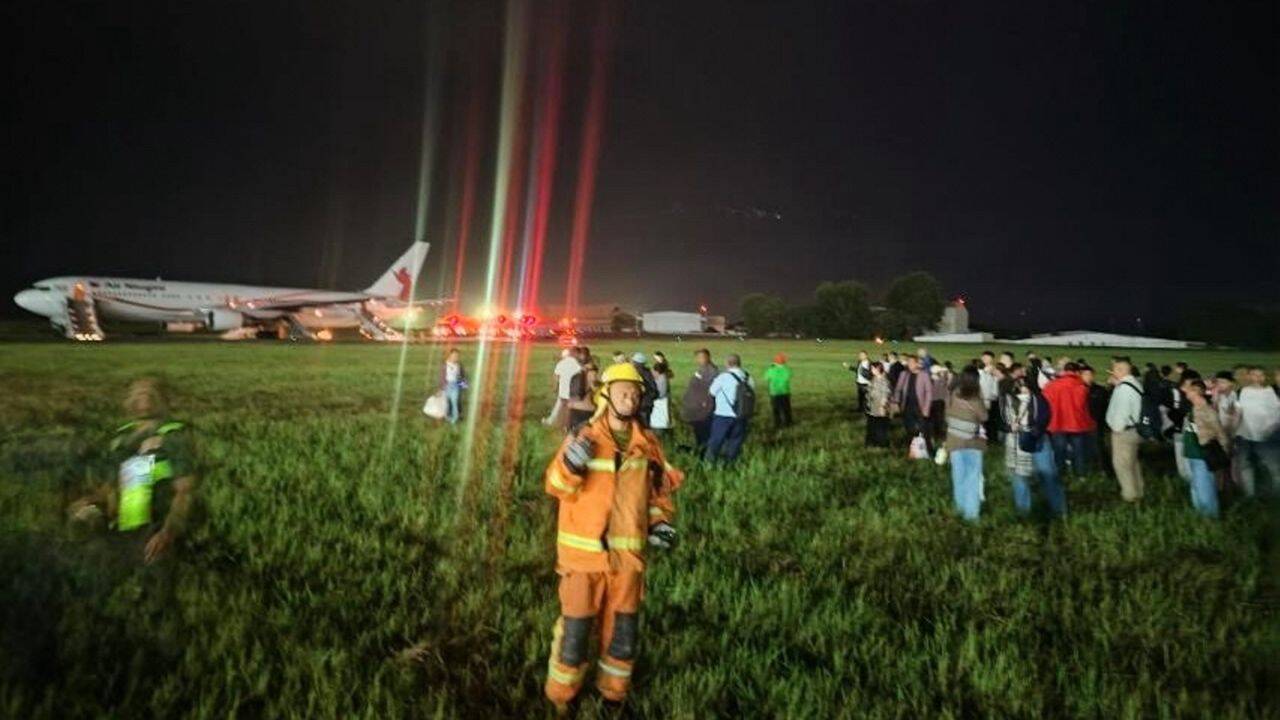
When an airline wire service prints a twenty-word headline—Air Niugini plane makes emergency landing in Philippines, all 146 safe—it sanitizes the longest twenty minutes in the lives of 146 human beings. Newsroom copy editors strip away the smell of stale coffee going cold on an armrest, the sudden weightlessness in the pit of the stomach when a captain pushes the nose down, and the quiet, terrifying negotiation every passenger makes with themselves when the cabin crew stops smiling and starts moving fast.
To understand what actually happened on that flight path between Papua New Guinea and the Philippines, you have to step inside the narrow aisle of a commercial airliner when an ordinary Tuesday turns into an emergency diversion.
The Anatomy of a Sudden Descent
Picture a hypothetical passenger—let us call her Elena—sitting in seat 14A, somewhere over the open water east of Mindanao. She has been flying this regional corridor for years, moving between mining contracts in Papua New Guinea and family obligations in Manila. Most travelers on Air Niugini's route between Port Moresby and Ninoy Aquino International Airport know the rhythm of the five-and-a-half-hour journey by heart. Meal service ends. The cabin lights dim. People pull hoodies over their eyes.
Nobody boards a flight expecting to test the emergency procedures printed on the laminated card in the seatback pocket.
When a commercial aircraft declares an emergency over water, the crisis rarely announces itself with cinematic explosions. In real aviation incidents, danger usually arrives as an amber warning light on the flight deck, a drop in bleed air pressure, a hydraulic fluid leak, or a cockpit windsheild cracking under thermal stress. Pilots call these moments "non-normal events," a phrase so aggressively calm it almost hides the stakes.
For the crew up front, a non-normal event triggers an immediate, ruthless triage. Every second counts, yet rushing kills. While passengers in the back are still wondering why the fasten-seatbelt sign just chimed twice in rapid succession, the captain and first officer are already running memory items before reaching for the Quick Reference Handbook.
Think of a modern airliner at cruising altitude like a deep-sea diver working at extreme depth. As long as the air supply holds and the pressure hull remains intact, everything feels effortless. The moment a valve sticks or a sensor flags an anomaly, the diver cannot simply swim sideways and wait it out. They have to begin a controlled ascent toward the surface—except in aviation, safety lies downward, toward thick, breathable air and concrete runways long enough to absorb seventy tons of landing weight.
Why 146 Lives Depend on Invisible Choreographies
Most people who read about an Air Niugini emergency landing in the Philippines ask the same immediate questions. What broke? Were the passengers in danger? Why did the plane land where it did instead of pushing on to Manila?
The answers lie in a global safety net that remains invisible until the exact minute a pilot squawks 7700—the universal transponder code for a general emergency.
The moment that four-digit code flashes onto air traffic control screens in Manila or Mactan-Cebu, the airspace around the distressed Boeing 737 changes shape. Controllers stop routing traffic by convenience and start clearing a corridor. Other commercial jets holding at thirty-five thousand feet are vectored miles away. Ground crews at the nearest suitable Philippine airport—whether Cebu, Davao, or Clark, depending on the aircraft's exact coordinates over the archipelago—receive a priority alert.
Down on the tarmac, yellow crash tenders roll out of their bays with engines idling. Firefighters pull on silver proximity suits while ambulances line up near the taxiway intersections, lights flashing silently against the asphalt.
Meanwhile, inside the cabin, the flight attendants undergo a transformation that anyone who has ever survived an emergency diversion remembers for the rest of their lives. One minute they are pouring orange juice; the next, their voices drop an octave, stripped of customer-service warmth and replaced by sharp, unmistakable authority.
Heads down. Stay down.
If you have never sat in brace position at two hundred knots, it is hard to describe how unnatural it feels. Your instincts scream at you to look up, to see out the window, to watch the runway coming up through the haze. Instead, you are staring at the carpet between your shoes, ankles tucked behind your knees, hands locked behind your neck, listening to the roar of air rushing past deployed flaps and landing gear.
The Weight of History Over the Pacific
Fear on a commercial flight never exists in a vacuum. It carries the weight of every headline passengers have ever read, especially in a region where aviation connects isolated island nations across vast stretches of open ocean.
Air Niugini, the national flag carrier of Papua New Guinea, operates in some of the most demanding geography on earth. Back home, its pilots navigate short jungle airstrips, sudden tropical downpours, and mountain ridges shrouded in cloud. International routes to Manila, Brisbane, and Singapore are the lifeline linking Port Moresby to the rest of the world. Travelers who rely on the airline know its crews are seasoned flyers, yet they also remember past scares—like the 2018 runway overrun in Chuuk Lagoon, where a Boeing 737 came to rest in shallow water and quick-thinking local boaters helped rescue passengers before the cabin flooded.
Memory travels fast down a narrow aisle. When a plane banks sharply off its planned heading over the Philippine Sea, nobody needs a briefing on how deep the water is below them.
That is the raw truth of commercial flight that statistics rarely soothe. We know, intellectually, that commercial aviation is the safest mode of mass transit ever invented. We know that modern twin-engine jets are certified under strict ETOPS standards—rules designed specifically so an aircraft can fly safely for hours on a single engine over empty ocean until reaching a diversion airport. We know that pilots spend dozens of hours every year inside full-motion simulators practicing engine fires, cabin depressurizations, and jammed flight controls until their hands move without conscious thought.
None of those statistics stop your palms from sweating when the cabin goes quiet and the ground rises up faster than it should.
Inside the Final Ten Minutes
Consider what happens in the final phase of an emergency landing in the Philippines.
Once the flight crew commits to a diversion, the workload inside the cockpit peaks. If the aircraft is still heavy with fuel meant for the full journey to Manila, the pilots must calculate stopping distances on a shorter runway, factoring in crosswinds, wet tarmac, and flap settings. The Boeing 737 does not carry fuel-dumping nozzles like larger wide-body jets; if an immediate landing is required, the pilots bring the airplane down heavy, relying on carbon brakes, thrust reversers, and spoilers to bleed off speed before the end of the concrete.
In the cabin, strangers become an accidental community.
In our hypothetical row 14, Elena watches the man across the aisle—a construction supervisor who spent the first three hours of the flight complaining loudly about baggage fees—quietly unclip his watch, slip off his shoes, and hand a tissue to the teenager trembling in the middle seat. Nobody checks their phone, partly because there is no signal over the sea, and partly because screens suddenly feel absurd.
Every rattle in the overhead bins sounds louder. Every subtle roll of the wings feels magnified.
Then the landing gear locks down with a heavy, reassuring thud beneath the floorboards. The engines spool up slightly to hold the glide slope against the drag of the flaps. Through the small oval windows, dark blue ocean gives way to fishing boats, green coastline, palm trees, and the white threshold markings of a Philippine runway rushing toward the nose.
Main wheels kiss the tarmac. Spoilers snap upward along the wings. Reverse thrusters roar, throwing everyone forward against their lap belts as the airplane shudders, slows, and finally rolls to a stop on the centerline.
What "All 146 Safe" Really Means
When the wire reports go out an hour later, the story shrinks back down into four reassuring words: all 146 safe.
Airlines issue brief statements confirming the flight landed without incident following a technical indication. Aviation authorities log the event for routine investigation. Within twenty-four hours, the headline disappears from news feeds, replaced by stock market ticks, political squabbles, and celebrity gossip.
Yet for the 146 people who walked down those mobile airstairs into the humid Philippine afternoon—passengers and crew alike—nothing about that day was routine.
Safety in aviation is never an accident, and it is never passive. It is bought in advance through thousands of unglamorous hours: mechanics checking turbine blades under fluorescent hangar lights at three in the morning, air traffic controllers keeping calm voices through static-filled headsets, flight attendants drilling evacuation commands until they can shout them in their sleep, and two pilots in the front seats refusing to panic when an amber light turns the sky upside down.
Hours later, standing inside the fluorescent glare of a terminal waiting area with a voucher for a bottle of water and a rebooked boarding pass in hand, the passengers finally pull out their phones to text family members waiting in Manila. They type three short words—Landed. I'm okay.—and stare down at the screen as their hands slowly stop shaking.