The air in Manitoba during mid-summer possesses a distinct weight. It is thick, heavy, and smells of baked asphalt and sweet prairie grass. On a Tuesday afternoon, most people in Winnipeg are thinking about ordinary things. They are thinking about the grocery list, or the squeak in the front brakes, or whether they have time to water the tomatoes before the sun goes down.
Then, the light changes. Recently making news lately: The Great French Thaw and the Lethal Politics of Keeping Cool.
It is a color that anyone born on the Canadian Prairies recognizes with a cold spike of adrenaline. It is not gray. It is not the deep indigo of a standard thunderstorm. It is an eerie, bruised green, a shade that looks entirely unnatural, as if someone dialed the saturation up to a sickening degree.
For the residents of one quiet Winnipeg neighborhood, that green sky was the first warning of an afternoon that would rewrite their understanding of safety. Minutes later, the wind did not just blow. It screamed. More insights regarding the matter are explored by Reuters.
We tend to view natural disasters through the lens of the spectacular. We look at footage from deep in the countryside, where massive wedges of darkness chew through empty wheat fields under an endless horizon. But when extreme weather enters city limits, the scale changes. It becomes intimate. It enters the backyard. It rips the shingles off the roof you just paid five thousand dollars to replace.
Environment Canada would later release a statement. They would use precise, clinical language. They would talk about radar anomalies, localized wind shear, and eventually, they would officially confirm what the people on the ground already knew with absolute certainty. A tornado had touched down in a Winnipeg neighborhood.
But a bureaucratic confirmation cannot capture the sound of a century-old oak tree snapping like a dry toothpick.
The Anatomy of an Ordinary Tuesday
Consider a hypothetical resident named Sarah. She lives on a street lined with modest bungalows, the kind built in the nineteen-fifties and sixties where neighbors still wave across the fence. Sarah was standing at her kitchen window when the birds stopped singing.
Silence.
It was a sudden, suffocating absence of sound. The neighborhood dogs, usually quick to bark at the mail carrier or a passing cyclist, went completely quiet. The leaves on the Manitoba maples stood perfectly still, pointing upward as if holding their breath.
Then came the pressure drop.
If you have never been close to a atmospheric event of this magnitude, the physical sensation is difficult to describe. Your ears pop, much like they do when a plane takes off, but the sensation is accompanied by a sudden weight in your chest. It feels as though the room is being emptied of oxygen.
Sarah looked out toward her backyard. The sky had darkened to near-midnight levels, though it was barely three in the afternoon. A plastic patio chair slithered across the grass, entirely on its own, before suddenly taking flight, lifting straight up into the air like a discarded piece of paper.
That is when the sound arrived.
People always say a tornado sounds like a freight train. The cliché exists because it is accurate. But it is more than just a roar. It is a mechanical, grinding screech combined with the deep, bass-heavy rumble of an explosion that refuses to end. It is the sound of thousands of individual objects—siding, branches, gravel, glass—being pulverized simultaneously.
She did not think. She ran for the basement.
The Cold Science of a Warm Afternoon
To understand why this happens, we have to look at the unique geometry of the Canadian Prairies. Winnipeg sits at the bottom of an ancient glacial lake bed, a vast, flat expanse that offers zero resistance to moving air masses.
During the summer, hot, humid air pushes north from the Gulf of Mexico, pooling over the southern prairies. At the same time, cold, dry air streams over the Rocky Mountains from the west. When these two massive entities collide over Manitoba, the atmosphere becomes a powder keg.
The technical term is convective instability.
Think of it as a massive thermal elevator. The hot air wants to rise rapidly, while the cold air wants to sink. If the conditions are just right—or just wrong—the rising air begins to rotate, fed by changing wind directions at different altitudes. This rotation forms a mesocyclone, the spinning heart of a severe thunderstorm.
[Hot, Humid Gulf Air]  ---> \
                             [Collision & Rotation] ---> [Tornado Touchdown]
[Cold, Dry Mountain Air] ---> /
Most of the time, these atmospheric battles play out over thousands of square kilometers of empty farmland. They knock down power lines in rural municipalities, drop baseball-sized hail onto canola crops, and vanish back into the clouds.
But the atmosphere does not recognize city zoning laws.
When that rotation tightens and descends into an urban center, the variables change instantly. A field of wheat offers little resistance and fewer projectiles. A residential neighborhood is a dense grid of potential missiles. Bricks, trampolines, garbage cans, and roofing tiles are swept into the vortex, turning a localized weather event into a meat grinder of flying debris.
The Paper Trail of Chaos
Hours after the wind died down, the official machinery began to move. Environment Canada meteorologists did not just look at the sky; they looked at data. They analyzed Doppler radar loops, tracing the velocity of the winds that had swept through the city. They looked for the telltale hook echo, a signature shape on radar screens that indicates rain and hail wrapping around a rotating column of air.
The next step was the physical assessment. Damage surveyors were dispatched to the Winnipeg neighborhood.
Their job is methodical, almost detached. They walk through the wreckage with clipboards and cameras, examining the patterns left behind by the wind. They look at the direction the trees fell. If the trees are all pushed in one direction, it was likely a straight-line wind event—a microburst or a plow wind.
But if the trees are thrown in a chaotic, crisscross pattern, with trunks snapped at varying angles and debris carried blocks away in multiple directions, it points to rotation.
They looked at the roofs. They looked at the structural integrity of the homes. Based on the degree of damage, they assigned a rating on the Enhanced Fujita scale.
The resulting report was brief. It confirmed the touchdown. It listed the time, the approximate path length, and the estimated maximum wind speeds. It was a document designed to be filed away in an archive, a single data point in a century-long ledger of Manitoba weather.
But for the people who live on those streets, the event cannot be contained in a PDF.
The Human Ledger
The true cost of a storm is found in the hours after it passes.
When Sarah crawled out of her basement, the world she knew had been violently rearranged. The air smelled of fresh pine sap and ruptured earth. The silence had returned, but it was a different kind of quiet now—the stunned stillness of an immediate aftermath.
She opened her front door. The street was unrecognizable.
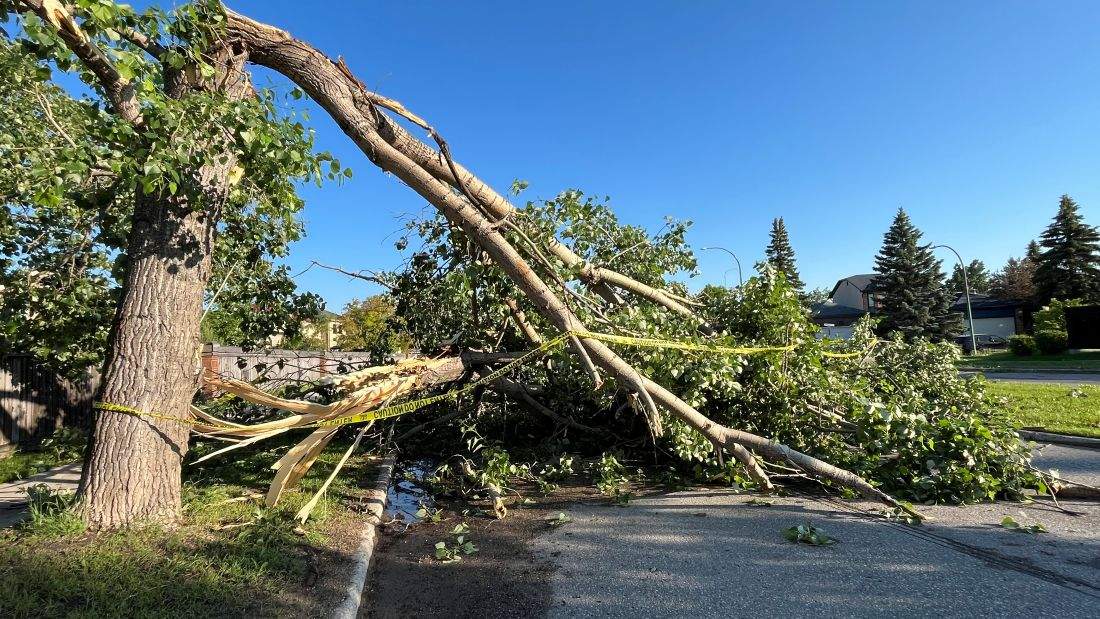
The massive oak tree that had shaded her neighbor’s driveway for half a century was lying on its side, its massive root ball ripped completely out of the earth, exposing dark, clay-heavy soil. A pink children’s bicycle was wedged into the branches ten feet above the ground. Insulation from someone’s attic hung from the overhead power lines like dirty insulation foam.
Neighbors began to emerge, blinking into the sudden, returning sunlight.
There is a specific look people have after surviving something like this. Their eyes are wide, their movements slow and deliberate. They look at their own hands as if ensuring they are still attached.
They did not talk about the meteorological conditions. They did not care about convective instability or radar signatures. They asked if everyone was accounted for. They looked for the elderly couple at number forty-two. They checked on the teenager who had been home alone down the block.
Then, the collective instinct kicked in.
Before the first emergency vehicles even arrived with their sirens wailing through the debris-littered streets, people were working. Someone brought out a chainsaw. Two others began dragging large branches off the asphalt so cars could pass. A neighbor from three doors down, a man Sarah had only ever exchanged brief nods with, appeared with a roll of heavy plastic sheeting and a staple gun to cover her broken living room window.
This is the part the official reports always miss. They can measure the wind speed, but they cannot measure the immediate, fierce resilience of a community that has just been shaken to its core.
The Illusion of the Grid
We live our lives under the assumption that our infrastructure is permanent. We build thick concrete foundations, string heavy wires across sturdy poles, and lay down blacktop that feels unyielding beneath our feet. We create a grid, and we believe that grid protects us from the wild, unpredictable realities of the natural world.
An event like a Winnipeg tornado shatters that illusion in a matter of seconds.
It reminds us that our cities are built on a fragile frontier. The prairies are beautiful, but they are also indifferent. The same sun that coaxes crops from the soil can power storms that can level a home.
The confirmation from Environment Canada is necessary. It provides the data that engineers use to update building codes. It helps insurers process claims. It gives the historical record the accuracy it requires.
But the real story belongs to the neighborhood. It belongs to the people who stood in the green light, who felt the pressure drop in their chests, and who came out of their cellars to rebuild their street, one broken branch at a time. They know that the sky can turn on them at any moment. And they know that when it does, they only have each other.