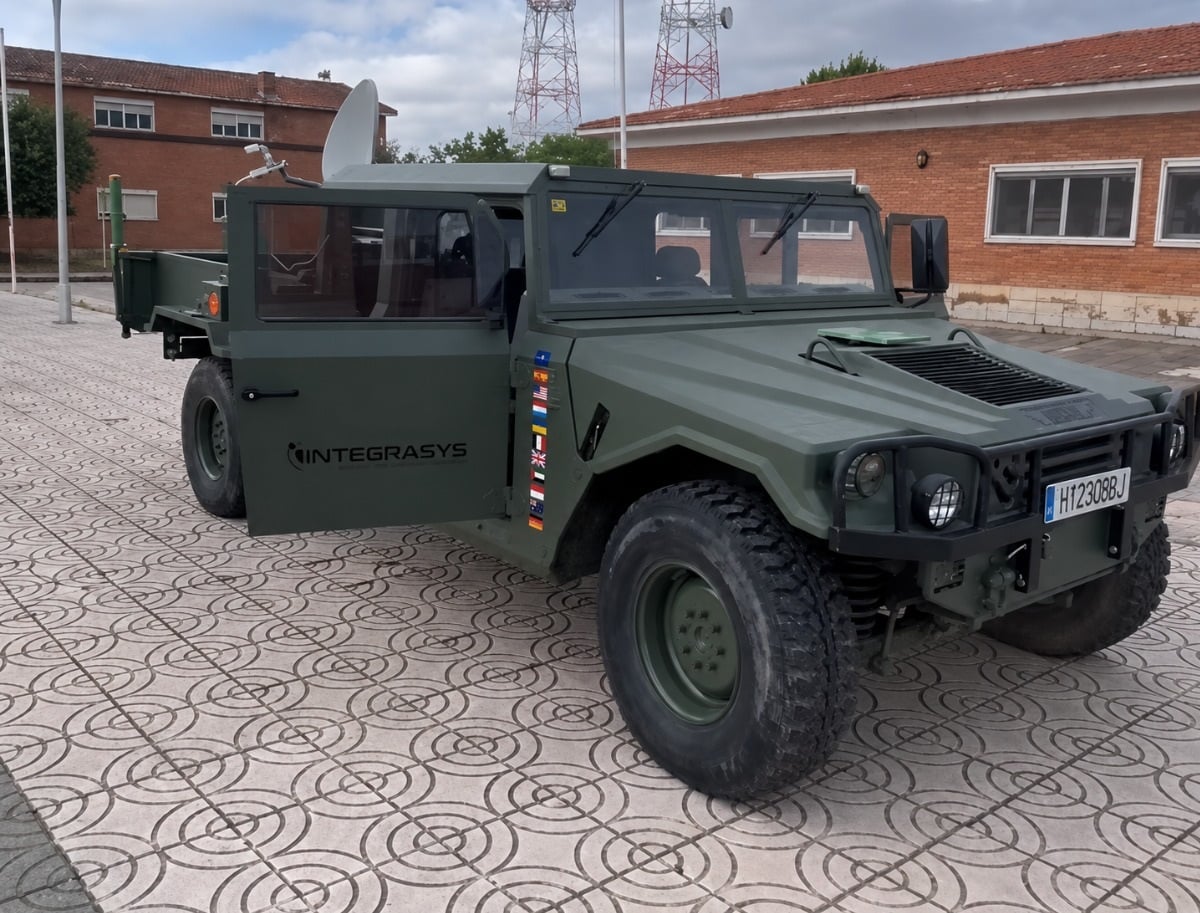
Defense tech bloggers are currently drooling over a Spanish firm's latest "innovation"—bolting electronic warfare equipment onto a retired military truck to create a mobile drone jammer. The defense sector loves this kind of narrative. It feels scrappy. It looks rugged. It ticks the sustainability box by recycling old hardware.
It is also an absolute death trap for the operators and a fundamental misunderstanding of modern electronic warfare.
The defense industry is trapped in a dangerous cycle of romanticizing retrofitted hardware. We see a refurbished four-wheel-drive chassis, a shiny new radome in the flatbed, and we clap like toddlers because it looks like a sci-fi movie. But if you have spent any time analyzing actual electronic order of battle data from recent conflicts in Eastern Europe or the Middle East, you know this concept is flawed from the tires up.
Bolting a high-powered electronic warfare (EW) suite to a slow, unarmored, retired logistics vehicle does not solve the drone problem. It just creates a larger, more expensive target.
The fatal flaw of the rolling radio tower
Let us dissect the basic physics of what this vehicle actually does. An electronic warfare drone jammer works by flooding specific frequency bands with radio frequency (RF) energy. It screams louder than the drone’s operator or GPS satellite, severing the command link or blinding the navigation system.
When you activate a high-powered omnidirectional or directional jammer, you are not stealthy. You are lighting a massive digital flare in the middle of a dark field.
In modern warfare, signals intelligence (SIGINT) units are hunting for that exact signature. The moment that retired army truck turns on its electronic warfare suite, every passive RF sensor within a 50-kilometer radius registers its exact coordinates. It takes less than thirty seconds for an automated artillery fire-control system or an anti-radiation loitering munition to calculate the point of origin and send a response.
Imagine a scenario where this mobile jammer deployed to protect a forward operating base. It successfully drops three commercial quadcopters. Fantastic. Meanwhile, a peer-adversary’s passive direction-finding array has localized the truck's emissions to a 10-meter grid square. The truck, built on a heavy, retired logistics chassis, requires several minutes to pack up, crank the engine, and find traction on muddy terrain. It is obliterated by a conventional mortar barrage before it even clears the tree line.
We are putting 21st-century electronic targets on 20th-century targets. It makes no tactical sense.
Mobility is an illusion when you are heavy and slow
The defense startup behind this vehicle argues that mobility is the ultimate countermeasure. The logic goes: if the jammer can move, it can survive.
I have spent years evaluating field deployments of tactical communication gear, and I can tell you that "mobile" is a relative term. A repurposed 10-ton cargo truck is mobile on a paved highway. It is semi-mobile on dry dirt roads. It is a sitting duck when it is bogged down in wet clay, trying to navigate narrow urban chokepoints, or maneuvering through dense forestry.
True tactical mobility in the age of persistent aerial surveillance requires agility, a low thermal signature, and a minimal physical footprint. A massive, high-profile military truck offers none of these. It cannot hide under standard camouflage netting without significant setup time. Its engine generates a massive thermal signature that thermal imaging sensors on high-altitude drones can spot from miles away.
If your drone countermeasure relies on a platform that requires a commercial commercial driver's license to operate, you have already lost the agility battle.
The economic illusion of refurbished military surplus
The second defense of this approach is always cost. "We are saving taxpayers money by using surplus vehicles!"
This is a classic sunk-cost fallacy dressed up as fiscal responsibility. Anyone who has ever managed a fleet of aging military vehicles knows that "retired" usually means "maintenance nightmare."
- Supply Chain Fragmentation: Finding replacement parts for a 30-year-old transmission or an obsolete braking system requires raiding junkyards or paying exorbitant custom fabrication costs.
- System Integration Overhead: Forcing a modern, highly sensitive electronic warfare system to interface with an ancient 24-volt electrical system requires massive power inverters, auxiliary generators, and custom shock-absorption mounts.
- Operational Downtime: The vehicle does not break down when it is sitting in a showroom. It breaks down when the auxiliary cooling unit for the jammer overloads the alternator in 100-degree weather during an operational drill.
When you add up the engineering hours required to make an old truck compatible with delicate solid-state electronics, you are not saving money. You are just hiding the costs in engineering line items instead of procurement line items.
The wrong solution to the wrong question
The industry keeps asking: "How do we transport our massive drone jammers to the battlefield?"
That is the wrong question. The correct question is: "Why are our drone jammers still so massive that they require a truck?"
The assumption that effective electronic warfare requires a heavy vehicle platform is a holdover from the Cold War, when jamming meant overpowering Soviet radar installations with megawatts of power. Today’s threat matrix consists of small, agile, cheap autonomous systems.
Defeating them does not require raw power; it requires precision, edge computing, and distributed networks.
| System Characteristic | The Old Truck Approach | The Distributed Approach |
|---|---|---|
| Footprint | High-visibility, 10-ton single point of failure | Dispersed, low-profile nodes |
| Target Signature | Massive RF emission + High thermal signature | Low-power directional bursts |
| Survivability | Low (Vulnerable to artillery and anti-radiation missiles) | High (Loss of one node does not compromise the network) |
| Deployment Time | Minutes (Requires stabilization and mast elevation) | Instantaneous (Always-on passive/active grid) |
If you rely on a single truck-mounted system, a single sniper round to the radiator or a piece of shrapnel to the generator terminates your entire anti-drone umbrella.
The harsh truth about kinetic vs. non-kinetic options
Let us address the elephant in the room that electronic warfare manufacturers hate to talk about: modern drones are evolving past RF dependency.
The assumption that jamming will always work is dangerously naive. Peer adversaries are already deploying autonomous drones utilizing optical grain matching and inertial navigation systems. These drones do not use GPS. They do not talk to an operator. They fly via pre-programmed algorithms that look at the terrain below through a camera lens and compare it to a satellite map stored onboard.
When an autonomous, optically guided drone flies into the airspace of your shiny, refurbished Spanish truck, your jammer can pump out all the RF energy it wants. The drone will not notice. It will follow its internal map straight down the thermal signature of the truck's exhaust pipe.
Electronic warfare is a critical piece of the puzzle, but treating it as a standalone shield mounted on a legacy vehicle is an operational failure. Effective counter-drone operations require a layered approach: passive RF detection, acoustic tracking, automated kinetic interception (such as programmable ammunition or counter-drone interceptor nets), and hard-kill laser systems.
Trying to do all of this from the back of an old cargo truck results in a vehicle that does nothing well. It is too vibrating for optical tracking, too unshielded for high-power microwaves, and too slow to escape retaliation.
Stop celebrating the repackaging of old ideas in green paint. If we want to solve the aerial threat dominating modern battlefields, we need to stop building bigger targets and start building smarter networks.