The weight of it is constant. It rests against the ribs, tucked beneath the fabric of a shirt, held by a simple cloth strap. To the uninitiated, it is a weapon. To the person wearing it, it is a heartbeat—a physical manifestation of a promise made three centuries ago to stand against injustice, to protect the vulnerable, and to never abandon one's faith.
It is called a kirpan. And recently, at a gym in Canada, it became a lightning rod for a collision between two incompatible worlds.
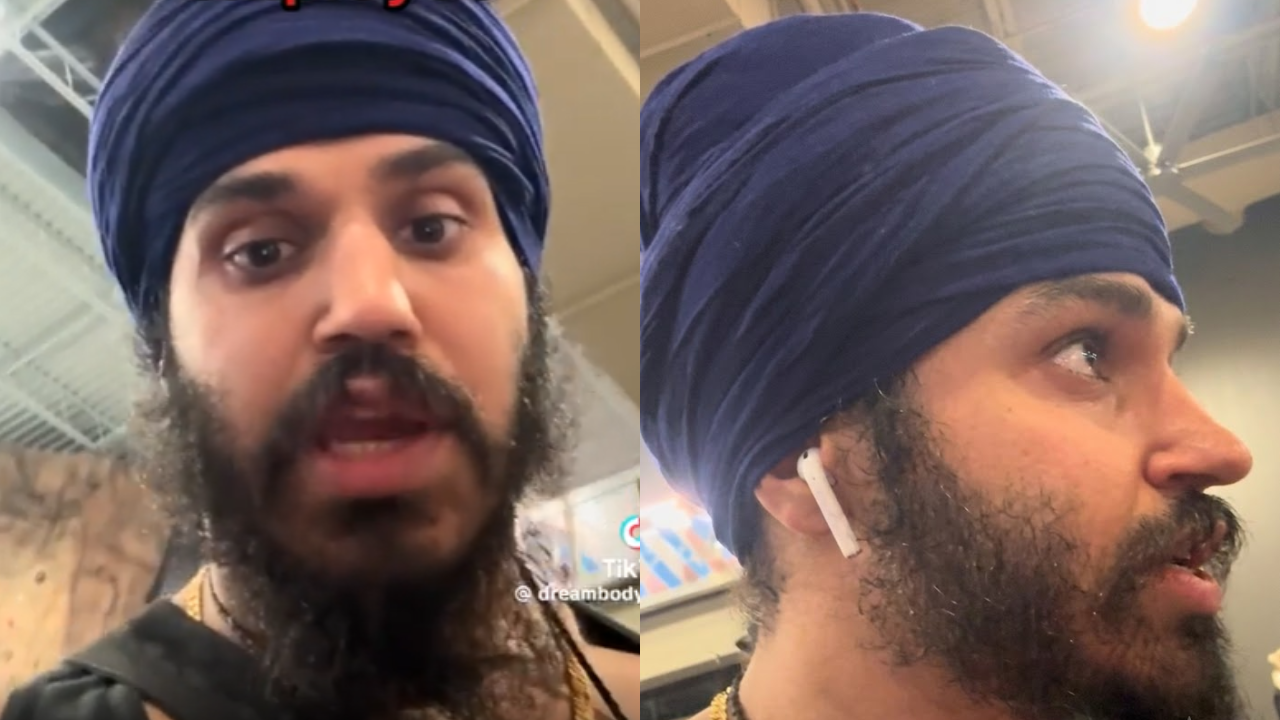
A young Sikh man, a creator on TikTok, walked through the doors of a fitness center. He sought, like anyone else, the dopamine hit of a workout and the routine of self-improvement. But he was stopped. Not because he lacked a membership, and not because he was disruptive. He was stopped because the gym’s staff saw a bulge beneath his clothing. When he explained that it was a religious article of faith—a mandatory requirement for baptized Sikhs—the atmosphere shifted. The environment, intended for physical commonality, suddenly felt like a courtroom. He was asked to leave.
He filmed the encounter. The internet did what it always does: it polarized. Some saw a dangerous blade in a space full of sweating, vulnerable people; others saw an act of systemic discrimination against a fundamental human right.
To understand why this happens, we have to stop looking at the steel and start looking at the intent.
The Anatomy of a Symbol
The kirpan is one of the Panj Kakar, the five articles of faith that every initiated Sikh must wear. It is not an accessory. It is not a decorative flourish. It is a vow.
Historically, the kirpan emerged during a time of extreme persecution in South Asia. It was a declaration that the wearer would act as a guardian. It is blunt-tipped, often sewn into its sheath, and functionally ceremonial. It is no more a "knife" in the predatory sense than a crucifix is a torture device. But in a modern secular society, context often gets stripped away until only the shape remains. And the shape of a blade triggers a primal, hardwired alarm.
This is the friction point. In our modern, sanitized public spaces, we have traded nuance for blanket safety policies. We create "zero tolerance" rules because they are easy to enforce and legally defensible. They don't require staff to understand theology. They don't require nuance. They simply require a glance: Is it sharp? Does it look like a weapon? Then it stays outside.
But when we apply a universal rule to a specific religious identity, we aren't being neutral. We are telling that person that their identity is secondary to our comfort.
The Invisible Stakes
Imagine you are that young man. From the moment you wake up, the kirpan is part of your body. You shower with it, you sleep with it, you live with it. It is a reminder to be better, to be brave, and to be selfless.
Now, imagine walking into a building and being told that to enter, you must effectively lobotomize your faith. You are being asked to choose between your civic participation and your spiritual integrity.
This is not a hypothetical dilemma for the Sikh community. It is a daily negotiation. They have successfully integrated into Canadian society, serving in the military, sitting in Parliament, and working as frontline medical staff—all while wearing their kirpans. If the Canadian Armed Forces can find a way to accommodate a soldier wearing a kirpan under their uniform, why can a gym not figure out how to accommodate a patron lifting weights?
The answer is rarely malice. It is usually a failure of imagination.
Fear as Policy
The gym manager who asks a Sikh to remove their kirpan is likely terrified of liability. We live in an age of litigation, where a single incident creates a catastrophic brand narrative. From the manager’s perspective, they aren't suppressing religion; they are managing risk. If they allow one person to carry a blade, how do they stop the next person from carrying something truly dangerous?
The slippery slope argument is the standard defense of the risk-averse. But it is a lazy one.
Accommodation is not an admission of chaos. It is the art of differentiation. We already allow people with medical devices, insulin pumps, and necessary prosthetics into spaces that have "no foreign object" policies. We have learned to tell the difference between a threat and a necessity. We simply haven't bothered to learn the difference between a weapon and a kirpan.
The Path Toward Coexistence
If we want to build communities that are genuinely inclusive rather than just performatively diverse, we have to move past the binary of "your rights vs. my safety."
Accommodating the kirpan doesn't mean allowing patrons to walk around brandishing steel. It means respecting the sanctity of the article of faith. Most Sikhs are more than happy to ensure the kirpan is securely fastened, worn under clothing, and kept out of sight. It is not meant to be seen, nor is it meant to be used.
When a conflict arises, the solution shouldn't be a summary ejection. It should be a conversation. How can we ensure you remain faithful to your practice while ensuring everyone here feels secure?
When we engage in that dialogue, we stop seeing each other as threats to be managed and start seeing each other as neighbors with different, yet equally valid, requirements for living a good life.
The Cost of Uniformity
When we enforce a rigid, monolithic standard of behavior, we don't just exclude the religious. We make the world flatter, duller, and more brittle. We create spaces where only one type of person, with one type of dress, and one type of history, feels at home.
The young man in the video eventually left the gym. He lost his workout. But the gym lost something far more significant: it lost its claim to being a community space. It signaled that there is an invisible bouncer at the door, and that bouncer has a very narrow definition of who belongs.
Every time we force someone to hide who they are to fit into the architecture of our daily lives, we shrink the world just a little bit more. We trade the vibrancy of a pluralistic society for the thin, fragile comfort of seeing only ourselves reflected in the faces of those around us.
True security isn't found in a policy that bans everything unfamiliar. It is found in the confidence to welcome a neighbor, even when their traditions are written in a language we have yet to learn. The kirpan is not a blade against us. It is a blade for us—a symbol of a commitment to defend the very freedom that allows us to walk into a gym, or a church, or a courtroom, and be exactly who we are.