A Roar Across the Moor
The smell hits long before the fire comes into view.
It is not the cozy, crisp aroma of a woodburning stove on an October evening. It is the acrid, metallic stench of ancient peat burning from the bottom up. Peat doesn't blaze like pine trees in California or eucalyptus in Australia. It smolders underground, a creeping subterranean furnace that transforms centuries of decaying moss into carbon-rich tinder. By the time flames break through the surface grass, the ground beneath your boots is already alive with heat.
Consider a volunteer crew standing on a hillside in the Scottish Highlands. Their boots are scorched. Their throats burn. They carry heavy beaters—metal pads on long sticks—and backpack sprayers holding a few precious gallons of water. Against a five-mile front of wind-driven fire racing across dry heather, human hands alone are a tragic mismatch.
They need water from the sky. And they need it fast.
When the Highland skies open up, it takes millions of gallons to douse a major moorland blaze. Yet, when fire chiefs dial for aerial support, they are often met with a stark reality: Scotland does not own a dedicated fleet of firefighting helicopters.
Instead, the nation relies on a patchwork system of private operators, estate helicopters, and good fortune. When a crisis erupts, the question isn't just how quickly an aircraft can drop water. It is whether one is even available for hire.
The Hidden Engine of the Bog
Scotland is famous for rain. The popular assumption—one held by tourists and locals alike—is that a land dripping with mist and framed by dark lochs could never truly burn.
That assumption is dangerous.
Spring in the Highlands brings a volatile meteorological window. Between March and May, before the new green shoots push through, last year's heather and bracken turn bone-dry. Sunlight cuts through cold, crisp air. High-pressure systems block incoming rain clouds, and dry winds sweep down from the northeast.
Under these conditions, a single dropped cigarette, a discarded glass bottle, or an escaped campfire turns thousands of acres into an inferno within hours.
+-------------------------------------------------------------------+
|               THE ANATOMY OF A HIGH-LATITUDE FIRE                 |
|                                                                   |
|   1. DRY SURFACE LAYER: Last year's dead heather & bracken         |
|   2. SUBSURFACE PEAT: Metres-deep carbon store, burns underground |
|   3. WIND SHIFT: Rapid spread across roadless terrain             |
|   4. ACCESS LIMIT: Ground crews take hours to march in with gear   |
+-------------------------------------------------------------------+
When a fire takes hold in remote terrain like Sutherland or the Galloway Forest, roads simply vanish. Fire engines cannot drive across a peat bog; an engine weighs twenty tons and will sink up to its axles in soft earth.
Firefighters must walk. They carry equipment on foot across mileage that takes hours to navigate. Every minute spent hiking is a minute the fire spends growing.
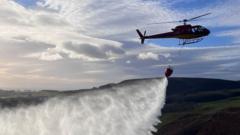
Aerial firefighting changes the calculus completely. A helicopter equipped with a heavy-duty flexible bucket—often called a Bambi Bucket—can scoop hundreds of gallons from a local loch, fly over the ridgeline in two minutes, and drop targeted loads directly onto the flank of a fire. It buys ground crews the one currency they lack: time.
The Economics of a Crisis
Why doesn’t Scotland maintain a fleet of red-painted, state-owned water bombers ready to launch from Elgin or Stirling at a moment's notice?
Money. And mathematics.
Dedicated firefighting aircraft are astonishingly expensive to buy, maintain, and pilot. A medium-lift helicopter costs millions of pounds upfront, with steep recurring bills for specialized aviation engineers, hanger space, and pilot training.
If that aircraft sits on a runway for nine months of the year doing nothing because the Scottish climate is doing what it usually does—raining—it becomes an easy target for budget cuts.
THE AERIAL FIRE RESPONSE COMPARISON

+--------------------------+---------------------------------+---------------------------------+
| Metric                   | State-Owned Fleet Model         | Commercial On-Call Model        |
+--------------------------+---------------------------------+---------------------------------+
| Upfront Capital Cost     | Extremely High (State Funded)   | Zero (Privatized Fleet)         |
| Year-Round Maintenance   | Paid by Taxpayer                | Paid by Commercial Operators    |
| Availability Guarantees  | Immediate / Guaranteed 24/7    | Conditional / Subject to Availability |
| Operational Flexibility  | Fixed Purpose                   | Multi-Role (Utility, Transport) |
+--------------------------+---------------------------------+---------------------------------+
So, the Scottish Fire and Rescue Service (SFRS) relies on private contracts. They hire civil aviation companies that spend most of their time moving deer stalks, repairing wind turbines, or carrying material to remote estate builds.
When a fire breaks out, the fire service calls these commercial operators and asks to hire their machines.
It sounds efficient on paper. In practice, it introduces friction at the exact moment friction can prove disastrous.
What happens if the commercial helicopters are already booked for maintenance? What if they are deployed hundreds of miles away carrying gravel up a mountain in Wales? What if the weather prevents a private helicopter from flying across the UK to reach a burning ridge in Ross-shire?
Contracting out safety works right up until the moment everyone needs the same resource at the same time.
What Happens When the Sky Stays Empty
Consider an actual incident on the hills above Cannich in 2023.
A blaze erupted in the dry spring conditions, eventually scorching over thirty square kilometers of land. The smoke drifted across the Great Glen, visible from space. Ground crews worked until their limbs shook with exhaustion.
The fire burned for days.
Helicopters were deployed, scooping water from nearby lochs to hit hotspots that humans couldn't reach. But the sheer scale of the event pushed local resources to their breaking point.
When fires hit this size, they create their own weather. Drafts of hot air pull oxygen into the core, propelling embers miles ahead of the main front. Ground beaters become useless. Without sustained, heavy water drops from above, the fire marches uninterrupted across the horizon.
The stakes go far beyond burned heather.
Scotland's peatlands are natural vaults holding vast amounts of carbon—more than all the forests of the UK combined. When these bogs burn, they do not just release smoke; they dump thousands of tons of stored carbon back into the atmosphere, turning a natural climate solution into a massive carbon source.
Destroying this habitat ruins decades of environmental restoration work in a weekend.
A Shift in the Wind
Fire chiefs across Europe are watching the climate trends with growing concern. Summers are getting hotter. Springs are getting drier. The historic weather patterns that kept Northern Europe damp and safe are shifting.
The debate in Scotland is no longer about whether wildfires will happen. It is about how often, how large, and how prepared the response will be.
Some experts argue for a shared national framework—a pool of government-funded utility helicopters operated in partnership with forestry bodies, mountain rescue, and emergency services. Such a setup would keep the aircraft busy year-round doing environmental monitoring, flood relief, and search operations, while standing ready to clip on a water bucket at thirty minutes' notice.
Others point out that formalizing agreements with existing commercial helicopter companies—paying retainer fees to guarantee availability during high-risk spring months—could deliver safety without the crushing overhead of a dedicated government fleet.
Whatever path is chosen, relying on informal arrangements and hopes for rain is no longer a plan.
Standing on a smoky ridge in the Highlands, watching the red glow expand across a hillside while listening for the distant thump of rotor blades that may or may not arrive, makes one truth perfectly clear:
When the peat starts to burn, help needs to come from the sky. And it cannot afford to be late.