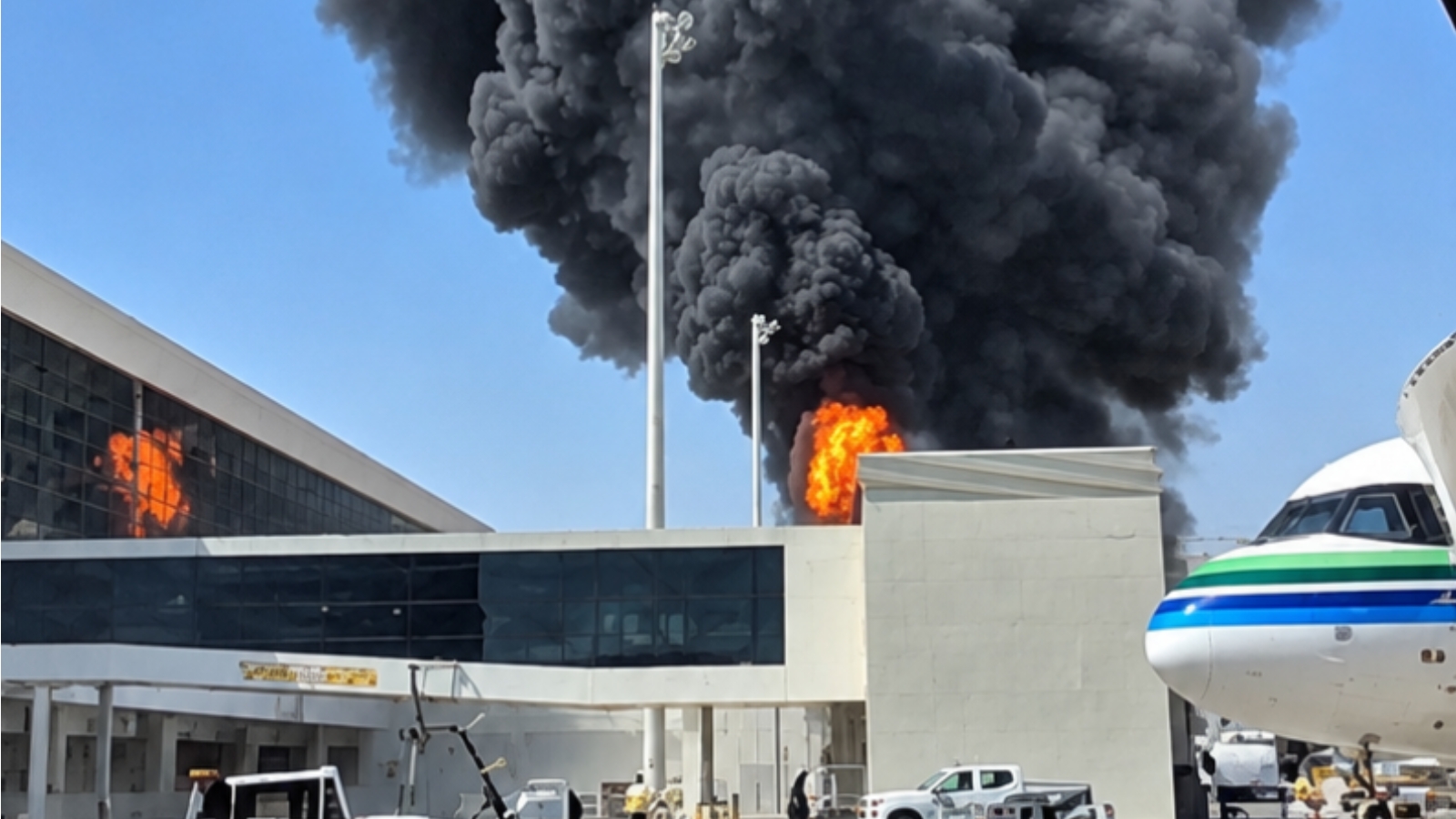
The morning air in Riyadh usually tastes of dust and sun-baked concrete, thick with the early stirrings of traffic along King Fahd Road. But on that Tuesday, the horizon did not simply brighten with dawn. It tore open.
Across the city, windows rattled in their frames not from a passing tremor, but from the sudden, concussive thud of intercepted ordnance overhead. Twelve lives vanished in a heartbeat, extinguished by a falling shard of an interceptor missile or the kinetic punch of an explosive-laden drone dropped from the blue. Twelve families woke up to routine, poured coffee, and were rewritten into casualty reports before noon. Don't miss our earlier post on this related article.
Smoke coiled into the stratosphere, dark and greasy, casting long, bruised shadows over office towers and empty patios alike.
We talk about geopolitics as if it were a game of chess played on a polished wooden board thousands of miles away. We discuss trajectories, defense budgets, deterrence thresholds, and the calculus of retaliation in sterile conference rooms where the coffee is always warm and the stakes are entirely theoretical. Yet war is never abstract when it arrives at your doorstep. War smells like cordite and scorched plastic. War sounds like the glass of your children's bedroom window showering onto the rug. To read more about the background here, Reuters offers an in-depth summary.
Consider what happens next in Washington, where thousands of miles of ocean buffer the immediate panic.
President Donald Trump stepped before microphones to weigh the wreckage, offering a stark assessment that the United States might soon wade directly into the fires of the ongoing campaign against the Houthis. The phrase itself—direct military intervention—slides off the tongue with bureaucratic ease. Yet every syllable carries the weight of a trigger squeeze.
For years, the conflict in Yemen and its bloody spillover into the Gulf have been treated as a localized fracture, a regional fire contained by proxy walls and economic embargoes. Commercial shipping reroutes around the Cape of Good Hope, adding millions to the cost of a container ship carrying sneakers or microchips. Insurance rates spike. Oil futures twitch on tickers in London and New York. The world grumbles, adjusts its supply chains, and moves on.
But gravity has a way of asserting itself.
When drones and ballistic missiles begin striking civilian infrastructure in a capital city of millions, the fiction of containment evaporates.
To understand why this moment feels so perilous, we have to look past the immediate outrage and examine the physics of modern asymmetric warfare. For months, the Houthis have demonstrated a chilling persistence, launching wave after wave of low-cost loitering munitions and anti-ship missiles across the Red Sea and deep into the Arabian Peninsula. They are manufacturing defiance on a budget, using off-the-shelf components, smuggled electronics, and raw ingenuity to challenge billion-dollar defense architectures.
It is a terrible inversion of economic logic. When a $20,000 drone forces a defender to fire a $3 million Patriot missile, the math is unsustainable.
Defense is a losing game when played purely from behind a shield. Eventually, the shield cracks, or the inventory runs dry. That is the haunting reality facing military planners in Riyadh and Washington today. The twelve dead in Riyadh are not just a tragic statistic; they are the physical manifestation of that mathematical tipping point.
When deterrence fails, escalation becomes the only language left on the table.
Step inside a hypothetical command bunker beneath the desert sands, illuminated by the cold, blue glow of tactical displays. Analysts track red vectors blinking across radar screens, tracing arcs from remote launch sites in the mountains of Yemen toward vital petroleum hubs and crowded residential sectors. The decision window shrinks from hours to minutes, and then to mere seconds. There is no time for diplomatic nuance or exploratory talks. There is only the binary choice: fire or absorb the blow.
Now layer on the American calculus.
For an administration looking at a volatile global stage—where conflicts in Eastern Europe and the Middle East threaten to merge into a single, unpredictable conflagration—stepping into the Yemeni theater is like grabbing a live wire. The stated objective is clear: secure the shipping lanes, degrade Houthi launch capabilities, and restore a semblance of deterrence. But military force has a notorious habit of writing its own script once unleashed.
Airstrikes flatten radar stations and underground depots. Retaliation follows retaliation. The cycle feeds itself, expanding outward until the regional skirmish resembles a regional conflagration.
We have seen this script before. We know how easily a targeted intervention curdles into an open-ended quagmire, pulling in allies, hardening enemies, and turning temporary grief into generational bitterness.
Yet standing still is no longer an option either. To do nothing in the face of escalating attacks on allied territory is to invite brazenness, signaling that borders are porous and deterrence is hollow.
That is the trap. Both action and inaction lead toward a precipice.
The smoke over Riyadh has cleared, swept away by the relentless desert wind, but the tension lingers, heavy and suffocating. Down on the streets, life resumes with a fragile, bruised normalcy. People return to work, buy groceries, and look up at the clear blue sky with a new, involuntary caution. They know what the horizon holds now. They know how thin the membrane is between ordinary peace and sudden, catastrophic ruin.
As leaders in Washington huddle behind closed doors and map out the next moves on the board, the true measure of their decisions will not be found in press releases or casualty tallies. It will be found in the quiet, agonizing moments when families across the region look out their windows, wondering if the sky above them is about to fall once more.


