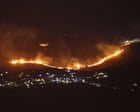
Ash does not fall like snow. Snow descends with a quiet, polite surrender, coating the world in a soft, white hush. Ash arrives heavy and oily, smelling of scorched pine resin and forgotten lives, clinging to the skin like a greasy ghost.
Stand on a hill in southern Lebanon when the wind shifts from the west. Look down at the valleys where ancient olive groves have stood for generations, their gnarled trunks older than modern borders, older than the disputes carved into maps. Now, look at the plumes. They do not rise from accidental sparks or the dry friction of an unforgiving summer. They crawl across the ridges in deliberate, creeping lines of white smoke that darken to bruised purple before dissolving into the Mediterranean blue. Meanwhile, you can explore other stories here: The Anatomy of Presidential Deception Protocols During High Threat Exit Operations.
Civil defense workers in towns like Bint Jbeil and Tyre know the routine by heart. They do not talk about geopolitical strategy over their lukewarm tea. They talk about water pressure. They talk about the distance to the nearest well, and whether the dirt tracks leading up the hillside have been cratered by artillery fire today.
According to local firefighters and environmental monitors, these are not the collateral damage of conventional combat. They are calculated burns. To explore the complete picture, check out the excellent report by The Guardian.
Consider what happens when an agricultural livelihood is reduced to charcoal. An olive tree is not merely a plant. It is a slow investment, taking decades to reach full yield, passed down from father to daughter, serving as the literal economic anchor of a village. When those trees burn, the income vanishes instantly. But the psychological toll runs deeper. The scorched earth policy strips the land of its cover, altering the microclimate, turning fertile hillsides into barren dust bowls where nothing can hide and nothing can grow.
To understand why this is happening, you have to look beneath the surface of the tactical maps. Modern warfare rarely confines itself to concrete and steel. It targets the very capacity of a region to sustain human habitation. Fire is an ancient weapon, brutal in its simplicity. It requires no sophisticated guidance system. It feeds on neglect, dry brush, and the summer heat.
Local civil defense teams describe a recurring pattern. Shelling hits the periphery of a village. Dry brush catches. The winds push the flames toward the orchards. When firefighters attempt to deploy their trucks, they find themselves blocked by ongoing bombardment or restricted zones. The fire is left to gorge itself. By the time the smoke clears, hectares of agricultural land have vanished, leaving behind skeletal trunks pointing black fingers at the sky.
(Note: While military spokespersons often attribute these blazes to stray munitions or returning fire from opposing factions, environmental agencies and local municipal leaders point to the systemic timing and concentration of the fires as evidence of deliberate environmental degradation.)
The heat on the ground is oppressive. Imagine standing next to a wall of fire that stretches for a kilometer, the air shimmering so violently that the horizon bends. Your eyes sting. Your throat burns with the acrid taste of carbon. Now imagine trying to fight that wall with equipment that is decades old, patched together with wire and stubborn hope, knowing that a secondary strike could land at any moment.
This is the reality for the crews who refuse to abandon their towns. They are fighting not just an element, but an intention.
History is full of scorched earth tactics, from the salt-sown fields of antiquity to the defoliated jungles of the twentieth century. The goal is always the same: deny the adversary sustenance, cover, and a reason to return. But land remembers. Soil holds the chemistry of violence long after the guns fall silent. The heavy metals from munitions, the carbonized remains of centuries-old root systems, and the erosion that inevitably follows the destruction of root structures transform a landscape for generations.
When the rains finally come in the autumn, they will not bring relief. They will bring mudslides. Without the roots of the olive trees and native shrubbery to hold the hillsides together, the topsoil will wash away in torrents, choking streams and burying what little is left of the terraces.
The strategy is efficient, terrifyingly so. It attacks the future by erasing the past.
Yet, walk through a village the morning after a fire has been beaten back from the doorstep. Look past the blackened perimeter walls and the smell of soot. You will see a farmer standing among the smoking ruins of his orchard, touching the charred bark of a trunk that somehow still holds a pocket of green beneath the dead surface. He is not shouting. He is not packing his bags. He is clearing away the ash, looking for a sign of life in a landscape determined to give none.
The smoke still hangs low over the valley, but the roots remain underground, waiting for the dark to break.