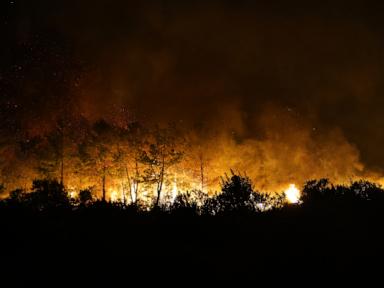
A ferocious wildfire erupted across Turkey's Mediterranean coastal province of Antalya, tearing through the Aksu and Kepez districts while forcing hundreds of residents from their homes. Fueled by intense seasonal winds and bone-dry brush, the fire jumped containment lines with terrifying speed, leaving emergency services scrambling to protect densely populated urban fringes. Power outages impacted thousands of properties, major regional transit arteries like the Antalya-Isparta highway faced strict closures, and emergency response teams raced against time to evacuate local animal shelters as thick ash blanketed the region.
Standard reporting frames these events as sudden acts of nature, isolated anomalies born entirely of summer heat. That narrative is dangerously incomplete. Anyone who has tracked Mediterranean basin meteorology for the past two decades recognizes a systemic shift in how these landscapes burn. The crisis in Antalya is not an unpredictable bolt from the blue. It is the predictable outcome of converging environmental pressures, aging infrastructure, and changing rural demographics that leave southern Turkey uniquely vulnerable to wind-driven infernos.
The Mechanics of a Mediterranean Blowup
Understanding why these fires escalate so violently requires looking at the interplay between topography and local wind patterns. Southern Turkey features steep, rugged terrain choked with dry pine forests and macchia scrub. When high-pressure systems push hot air down from the interior plateaus toward the coast, they create downslope winds that dry out vegetation on contact.
As wind speeds cross critical thresholds, fire behavior changes fundamentally. Flames stop relying solely on the slow crawl of ground fuel. Instead, high-velocity air carries burning embers hundreds of meters ahead of the main front, igniting spot fires that bypass traditional firebreaks entirely.
Consider a hypothetical scenario in a residential zone bordering a dry pine belt. A wind gust carrying glowing pine needles deposits them directly into dry suburban gutters or unmanaged brush behind a backyard fence. Within minutes, a single spot fire transforms into multiple structural ignitions, overwhelming ground crews who must divide their resources between forest perimeters and burning neighborhoods. This dynamic explains why municipal authorities in Antalya had to evacuate hundreds of homes and clear out animal shelters on short notice. Traditional defensive lines hold up against crawling ground fires, but they fail utterly against wind-driven ember storms.
Infrastructure Under Pressure
The operational burden on Turkey's General Directorate of Forestry and local municipal brigades is immense. Dispatching dozens of helicopters, fixed-wing air tankers, and hundreds of ground trucks requires logistics matching a military operation. Yet, hardware alone cannot solve a structural geographic crisis.
Rural depopulation plays a massive, underreported role in how these fires behave. For generations, traditional pastoralist communities grazed livestock and cleared underbrush in these forested hills, naturally suppressing the accumulation of dead biomass. As younger generations migrated to urban centers like Antalya, Istanbul, and Ankara, those rural management practices vanished. Forests grew denser, continuous, and choked with dry fuel. When an ignition occurs today, it feeds on decades of accumulated forest litter that has never seen a controlled burn or livestock clearance.
Furthermore, the expansion of suburban development into the wildland-urban interface creates a logistical nightmare for incident commanders. Protecting isolated homes scattered throughout forested ravines demands disproportionate firefighting resources. Every engine assigned to defend a poorly cleared hillside property is an engine pulled away from holding the main flank of the fire.
The Structural Reality Ahead
Southern Turkey faces a compounding crisis where extreme weather windows are lengthening annually. Spring rains arrive later, summer heatwaves linger deeper into autumn, and wind events become more erratic. Relying purely on reactive firefighting—deploying massive air armadas only after smoke appears on the horizon—is an expensive, unsustainable strategy.
Mitigating future disasters demands structural changes that rarely make headlines. It requires mandatory defensible space zoning around every rural and semi-urban structure, aggressive investments in localized water infrastructure, and a return to proactive prescribed burning during the cooler winter months to clear out excess underbrush. Until regional planning accounts for the brutal mathematics of wind and fuel loads, coastal provinces will continue to lurch from one evacuation emergency to the next.
The smoke over Antalya is clearing, but the systemic vulnerabilities remain entirely intact.
Inside the Antalya Wildfire Evacuations - Footage from the region captures the scale of the emergency as wind-driven flames threaten local communities and force mass evacuations.