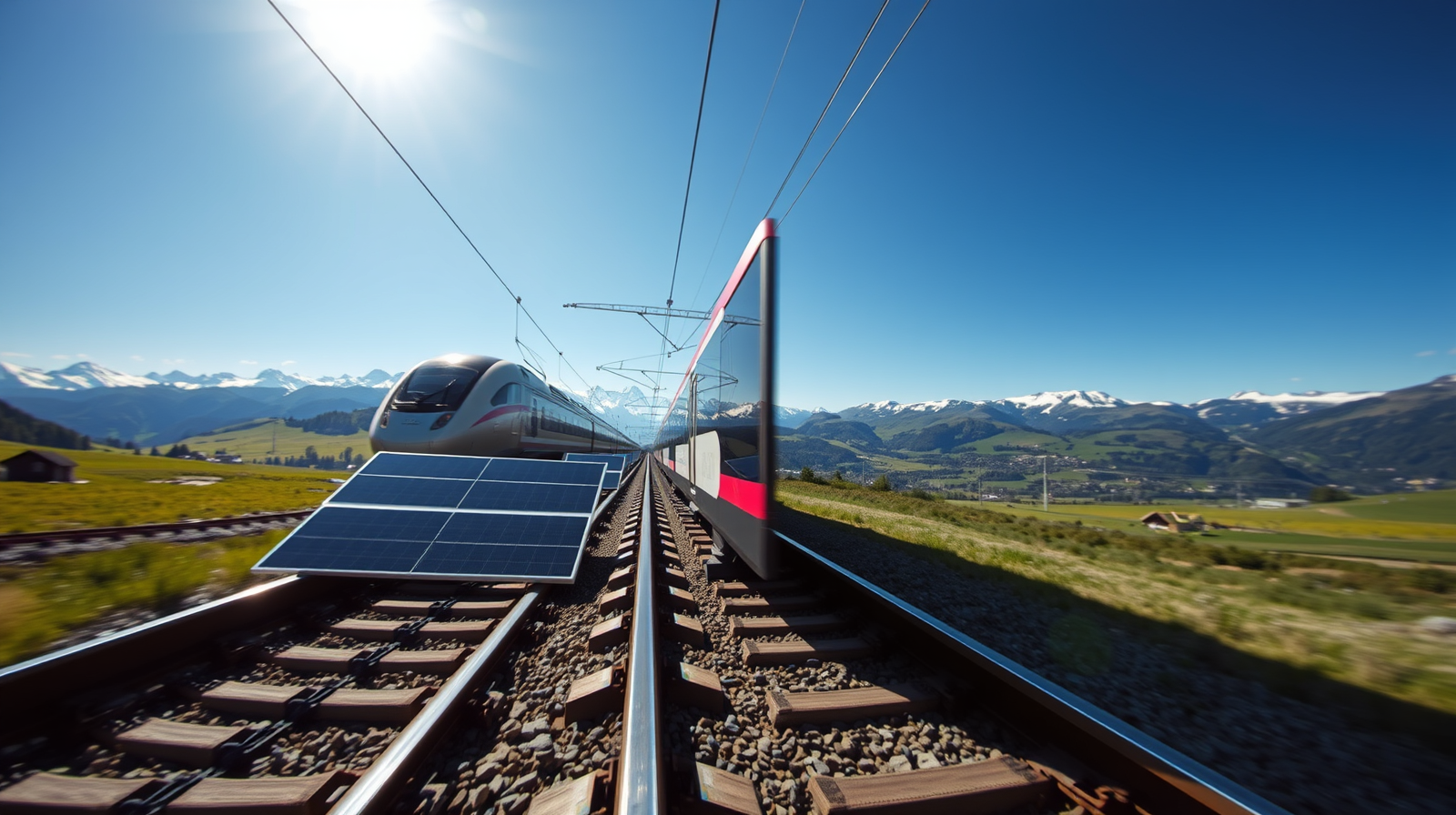
The Tracking of a Solar Experiment
Placing solar panels flat on the ground between active steel railroad tracks sounds like a recipe for expensive, shattered glass. Yet, a Swiss startup called Sun-Ways just finished a full year of doing exactly that in the village of Buttes. Over 11,000 trains barreled over a 100-meter stretch of track lined with 48 custom solar panels, and the system didn't break. It generated 16,000 kilowatt-hours of power.
Now, headlines claim Italy is next in line to transform its massive rail network into a sprawling solar plant. Sun-Ways signed an agreement with an unnamed Italian partner to pitch the concept to Rete Ferroviaria Italiana (RFI), the state-owned infrastructure giant.
It makes for great press. But if you look past the optimistic announcements, the gap between a 100-meter Swiss experiment and thousands of kilometers of Italian track is massive. The technology works in a controlled environment, but scaling it introduces serious engineering and bureaucratic hurdles that nobody has actually solved yet.
What Happened in the Swiss Test
The Sun-Ways design bypasses a major headache of industrial solar development: land acquisition. Building a standard solar farm requires buying up acreage, which often means fighting with agricultural communities or clearing natural habitats. Tracks are already there, sitting in the sun all day doing nothing but holding up trains.
The Swiss pilot used a 100-meter section of track to test the basic structural survival of these panels.
- The Design: The panels lie completely flat between the rails, anchored directly to the ties.
- The Maintenance Solution: Track maintenance crews regularly use massive machinery to grind rails and pack ballast. Sun-Ways partnered with rail maintenance company Scheuchzer to use a machine that can mechanically click down or remove up to 1,000 square meters of panels in a single day.
- The Output: The 18-kilowatt test rig fed 16,000 kWh into the local grid over 12 months. That is roughly what three or four Swiss homes use in a year.
The International Union of Railways originally worried that passing trains would cause micro-cracks from violent vibrations, or that glare would blind train drivers. After a year, the anti-reflection coating worked, and no structural failures occurred.
Why Italy is an Entirely Different Beast
The Swiss network is pristine, heavily funded, and compact. Italy has over 16,000 kilometers of active railway lines, stretching from the snowy Alps down to the scorching coast of Sicily. On paper, Italy has much better solar irradiance than Switzerland, making it an obvious target for expansion.
But look at the actual paperwork signed for the Italian expansion. Sun-Ways didn't sign a contract with RFI. They signed a deal with a local intermediary who is trying to get a meeting with RFI. No specific track has been chosen, no budget is allocated, and the Italian rail regulator hasn't even looked at the safety data yet.
The physical geography of Italian rail creates immediate problems. The network includes thousands of tunnels and viaducts where sunlight never hits the tracks. More importantly, laying panels perfectly flat means an automatic 10% drop in energy yield compared to angled rooftop systems. In Southern Italy, where dust, dirt, and industrial soot are common, flat panels will collect grime incredibly fast. While Sun-Ways suggests mounting brushes to the bottom of regular trains to clean them, implementing that across a complex, multi-operator network like Italy's is an administrative nightmare.
The Engineering Blindspots Nobody is Talking About
The big issue isn't the glass breaking; it is the electricity itself.
Right now, the Swiss pilot feeds its tiny power output straight into a low-voltage local grid. It is basically acting like a small residential rooftop system. If you scale this up to a few kilometers of track, you suddenly have a medium-sized power plant spread out over a long, skinny line.
The current technology cannot easily convert that distributed power into high-voltage electricity for efficient long-distance transmission. You either need to build expensive sub-stations every few hundred meters along the tracks, or you need to feed the power directly into the train's overhead traction lines. Feeding power directly to the trains is the ultimate goal, but railway power grids operate on highly specific frequencies and safety tolerances. You can't just wire a fluctuating solar array directly into a system powering a 300 km/h Frecciarossa high-speed train without risking major electrical disruptions.
Domestic competitors like Italy's Greenrail have spent years working on integrating solar directly into the concrete ties themselves. That approach didn't take off widely because those panels aren't easily removable, making track maintenance impossible. Sun-Ways solved the removability issue, but they haven't solved the high-voltage transmission problem.
The Immediate Reality Check
If Italy actually moves forward with a pilot program, don't expect to see solar panels on the high-speed line between Milan and Rome. It would likely start on a low-traffic, regional route where a technical glitch won't paralyze national transit.
If you want to track the actual viability of this technology, watch these specific markers over the next 12 to 18 months:
- The French Connection: France's national rail operator, SNCF, signed a direct cooperation agreement with Sun-Ways earlier this year. Because SNCF has direct control over its testing environments, France will likely build a medium-scale pilot line before Italy clears its bureaucratic hurdles.
- The 500-Meter Barrier: Watch if Sun-Ways can successfully operate a continuous installation longer than 500 meters. That is the current technical limit for their electrical architecture.
- Regulatory Sandboxes: Keep an eye on whether European transit authorities grant special regulatory exemptions for infrastructure testing. Without a fast-track approval process, getting safety certifications for track-mounted electronics can take up to three years per country.
Solar rail is an incredibly clever way to utilize dead space, but it remains a boutique engineering project. The Swiss test proved the panels can survive the weight of a train, but proving they can power a country's infrastructure is still miles away.