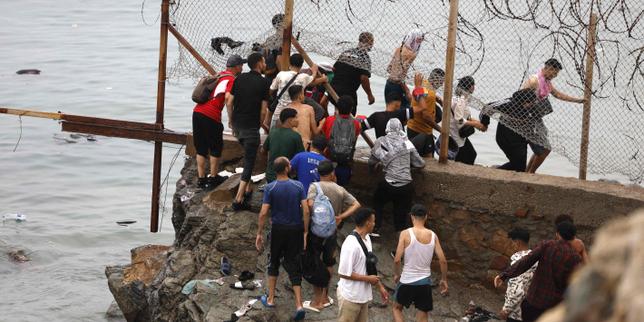
Borders leak. Stories blur. Security forces point fingers at each other while migrants pay the absolute highest price for political theater.
If you have been following the tense geopolitical dance between Spain and Morocco, you know that keeping the peace at the border is basically impossible. But a leaked Spanish police report regarding events in Ceuta just blew the lid off the official narrative. It raises deeply uncomfortable questions about the real role Moroccan law enforcement played during a massive crossing.
Let's look past the diplomatic spin. We need to talk about what actually happened, why this specific report matters, and what it signals for future border security in the region.
The Ceuta Flashpoint That Broke the Rules
Ceuta isn't just a border town. It is a European Union enclave sitting right on the northern coast of Africa, sharing a heavily fortified perimeter with Morocco. Thousands try to breach these fences every year. Most fail. Some make it.
The incident detailed in the Spanish police report wasn't your average Tuesday morning skirmish. It involved a coordinated rush that overwhelmed traditional containment protocols. When you read through the operational logs, a stark discrepancy emerges between public diplomatic handshakes and boots-on-the-ground reality.
Spanish authorities on the ground noted unusual passivity from Moroccan counterparts. That is the polite way of saying the Moroccan forces stood back and watched.
Why does this matter? Because regional cooperation relies entirely on mutual trust. Spain pays massive subsidies and provides equipment to help Morocco police its side of the perimeter. If Moroccan forces decide to look the other way, Spanish guards get overwhelmed instantly.
Reading Between the Lines of the Police Dossier
Police reports are dry documents. They love timestamps, GPS coordinates, and tactical jargon. Yet, reading this specific dossier feels like watching a slow-motion car crash.
According to the leaked file, Spanish surveillance units tracked large groups gathering near the border hours before the main push. They alerted Moroccan posts immediately. Standard procedure dictates a rapid deployment to disperse the crowds before they reach the double fence.
Instead, deployment was sluggish. Sometimes non-existent.
Officers on duty wrote that Moroccan personnel appeared to receive orders to hold back. That is not a minor operational hiccup. That is a strategic choice.
When you use migration as a political pressure valve, borders turn into accordions. They expand and contract based on whatever diplomatic dispute is happening in Madrid or Rabat at that exact moment. You cannot look at the Ceuta border events in a vacuum. Bilateral relations between Spain and Morocco have always been volatile, swinging wildly between counter-terrorism partnerships and sudden diplomatic freezes.
What Most People Get Wrong About Border Control
People assume borders are managed by strict mathematics. More guards plus more concrete equals fewer crossings.
That is completely false.
Borders are messy human systems driven by political will. If the political will on one side evaporates, the fence becomes nothing more than expensive scrap metal.
We saw this playbook before during previous diplomatic standoffs. When tensions flare over disputed territories or fishing rights, border enforcement mysteriously softens. The police report on Ceuta highlights this exact vulnerability. Spain relies heavily on an external actor to do its dirty work, which means Madrid is essentially holding a tiger by the tail.
If Morocco wants to signal displeasure to the European Union, letting a few hundred young men run toward the Ceuta fence sends a very loud message without firing a single shot.
The Human Toll Behind the Bureaucracy
Let us not lose sight of the people caught in the gears of this machine.
Migrants attempting to scale the Ceuta fences face razor wire, tear gas, and brutal falls. Many sustain permanent injuries. They are young, desperate, and heavily marketed to by human smuggling networks that promise easy entry into Europe.
When border guards play a game of geopolitical chess, human lives become pawns. The Spanish police report details injuries on both sides of the fence, but it barely captures the sheer desperation driving people to throw themselves against industrial barriers.
Organizations tracking Mediterranean migration routes note that whenever diplomatic channels freeze, crossing attempts spike. It is a direct correlation. You can track foreign policy press releases just by looking at hospital admissions in border enclaves.
Where This Leaves Us Now
Governments will issue boilerplate denials. Foreign ministries will release joint statements about shared values and strong strategic partnerships. Nobody wants a full-blown diplomatic crisis over a leaked document.
Trust is broken, though. You cannot un-read a police report that details systemic inaction during a security breach.
For Spain, the takeaway is brutal. Outsourcing border enforcement to an authoritarian neighbor means you never truly control your own perimeter. You are renting your security month-to-month.
Keep a close eye on upcoming bilateral funding packages and EU migration aid disbursements. Watch how fast Moroccan border patrols suddenly become hyper-vigilant the moment those checks clear. That will tell you everything you need to know about how much this police report actually changed the game behind closed doors.

