Every productivity guru, corporate efficiency consultant, and Silicon Valley pitch deck tells you the same predictable lie: time must be monetized, optimized, or at least turned into an asset that scales. If you are not hustling toward a passive income stream, a Series A funding round, or a personal brand milestone, you are allegedly wasting your finite existence.
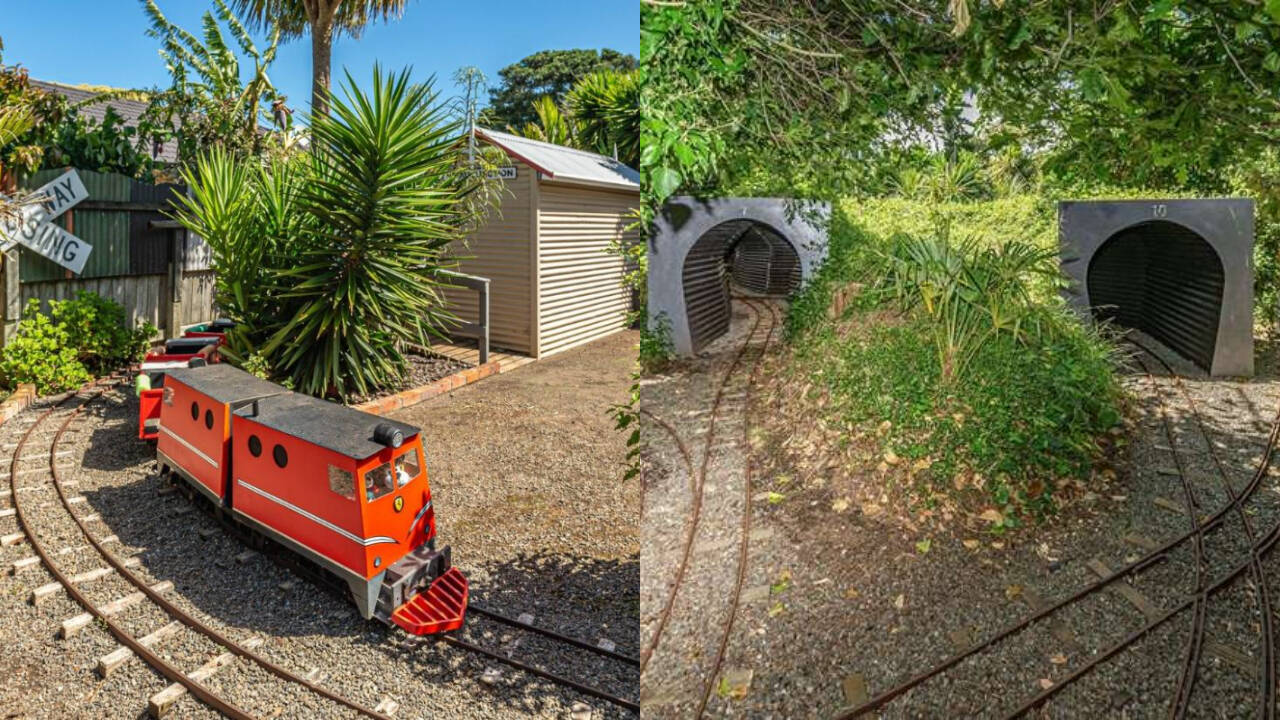
Enter a retired New Zealand man named Ian Richardson who spent eleven years laying down a 370-metre miniature railway around his suburban Whanganui home.
The mainstream news coverage treated this feat like a whimsical local interest story—a quirky grandpa keeping busy with a glorified toy train. They looked at a man spending more than a decade welding tracks, carving gradients, and engineering miniature locomotives through his cabbage trees and flower beds, and they smiled condescendingly. They called it a hobby. They called it a charming distraction from the real world.
They missed the point entirely.
This project was not a hobby. It was a profound act of systemic defiance. In an era dominated by hyper-accelerated digital burnout, algorithmic dopamine loops, and subscription-model consumption, building a physical railroad in your dirt for eleven years is the most radical counter-cultural statement a human being can make.
The Cult of Scalability is a Trap
We have been brainwashed into believing that an endeavor is only valid if it scales. If your project cannot reach millions of users, generate recurring revenue, or be packaged into a downloadable course, you are told to pivot.
Look at modern software development or content creation. Everything is designed to be frictionless, weightless, and infinitely reproducible. We live in a digital cloud where nothing can be touched, nothing resists us, and therefore, nothing truly matters. You can delete a million lines of code with a keystroke. You can archive an entire digital portfolio in a second.
When you spend eleven years bending physical steel, mixing concrete by hand, and calculating drainage gradients so a miniature steam locomotive does not derail during a winter downpour, you are anchoring yourself to reality. You are dealing with friction, gravity, and material resistance.
I have watched founders blow millions of dollars scaling useless software solutions that solved problems nobody actually had, all because the venture capital ecosystem demanded hyper-growth. Meanwhile, a man in New Zealand built a self-sustaining engineering marvel in his backyard that required zero server maintenance, zero venture capital, and zero user acquisition funnels.
The lazy consensus says that productivity equals speed. The reality is that true mastery requires deep, unhurried friction.
The Economics of Absolute Uselessness
Let us talk about utility. Modern consumer culture evaluates everything through the narrow lens of immediate ROI. Does it save time? Does it increase efficiency? Does it provide instant entertainment?
By these metrics, a 370-metre backyard railway is a catastrophic financial and temporal failure. The steel costs alone could have bought a nice used car. The hours invested could have been turned into thousands of freelance billable units.
And that is precisely why it is brilliant.
Economists call things that have no external market value "inefficient." I call them sanctuaries. The moment you tie your creative output to external financial validation, you surrender ownership of your mind. You start writing for the algorithm. You start building products for the focus group. You start living a life curated by the approval of strangers.
When you commit to a project that nobody asked for, that nobody will pay to see, and that serves no corporate master, you reclaim your agency.
Imagine a scenario where every knowledge worker on earth spent one hour a day building something physical, stubborn, and entirely useless to the market economy. The entire attention-economy bubble would pop overnight. People would stop scrolling through algorithmic feeds because they would finally remember the visceral satisfaction of making something real with their own hands.
The Mechanics of Obsession
Let us examine what actually goes into eleven years of backyard engineering. Critics assume it is just playing with toys. They do not understand the physics of scale.
When you shrink a railway down to miniature proportions, you cannot just scale down the engineering. Physics does not work that way. Weight ratios change. Momentum behaves differently on a 1:8 scale track than it does on standard gauge rail. A slight miscalculation in the banking of a curve means a locomotive flying off the ballast at three miles per hour, destroying months of masonry work.
Richardson had to master track geometry, electrical wiring, ballast compaction, and landscape drainage. He did not watch a three-minute YouTube tutorial to fix these problems. He failed, he redesigned, he rebuilt, and he waited for mortar to cure.
We have engineered discomfort out of modern life. If an app takes three seconds to load, we twitch. If a piece of furniture requires more than four Allen-wrench turns, we write angry reviews. We have traded competence for convenience.
When you eliminate friction from life, you also eliminate resilience. A generation raised on instant digital gratification breaks down the moment a project takes longer than a quarter to yield results.
The Myth of Work-Life Balance
Corporate wellness culture loves to talk about work-life balance as if life is a pie chart where you neatly divide your hours between logging billable data and doing yoga.
This is a sanitised corporate lie designed to keep you functioning efficiently within the machine. True fulfillment does not come from balance; it comes from deep, irrational immersion.
Nobody on their deathbed ever looked back and said, "I am so glad I optimized my Jira backlog and maintained a pristine email inbox." They remember the things that consumed them entirely—the gardens they planted, the books they wrote, the stubborn, irrational projects they built against the advice of everyone around them.
Eleven years is a long time. Governments rise and fall. Tech stacks become obsolete three times over. Trends mutate and die within a single news cycle. But steel tracks embedded in concrete endure.
Why You Are Afraid to Build Your Own Track
The reason this story triggers defensive cynicism in so many people is that it holds up an uncomfortable mirror to their own lives.
You look at a man who spent a decade laying track in Whanganui, and a quiet voice in your head asks: What have I built that will still be standing in eleven years?
If the answer is a hundred thousand Slack messages, a stack of quarterly reports, and a higher net worth tied up in index funds you never touch, that stings.
We mock the eccentric hobbyist because his dedication exposes the hollow transactional nature of our own daily routines. We want to believe that our frantic pursuit of career advancement is the only sensible path, because the alternative—dedicating a decade to something purely for the love of the craft—requires a level of courage most people are too terrified to muster.
Stop looking for shortcuts. Stop trying to scale every aspect of your existence. Find something difficult, stubborn, and completely impractical, and spend the next decade mastering it.
The train is already leaving the station. You can either keep scrolling, or you can pick up a shovel.