Thousands of feet above the earth, the sky is supposed to be vast. Empty. A silent ocean of blue where nothing exists except the hum of engines and the steady push of air against metal.
Ask any pilot. They will tell you that the horizon is a place of profound solitude. Until it isn't. You might also find this connected article insightful: The Anatomy of Political Exile: Risk Modeling the Return of Sheikh Hasina.
Picture a commercial airliner cutting through the upper atmosphere. Inside, the cabin is a capsule of quiet routine. Overhead compartments are clicked shut. Coffee cups sit in holders. Passengers lean against window frames, watching wisps of cloud drift past, completely unaware of the precise geometry of their journey. They are moving at hundreds of miles per hour, suspended in a delicate trust between engineering, physics, and air traffic control.
Now, introduce a variable. As discussed in latest reports by Associated Press, the effects are notable.
A sudden, sharp banking maneuver. A jolt that rattles the coffee in its cup. In the cockpit, warning lights flash with frantic urgency. The collision avoidance system screams a single, terrifying word.
Traffic.
The Weight of Proximity
In aviation, safety is measured in margins. We talk about altitude, separation standards, and flight paths as if they are abstract lines drawn on a chalkboard. But they are real. They are physical buffers standing between thousands of lives and catastrophic impact.
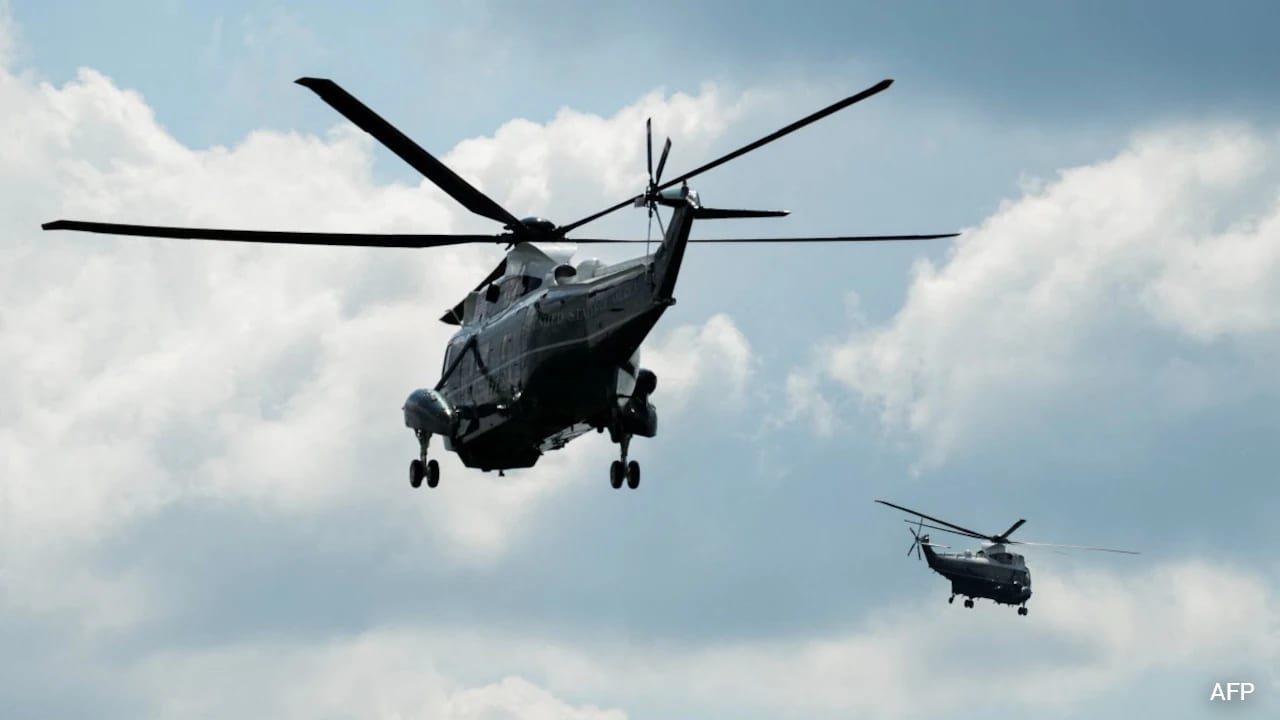
When a helicopter carrying President Donald Trump came dangerously close to a commercial passenger plane, the immediate headlines focused on the political figures involved. Probe launched. Investigation underway. Standard bureaucratic language designed to turn a heartbeat of sheer terror into a morning news bulletin.
[Image of helicopter in flight]
Strip away the politics. Look only at the physics.
Consider what happens when two massive objects occupy the same invisible corridor of air. A commercial jetliner is not a sports car; it cannot swerve on a whim. It moves with immense inertia. A helicopter, agile and low-flying, operates under an entirely different set of rules, navigating the crowded airspace where civil aviation intersects with high-profile transport.
When their paths intersect unexpectedly, the buffer vanishes.
The Invisible Architecture of the Sky
Most people assume the sky is a free-for-all, with pilots simply steering around one another like drivers on an open highway. The reality is far more rigid, yet shockingly fragile.
Airspace is divided into sectors, corridors, and altitudes, monitored by human eyes staring at glowing screens and automated safety nets designed to catch human error before it becomes fatal. Every departure, every ascent, every vector change is choreographed.
When that choreography breaks down, the margin for survival shrinks to seconds.
Think about the air traffic controllers. Men and women sitting in dimly lit rooms, listening to the constant chatter of radio frequencies, tracking dots on a radar scope. For them, a near-miss is not a political talking point. It is a failure of the system, a terrifying reminder that the invisible walls keeping aircraft apart can sometimes crack.
In the case of the Trump helicopter incident, reports highlighted a breakdown in separation. But numbers and transcripts do not capture the sensation of looking out a cockpit window and seeing another aircraft where the empty sky ought to be. They do not capture the sudden drop in the stomach, the instant spike of adrenaline, or the split-second decisions made by flight crews whose training is the only thing standing between order and chaos.
The Echo After the Silence
The probe was launched. Reports were filed. Investigators will analyze radar data, listen to audio recordings of radio transmissions, and measure distances in feet and seconds.
Yet, the questions left behind linger much longer than the investigation will.
How close is too close? In an era where our skies grow increasingly crowded with commercial flights, private charters, and specialized aircraft, the margins are tightening. Every near-miss is a warning shot fired by probability. It tells us that the systems we rely on are only as strong as their weakest link, and that human error remains an unyielding constant in a technological world.
The plane landed safely. The passengers walked out into the terminal, retrieved their luggage, and drove home to their families, most of them entirely oblivious to how close they had come to the edge.
Somewhere up above, the sky remains wide, blue, and deceptively empty.
And the next flight is already taking off.