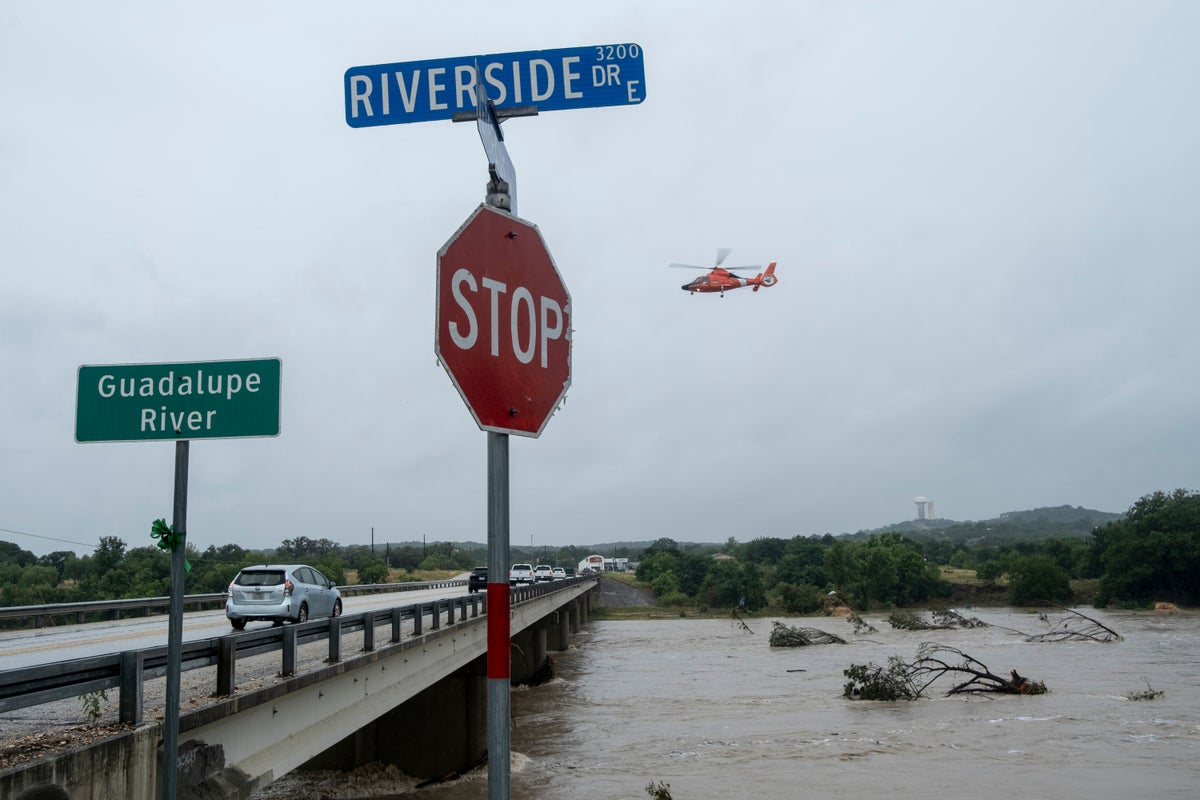
Every time a heavy storm system stalls over Southeast Texas, the media runs the exact same script.
We see dramatic helicopter footage of brown water swallowing suburban cul-de-sacs. We see heroic first responders navigating yellow inflatable boats down streets that look like rivers. We hear local officials lamenting another "unprecedented" weather event, shaking their heads at the sky as if Zeus himself personally targeted their county.
It is a comfortable narrative. It frames these events as tragic acts of God. It suggests that nothing could have been done, and that the only logical response is to rebuild, pray for dry weather, and wait for the next federal disaster declaration check to clear.
It is also a lie.
The devastating floods that routinely submerge parts of Texas are not natural disasters. They are engineering, financial, and political choices. We are not victims of the weather; we are victims of a lucrative, tax-subsidized real estate machine that builds houses where water belongs and then asks the American taxpayer to foot the bill when the drywall gets wet.
Let us stop pretending this is a surprise. Let us look at the actual mechanics of why Texas floods, and why the current strategy of building, flooding, and rebuilding is a form of municipal madness.
The Broken Math of the Hundred Year Flood
The most dangerous phrase in modern real estate is "the 100-year flood."
Ask the average homebuyer what that means, and they will tell you it represents a flood that happens once every century. They buy a home in a "100-year floodplain" assuming they are safe because the area flooded five years ago, meaning they have 95 years of dry safety left.
This is a catastrophic misunderstanding of basic probability.
A 100-year flood is not a calendar event. It is a statistical boundary. It means an event has a 1% chance of occurring in any given year.
To make matters worse, those 1% probabilities are calculated using historical weather data that is decades out of date. In Texas, rainfall frequency values were calculated back when Eisenhower was in office. The National Oceanic and Atmospheric Administration (NOAA) updated these values with Atlas 14, which revealed that what we used to call a "100-year storm" is actually a "25-year storm" in many parts of Texas.
| Old Terminology | Actual Annual Probability | Reality on the Ground |
|---|---|---|
| 100-Year Storm | 1% chance per year | Happens multiple times a decade |
| 500-Year Storm | 0.2% chance per year | The new baseline for major tropical systems |
| Out of Floodplain | "Safe" zone | Saturated by local street runoff within hours |
When you buy a house with a 30-year mortgage in a designated 1% annual chance floodplain, your compound mathematical probability of getting flooded during that mortgage is not 1%. It is roughly 26%.
Would you board an airplane if you had a 26% chance of crashing? You would not. Yet millions of Texans sleep under roofs with those exact odds, comforted by outdated federal maps and reassuring real estate agents.
The Great Concrete Lie
We are told that Texas floods because of flat topography and clay soils.
This is half true. The Gulf Coast of Texas is undeniably flat, and its native soils—specifically clays like Houston Black—behave like concrete once they are saturated. They do not absorb water; they shed it.
But nature engineered a solution for this: native coastal prairies. Deep-rooted prairie grasses act like giant sponges, holding millions of gallons of water in place and slowing its journey toward the bayous.
Then came the developers.
I have sat in zoning meetings where developers claimed that replacing five hundred acres of native prairie with concrete, asphalt, and strip malls would have "zero net impact" on regional drainage. They point to their engineered detention basins as proof.
This is a mathematical illusion.
A standard detention basin is designed to capture runoff from a specific property and release it slowly into a nearby channel. But these calculations assume a static environment. They do not account for the cumulative effect of five hundred other developments doing the exact same thing simultaneously.
When every developer dumps their "slowly released" water into the same bayou at the same time, the bayou backs up. The water has nowhere to go. It backs up through the storm drains, pushes up through the manhole covers, and flows straight into living rooms.
We have paved over the natural sponge and replaced it with a funnel. Then we act astonished when the funnel overflows.
The Federal Flood Insurance Ponzi Scheme
The true villain in this story is not the developer. It is the federal government.
Under normal market conditions, private insurance companies would refuse to write policies for homes built in low-lying swamps. Or, they would charge premiums so astronomical that no one could afford to buy the home. This is how the free market regulates risk. If it is too dangerous to build there, the cost of insurance makes it unprofitable to do so.
But in 1968, the federal government created the National Flood Insurance Program (NFIP).
The NFIP was designed with good intentions, but it has morphed into a massive, taxpayer-funded subsidy for high-risk behavior. By capping premiums and offering government-backed guarantees, the NFIP artificially lowers the cost of living in harm’s way.
Consider the phenomenon of "severe repetitive loss properties." These are homes that have flooded multiple times, received massive insurance payouts, and been rebuilt in the exact same spot.
A single home in Houston valued at $115,000 flooded 16 times in 18 years, receiving more than $800,000 in federal flood insurance payments.
This is not insurance. This is a recurring construction subsidy funded by taxpayers in Ohio, Idaho, and Nebraska who will never set foot in Texas.
By removing the financial penalty of living in a floodplain, the government has incentivized people to stay in harm's way. We have socialized the risk and privatized the profit. Developers make their margins, cities collect their property taxes from new subdivisions, and when the inevitable storm hits, the federal government writes the check.
The Illusion of Infrastructure
Whenever a city floods, the immediate cry from the public is for bigger infrastructure. Build bigger reservoirs. Dig wider bayous. Install massive pump stations.
This is a trap.
You cannot engineer your way out of a hydrologic deficit this large. The Army Corps of Engineers has built some of the most sophisticated flood control structures in the world in Texas, including the Addicks and Barker reservoirs. During Hurricane Harvey, these reservoirs filled so quickly that officials had to make a horrific choice: let the dams fail catastrophically, or conduct controlled releases that flooded thousands of homes downstream that had never flooded before.
We have reached the physical limits of concrete engineering.
Every time we widen a bayou, we simply speed up the delivery of floodwater to the neighborhood downstream. We are not solving the problem; we are just moving it. We are shifting the water from wealthy master-planned communities to older, lower-income neighborhoods that lack the political capital to demand massive concrete bypass channels.
How to Actually Fix the Problem
If we want to stop rescuing families from rooftops, we must stop pretending that our current approach is sustainable. We need to implement three immediate, painful, and highly unpopular policy shifts.
1. End the Rebuild Subsidy
If a property insured by the NFIP floods twice, the owner should face a hard choice: accept a government buyout at fair market value before the flood, or lose their eligibility for federal flood insurance permanently. We must stop paying people to live in rivers.
2. Ban Slab-on-Grade Construction in Low-Lying Counties
Building a home on a flat concrete slab directly on the ground in a subtropical coastal plain is architectural malpractice. Every new home built in high-risk zones should be elevated on piers, allowing water to flow underneath the structure without ruining the living space.
3. Implement Strict Impervious Cover Fees
If you pave over land, you are creating a public nuisance by forcing your runoff onto your neighbors. Every commercial and residential property should be taxed based on its square footage of impervious cover (roofs, driveways, parking lots). Use those funds exclusively to buy back flood-prone land and restore it to native prairie.
The Brutal Truth
The next time you see a news anchor standing in thigh-deep water in a Texas subdivision, do not feel bad for the "unforeseen" circumstances. Feel bad for the families who were lied to by outdated maps, sold out by local planning commissions, and trapped in a cycle of flood-and-rebuild by a broken federal insurance program.
The water is not invading our communities. We invaded the water's home, and the water is simply trying to reclaim its property. It is time we let it.