The internet loves a good festival fail.
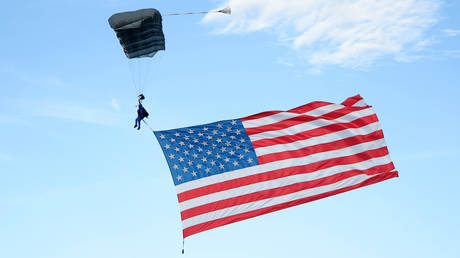
A skydiver trailing a massive American flag misses the drop zone, shears through a structural support, and plummets headfirst into a crowded beer pavilion. The video goes viral. The comment sections light up with cheap jokes about drunk spectators and sudden gusts of wind. The local news runs a boilerplate segment on "freak weather anomalies" and "miraculous escapes."
It is a comfortable narrative. It treats the incident as an act of God—a sudden, unpredictable twist of fate that no amount of preparation could have prevented.
It is also complete nonsense.
As someone who has spent two decades analyzing aviation mishaps and structural rigging, I can tell you that the "freak accident" defense is the biggest lie in event entertainment. When a professional canopy pilot crashes into a concession stand, it is almost never a sudden act of nature. It is a predictable failure of physics, ego, and event management.
We need to stop treating these public stunts as harmless half-time shows and start recognizing them for what they actually are: high-risk aviation maneuvers executed inside poorly designed obstacle courses.
The Myth of the Freak Gust
Every time a canopy pilot misses a target, the immediate excuse is wind shear.
Let's dismantle that right now. Professional exhibition skydivers are not rookies jumping out of a Cessna 172 for a bachelor party. They hold specialized licenses, often racking up thousands of jumps. They know how to read a wind sock. They know how to calculate drift.
When a highly experienced jumper collides with a temporary structure, the root cause is rarely the weather. It is aerodynamic drag amplification.
Look closely at the footage the media loves to loop. The jumper isn't just carrying himself; he is towing a massive, heavy, lead-weighted nylon flag.
$$\text{Drag} = \frac{1}{2} \rho v^2 C_d A$$
When you add a giant piece of fabric to a jumper's kit, you exponentially increase the surface area ($A$) and alter the drag coefficient ($C_d$). This fundamentally degrades the canopy's glide ratio. The flag acts as a massive aerodynamic anchor, drastically restricting the pilot's ability to execute deep brakes or radical flat turns in the final fifty feet of flight.
The competitor articles focus on the spectacle of the crash. They miss the mechanical reality: the jumper didn't get hit by a sudden gust; they ran out of altitude and airspeed because they underestimated the parasitic drag of their own stunt props. They flew a compromised wing into a confined space.
The Illusion of the Safe Drop Zone
Event organizers love to brag about their safety protocols. They point to a 50-by-50-foot patch of grass in the middle of a festival ground and call it a designated landing area.
In the aviation world, that is not a landing zone. That is a trap.
Municipal festival layouts are designed by vendors and crowd-control specialists, not aviation experts. They place high-profile attractions—like massive beer tents, sound stages, and audio towers—directly adjacent to the open spaces to maximize foot traffic.
This creates a deadly phenomenon known as mechanical turbulence.
When ambient wind hits a large, flat-walled structure like a commercial beer tent, it doesn't just pass over it smoothly. It creates a vortex shedding effect on the leeward side. A jumper descending into an infield isn't dropping through clean air; they are entering a chaotic micro-environment filled with invisible rotors and downdrafts created by the very structures they are trying to avoid.
If you place a beer tent fifty feet from the target, you have effectively contaminated the airspace. The jumper isn't failing because they lack skill; they are failing because the venue layout turned a standard landing into a fluid dynamics nightmare.
The E-E-A-T Reality: The Cost of the Spectacle
I have consulted on large-scale outdoor events where organizers wanted to drop skydivers into stadium parking lots surrounded by light poles and power lines. When you tell them the margin for error is razor-thin, they don't look at the physics—they look at the ticket sales. Stunts sell wristbands.
But let's be transparent about the counter-argument here. The contrarian take demands absolute honesty: completely eliminating these risks means killing the spectacle entirely.
If you increase the safety margins to commercial aviation standards, you have to push the landing zones miles away from the crowd. The audience loses the thrill of seeing a jumper land on the fifty-yard line. The sponsors lose their photo op. That is the trade-off.
But if venues are going to keep selling the thrill of close-proximity landings, they must accept the liability that comes with it.
How to Actually Fix the Festival Drop Zone
Stop asking if the jumper is certified. Start asking how the venue is zoned. If you are an event producer, a city planner, or a safety inspector, stop relying on the "lazy consensus" of standard festival insurance waivers. Implement these design mandates instead:
- Enforce Zero-Structure Buffer Zones: No temporary structures, tents, or towers within a 3:1 ratio of the height of the tallest surrounding obstacle relative to the landing target.
- Mandatory Aerodynamic Audits: Any jumper carrying a flag exceeding standard dimensions must perform a verified drop test at an airport drop zone under identical payload weights before entering a public venue.
- Acknowledge the Downwind Rotor: If the wind is blowing directly against a major structure toward the landing zone, the jump must be scratched immediately—regardless of what the baseline wind speed meter says at ground level.
The viral videos will keep happening as long as we treat aviation stunts like carnival acts. The wind didn't crash that party. Bad physics and poor space planning did. Fix the layout, or stop the show.