Panic makes bad policy.
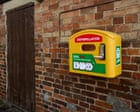
Every few months, a headline screams that millions of lives are at risk because a rural village, a high street, or a community hall lacks an Automated External Defibrillator (AED). Activists demand a device on every street corner. Politicians nod sagely, pass funding measures, and cut ribbons next to shiny yellow boxes mounted on brick walls.
It feels good. It feels proactive. And it is completely missing the point.
Blanketing England and Wales with tens of thousands of unmaintained metal boxes isn't saving 16 million people. It is a costly distraction that gives the public a false sense of security while ignoring the actual bottlenecks in out-of-hospital cardiac arrest (OHCA) survival.
I’ve watched local councils and well-meaning charities blow thousands of pounds per unit on hardware that rots in silence. We are optimizing for photo opportunities instead of survival rates.
Here is the uncomfortable truth: buying more defibrillators without fixing CPR awareness, device registration, and battery maintenance is a colossal waste of resources.
The Myth of the Hardware Solution
The mainstream narrative is simple: more AEDs equals fewer deaths.
It is a comfortable lie because it suggests a complex medical emergency can be solved with a credit card purchase. But public access defibrillation operates on a brutal logistical curve.
A defibrillator is useful for precisely one thing: terminating a shockable rhythm—specifically Ventricular Fibrillation (VF) or Pulseless Ventricular Tachycardia (pVT)—within the first few minutes of collapse. If the heart is in asystole (a flatline) or Pulseless Electrical Activity (PEA), a defibrillator will do absolutely nothing. It will sit there, analyze the rhythm, and politely tell you to resume CPR.
Data from the Resuscitation Council UK and global cardiac arrest registries show that only a fraction of out-of-hospital cardiac arrests present with a shockable rhythm by the time a bystander actually attaches the pads. If the bystander spends six minutes hunting down a box mounted outside a closed community centre three streets away, the window of opportunity has already slammed shut.
Brain tissue dies within four minutes of oxygen deprivation. A chest compression given immediately keeps oxygenated blood moving to the brain. A defibrillator fetched eight minutes into a collapse without prior CPR is just an expensive prop for a corpse.
The Forgotten Variable: Chest Compressions
We have fetishized the machine and forgotten the mechanic.
If you collapse in public tomorrow, your survival depends almost entirely on one single factor: whether the person standing next to you starts hard, fast chest compressions within ten seconds.
CPR keeps the brain alive and preserves a shockable rhythm until advanced care arrives. Without high-quality CPR, the heart deteriorates into asystole rapidly. Once it flatlines, no amount of electricity will bring it back.
Yet, we spend millions marketing the AED while basic CPR training remains optional, spotty, and plagued by public fear. People are terrified of breaking ribs. They are terrified of getting sued—despite legal protections. They stand around waiting for a machine to arrive rather than putting their hands on the patient's chest and pumping.
Imagine a scenario where a city bans all AED purchases for five years and diverts every single pound into mandatory, high-intensity bystander CPR training in high schools, workplaces, and driving tests. The survival rate would jump. Not because machines aren't useful, but because chest compressions buy the time required for any medical intervention to matter.
The Invisible Cemetery of Dead Batteries
Here is the scandal no one talks about at the ribbon-cutting ceremonies: thousands of public AEDs across the UK are functional paperweights.
An AED is not a bench. You do not buy it once and walk away. It requires:
- Regular replacement of lithium batteries (every two to five years).
- Continuous replacement of gel pads, which dry out over time and lose conductivity.
- Routine software updates for updated resuscitation guidelines.
- Climate-controlled, heated cabinets to prevent freezing temperatures from destroying battery capacity in winter.
When a charity raises £1,500 to install an AED on a village wall, who pays for the £100 pad replacement three years later? Who checks the status indicator light every month?
In practice, often nobody.
Emergency services dispatch software needs to know where an AED is located, its accessibility hours, and whether it is functional. When an emergency call comes in, the operator can only direct a bystander to an AED if it is actively registered on databases like The Circuit (the national defibrillator network managed by the British Heart Foundation in partnership with NHS ambulance services).
Thousands of units sit unregistered. An unregistered AED does not exist to the ambulance service. It is an invisible icon on a brick wall while someone dies 200 yards away.
We are building a graveyard of dead batteries and expired gel, funded by community bake sales, while pretending we solved a public health crisis.
Strategic Placement Beats Blind Proliferation
"We need one on every street corner" is a slogan for people who do not understand spatial analytics.
Blanket coverage is an inefficient allocation of capital. Mounting an AED outside a closed pharmacy in a quiet suburb where the average age is 35 and people sleep eight hours a night yields virtually zero statistical return on investment.
Where do cardiac arrests actually happen?
Roughly 70% to 80% occur in private residences. Placing a public access defibrillator outside a bank on a commercial high street does nothing for the 72-year-old having an arrest in their living room three miles away at 2:00 AM.
If we insist on spending money on hardware, the deployment must be hyper-targeted:
- Transit hubs and high-density footfall zones: Train stations, airports, major sports venues.
- High-risk demographic clusters: Retirement communities, dialysis centers, elderly care facilities.
- First-responder networks: Equipping police vehicles, fire engines, and postal delivery vans—units that are already mobile and moving through neighborhoods 24/7.
Putting an AED in a police cruiser that is actively patrolling a grid means the device is moving toward the emergency at 40 miles per hour while the dispatcher is still taking the call. Mounting it on a static wall in a sleepy village square means someone has to run to it, remember the code, unlock it, and run back.
Physical mobility beats geographical saturation every single time.
The Counter-Argument: Isn't One Saved Life Worth It?
This is the emotional shield used to shut down any rational discussion about resource allocation. "If it saves just one life, it’s worth any cost."
It sounds compassionate. It is economically and ethically flawed.
Healthcare economics is fundamentally about the trade-off of finite resources. Every pound spent buying, installing, and maintaining an underutilized, unmaintained public AED is a pound not spent on paramedic staffing, public CPR education, or fast-response vehicle fleet maintenance.
If £2,000 spent on an AED has a 0.01% chance of being used in its five-year lifespan, but that same £2,000 spent on targeted CPR training for 200 community members yields three successful bystander interventions over the same period, continuing to prioritize the hardware is a policy failure.
We must stop treating public health like a consumer goods market where buying more gadgets equals better outcomes.
How to Actually Fix the Survival Rate
If we want to stop playing security theater and start saving people who suffer an out-of-hospital cardiac arrest, we have to flip the current priority stack on its head.
1. Mandate Practical CPR Training
Stop making CPR an opt-in luxury. Make practical, hands-on compression training a mandatory requirement for obtaining a driver's license, graduating secondary school, and renewing professional certifications. Remove the fear of litigation and the fear of doing it wrong. Emphasize one rule: Bad CPR is infinitely better than no CPR.
2. Fund Maintenance, Not Just Purchase
Pass strict statutory requirements that prohibit the installation of a public AED unless a designated custodian registers it on national databases and commits to a funded five-year maintenance contract. If you cannot afford to maintain the pads and batteries, you cannot afford the machine.
3. Mobile Dispatch Integration
Stop installing static boxes on walls that nobody can find in the dark. Focus funding on equipping every primary emergency service vehicle—including police cars and fire appliances—with tracked, fully maintained defibrillators integrated directly into dispatch systems.
4. Overhaul the Dispatch Process
Equip ambulance control rooms with video-assisted dispatch tools where operators can instantly view a bystander's smartphone camera, guide compression depth and rate in real time, and confirm if an AED is genuinely required before someone runs off to find one.
Stop applauding every time a new yellow box is screwed onto a wall. Demand real infrastructure, relentless CPR education, and rigorous device maintenance.
Hardware is easy to buy. Real capability takes work.