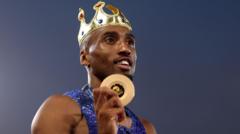
The media wants you to believe that running a fast circle in front of your childhood neighbors grants you some kind of mystical thermodynamic advantage. Every sports desk in the country ran identical copy celebrating Matthew Hudson-Smith storming to his third European 400m title at Alexander Stadium, painting it as a fairytale homecoming written in the stars.
It is lazy journalism. It substitutes emotional narrative for biomechanical reality. Learn more on a related subject: this related article.
Let us dismantle the romantic consensus. A track is a polyurethane loop laid over asphalt and concrete, measuring exactly four hundred meters inside the curb, whether it sits in Birmingham, Tokyo, or a desolate industrial park in Poland. The synthetic surface does not care about your postcode. The stopwatch does not weep tears of civic pride. When analysts attribute a championship performance to the comforting hum of a local crowd, they insult the years of grueling, solitary physiological torment required to split 44.17 seconds.
The Myth of the Home Track Advantage
We are fed a constant stream of psychological fluff about the power of the home crowd. Fans roar, adrenaline spikes, and the athlete supposedly transforms into something superhuman. Further journalism by NBC Sports highlights similar views on the subject.
Physiologically, adrenaline is a blunt instrument. In a sprint event lasting under forty-five seconds, an over-stimulated nervous system often leads to catastrophic pacing errors. Athletes blow up by the three-hundred-meter mark because the emotional noise of a home crowd causes them to mismanage their energy distribution.
Hudson-Smith succeeded not because he was running in Birmingham, but because he survived lane nine.
Running blind on the outside is a technical nightmare. You have zero visual cues from your primary competitors. You cannot gauge your splits against the field. You have to run a blind, pure-effort time trial against your own internal pacing clock.
"Every time someone beats me, I kind of end their career." — Matthew Hudson-Smith
That quote reveals the competitive ruthlessness required to win at an elite level, and it has nothing to do with being a hometown hero. It speaks to absolute psychological armor. The fans in the stands are background noise; the lane markers and splits are the only reality that matters.
The Brutal Physics of the Four Hundred Meters
To understand why treating this race as a cozy local celebration misses the point, look at the physical cost of the event itself. The four hundred meters is widely acknowledged by sports scientists as the single most punishing event in track and field.
It is a high-speed sprint executed entirely in a state of severe oxygen debt. By the final hundred meters, the accumulation of blood lactate and hydrogen ions shuts down muscle fiber recruitment. Your limbs turn to concrete. Your vision narrows.
At this stage, a cheering crowd cannot clear the lactic acid out of your hamstrings.
| Race Phase | Physiological State | Common Failure Mode |
|---|---|---|
| 0 - 100m | Acceleration & Drive | Wasting energy through excessive tension |
| 100 - 200m | Float & Maintenance | Dropping velocity too early |
| 200 - 300m | Maximum Aerobic Power | Hitting the wall prematurely |
| 300 - 400m | Severe Acidosis | Form collapse and deceleration |
When competitors like France's Muhammad Abdallah Kounta or the Netherlands' Jonas Phijffers closed the gap down the home straight, they were not fighting romantic destiny. They were fighting the same biochemical breakdown that Hudson-Smith was battling. The Briton held on because his stride mechanics degraded slower than theirs, a product of targeted eccentric hamstring training and elite aerobic capacity, not local geography.
Unconventional Training Takeaways
If you want to apply elite athletic principles to your own training, stop looking for external inspiration and start engineering your environment for data isolation.
- Eliminate Emotional Crutches: If you rely on external validation, hype songs, or a cheering crowd to hit your performance thresholds, you will fold the moment those variables disappear. Train in silence. Master the data of your own splits.
- Embrace Constraint-Led Practice: Just as Hudson-Smith had to conquer lane nine's isolation, you should intentionally practice under handicapped conditions. Train when you are tired, train without your favorite gear, and remove visual pacers.
- Respect the Acidosis: Stop blaming bad performances on lack of motivation or bad luck. If you tie up at the end of a hard effort, your energy system simply ran out of buffer capacity. Fix your pacing strategy through disciplined split tracking.
The next time a major event rolls around, ignore the fairy tale headlines about destiny and home turf. Look at the split times. Look at the lactic tolerance. The stopwatch never lies, and it certainly doesn't play favorites.