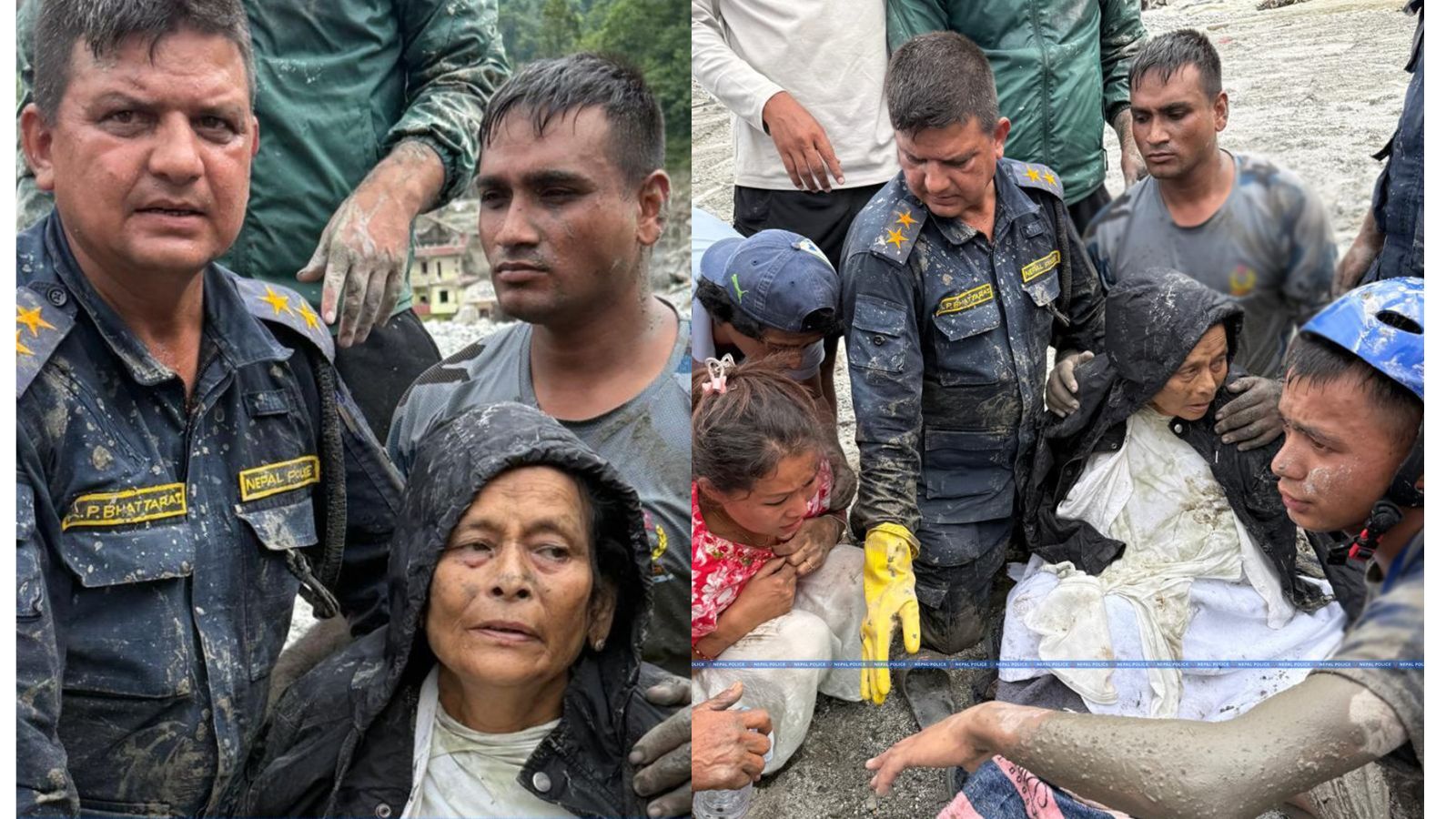
Every time a wall of water tears through a Himalayan river valley, mainstream media outlets rush to roll out the same predictable panic. Following the catastrophic ice-rock avalanche and subsequent flash floods in Nepal, the commentary machine shifted into a familiar gear. Headlines across the subcontinent began hyperventilating about whether India is next, pointing accusatory fingers at retreating glaciers, expanding high-altitude ponds, and a warming planet.
The lazy consensus argues that if we just map every glacial lake, install a few more remote sensors, and blame global carbon emissions, we can outsmart the mountains.
This diagnosis is comforting, highly marketable, and fundamentally wrong.
The obsession with Glacial Lake Outburst Floods misses the core mechanical reality of why the Himalayas are failing. The threat to India is not merely an overflowing pool of water waiting for a dam to break. The real danger is a systemic, multi-hazard cascade driven by internal bedrock failure, subterranean warming, and the criminal placement of heavy infrastructure in active debris corridors.
The Flawed Fixation on Standing Water
Open-source satellite analysis of recent disasters reveals a glaring oversight in how bureaucrats and desk-bound experts assess risk. When the disaster struck near the Nepal-Tibet border, analysts scrambled to isolate pre-existing lakes that might have burst. Yet, ground and radar data pointed to something entirely different: an initial mass movement of sheer rock and ice breaking away from a steep slope, displacing material at velocities that render static lake-monitoring completely useless.
Geophysicists tracking surface displacement noted measurable bedrock acceleration weeks before the collapse. The failure did not begin with water accumulating peacefully behind a moraine wall. It began deep within the permafrost, where frozen joints thawed, lost their structural integrity, and triggered a high-velocity mechanical avalanche.
If disaster management agencies continue spending millions draining high-altitude lakes while ignoring structural rock mechanics, they are bailing out a sinking ocean liner with a teaspoon. Standing water is often the symptom of a destabilized slope, not the root cause.
The Engineering Hubris in the Valleys
The true vulnerability of the Himalayan region is not found exclusively at five thousand meters above sea level. It is built squarely in the narrow river gorges below.
For decades, developers have treated Himalayan river corridors as infinite real estate for cascade hydroelectric projects, highways, and tourist settlements. Imagine a scenario where a multi-ton boulder and ice mass drops thousands of meters into a constrained gorge, instantly displacing millions of cubic meters of water, soil, and pulverized rock. No early warning system on Earth can save a downstream concrete powerhouse when the riverbed itself transforms into a moving slurry of jagged debris within minutes.
The institutional response in India follows a predictable cycle of denial, panic, brief data collection, and eventual amnesia. State governments commission hurried hazard assessments for specific basins—such as the Mago Chu basin in Arunachal Pradesh or the Gepang Gath area in Himachal Pradesh—treating each valley as an isolated micro-system.
This atomized approach ignores the interconnected physics of the mountain range. The Himalayas are not a collection of independent slopes; they are an over-steepened, tectonically active wedge responding dynamically to shifting thermal baselines.
The Uncomfortable Truth About Prediction
Let us dispense with the corporate fiction that better artificial intelligence and satellite tracking will give us absolute predictability. Radar interferometry and high-resolution optical imagery are remarkable tools, but they cannot predict the exact micro-second a fracture propagates through hidden bedrock.
When researchers point to cumulative movement near a slope, they are identifying long-term strain, not a ticking clock with an alarm set for Tuesday afternoon. Pretending that we can forecast individual slope collapses with enough precision to evacuate thousands of construction workers and villagers is a dangerous delusion designed to protect bureaucratic liability.
If prevention is structurally impossible for every localized slope failure, the strategy must pivot entirely away from prediction and toward radical retreat.
What Actually Works
Real resilience in the high mountains requires a complete inversion of spatial planning.
- Mandatory Zero-Construction Buffers: Enforce strict, non-negotiable zoning laws that ban permanent concrete infrastructure, major hydropower diversion tunnels, and high-density tourist hubs within active high-energy debris tracks.
- Decentralized Local Redundancy: Abandon reliance on centralized early warning systems that depend on fragile optical fiber cables strung across remote gorges—cables that are invariably severed in the first minute of a debris flow. Rely instead on community-level acoustic and seismic monitoring tied directly to automated vertical evacuation protocols.
- Passive Engineering Over Hard Armor: Stop building massive concrete walls to channel high-energy torrents. The kinetic force of a Himalayan debris flow will pulverize concrete structures like chalk. Design flexible, adaptive valley management that lets water and rock dissipate safely across wide, unconstrained alluvial fans.
The mountains are rewriting the rules daily. Stop trying to negotiate with a geological collapse using spreadsheets and satellite dashboards.