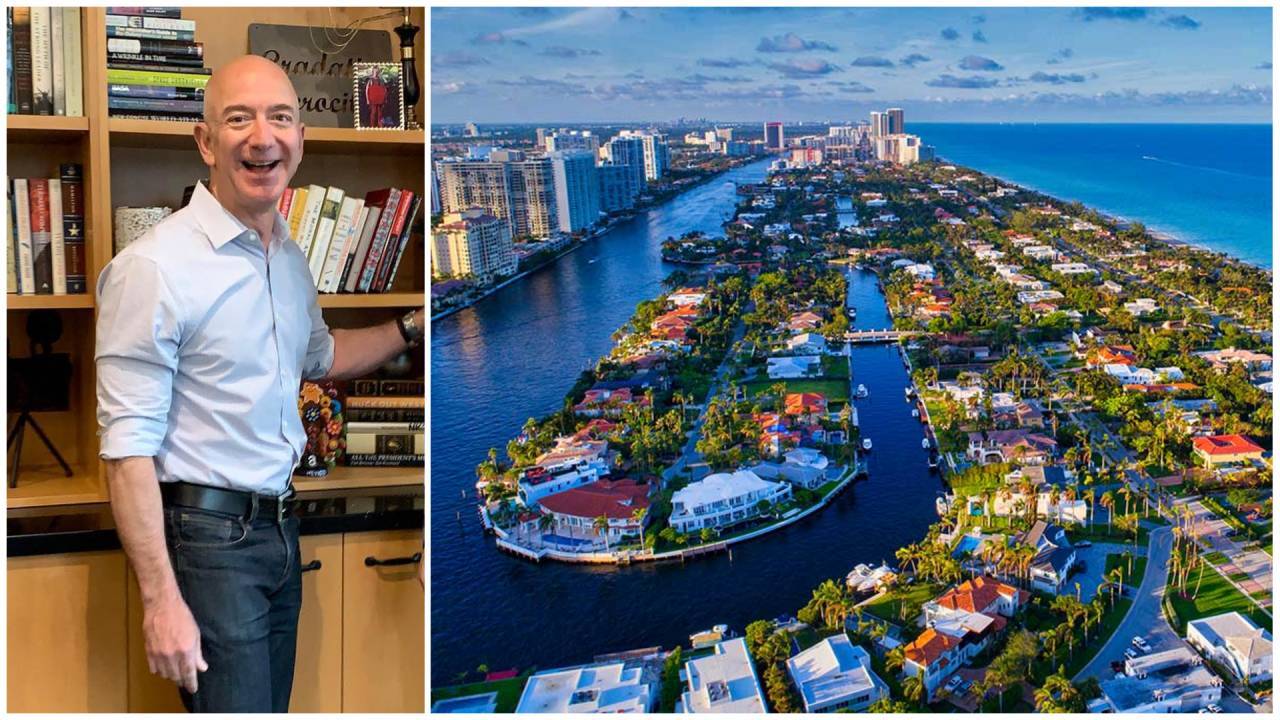
Real estate gossip columns are salivating over a single, breathless question: Did Jeff Bezos just drop $69.5 million on a Golden Beach mansion a few miles north of Indian Creek Island?
You are asking the wrong question. For a closer look into this area, we suggest: this related article.
Whether the Amazon founder signed the closing documents on that specific stretch of South Florida sand is irrelevant. Obsessing over the buyer's name is the classic retail investor trap—watching the celebrity magician's left hand while missing the structural capital reallocation happening in the right.
When a billionaire moves tens of millions of dollars into a hyper-illiquid, coastal barrier island, it is not a vanity purchase. It is not about the thread count of the cabana towels or the proximity to Tom Brady on Indian Creek. It is a cold, calculated balance sheet maneuver disguised as lifestyle porn. For further context on this development, in-depth reporting is available on Financial Times.
The Lazy Consensus of Celebrity Real Estate
Mainstream financial media treats ultra-luxury real estate like a scoreboard for ego. The narrative is predictable. A centibillionaire already owns three adjoining mansions on Indian Creek—Miami’s famed "Billionaire Bunker"—where he has spent upwards of $237 million assembling a private compound. Suddenly, an anonymous LLC scoops up a massive oceanfront estate just up the A1A in Golden Beach for $69.5 million. The press immediately defaults to speculation about guest houses, security perimeters, and yacht dockage.
That is the lazy consensus. It assumes billionaires buy property the way upper-middle-class doctors buy vacation homes, just with extra zeros tacked onto the mortgage.
They do not.
At the $50 million-plus tier, residential real estate ceases to function as shelter. It operates as an alternative asset class with distinct tax, liquidity, and wealth-preservation mechanics that traditional equities cannot replicate. If you look at South Florida trophy properties through the lens of architectural digests, you miss the entire thesis.
I have sat across the table from family office principals structuring these exact acquisitions. They do not care about the marble countertops. They care about basis, state-level wealth extraction, and land scarcity in municipalities that have legally outlawed future density.
The Geography of Scarcity and Regulatory Moats
To understand why capital is flooding into Golden Beach and Indian Creek, look at the zoning laws, not the ocean views.
Most coastal real estate is vulnerable to one fatal flaw: developers can always build up. If you buy a $40 million beachfront estate in Sunny Isles or Miami Beach, there is a non-zero chance that within a decade, a 60-story luxury condominium tower will rise next door, blocking your sun, crowding your beach, and diluting the exclusivity of your dirt.
Indian Creek and Golden Beach engineered an artificial supply cap decades ago.
- Indian Creek Village is a private, gated island with roughly 41 residential lots, its own police force, and an ironclad mandate against commercial development or multi-family zoning.
- Golden Beach is a single-family residential town tucked between the Atlantic Ocean and the Intracoastal Waterway. No condos. No hotels. No commercial retail. Just roughly a mile of direct oceanfront sand divided among private estates, protected by its own municipal police department.
When you buy in these municipalities, you are not buying a house. You are buying into a regulatory moat. The supply of oceanfront lots in Golden Beach is permanently fixed. In economics, when demand from a growing global pool of centibillionaires collides with a permanently fixed supply of coastal land, price elasticity disappears.
A $69.5 million price tag sounds obscene to a salaried worker. To a family office managing $10 billion, locking up a non-replicable physical asset in a zero-income-tax jurisdiction is basic portfolio hygiene.
The Tax Arbitrage Nobody Mentions
Let us talk about the elephant in the room: Washington State versus Florida.
When Bezos announced his relocation from Seattle to Miami, the public relations machine spun a heartwarming story about wanting to be closer to his aging parents and Blue Origin’s operations in Cape Canaveral. Both things can be true. Neither is the primary financial driver.
In 2022, Washington State implemented a 7% capital gains tax on the sale of long-term assets—such as stocks and bonds—exceeding $250,000. For a founder whose net worth is heavily concentrated in appreciated equity, staying in Seattle meant voluntarily surrendering 7% of every future stock liquidation to Olympia.
Florida has no state income tax. No state capital gains tax. No state estate tax.
Look at the math. If you sell $10 billion worth of stock as a Washington resident, you owe $700 million in state capital gains taxes. If you establish bona fide domicile in Florida before executing those sales, your state tax bill is zero.
Suddenly, spending $237 million on Indian Creek and another $69.5 million in Golden Beach does not look like an extravagance. It looks like a rounding error on the tax savings alone. Even if the real estate never appreciates by a single dollar, the jurisdictional arbitrage pays for the dirt several times over.
Why Anonymous LLCs Hide the Real Buyers
Everyone wants to know if the LLC behind the $69.5 million Golden Beach transaction belongs to Bezos. Here is the truth about how these deals actually get structured—and why the public rarely gets the full picture until years later, if ever.
High-net-worth buyers do not walk into a title company with a personal checkbook. Every trophy acquisition is wrapped in layers of Delaware or Wyoming limited liability companies, often managed by blind trusts or law firms specializing in family office privacy.
Why? Because the moment a seller realizes Jeff Bezos, Ken Griffin, or Mark Zuckerberg is on the other side of the negotiation, the "billionaire tax" kicks in. A property worth $45 million magically becomes $70 million. Worse, neighboring properties immediately mark up their asking prices, artificially inflating the cost of assembling adjacent parcels.
Imagine a scenario where a billionaire wants to buy three neighboring lots to create a mega-compound. If the seller of Lot A leaks the buyer's identity to the press, the owners of Lots B and C will hold out for extortionate premiums. Secrecy is not paranoia; it is price control.
Furthermore, family offices frequently buy properties for key executives, security details, or joint-venture partners using the same legal infrastructure they use for personal residences. Just because an LLC shares a registered agent or a legal team with a known billionaire's previous purchases does not guarantee the billionaire plans to sleep in the master bedroom.
Dismantling the "Bubble" Myth
Whenever a South Florida property trades above $50 million, pundits predict an imminent crash. They point to rising property insurance rates, property tax assessments, and sea-level rise as proof that ultra-luxury buyers are delusional.
This critique fundamentally misunderstands how the ultra-wealthy underwrite risk.
- Self-Insurance: When your liquid net worth exceeds the GDP of a small nation, you do not care that Citizens Property Insurance raised premiums by 40%, or that private carriers are pulling out of Florida. Centibillionaires self-insure. They carry catastrophic liability umbrellas and treat physical hurricane damage to a structure as a minor maintenance expense. The value is in the land, not the stucco box sitting on top of it.
- Inflation Hedging: Sovereign debt across the G7 is ballooning. Fiat currencies are systematically debased over multi-decade horizons. Trophy real estate in premier global enclaves—Miami, Aspen, Manhattan, London—acts as a hard asset store of value. You cannot print more oceanfront dirt in Golden Beach.
- Intergenerational Wealth Transfer: Through Grantor Retained Annuity Trusts (GRATs) and qualified personal residence trusts, ultra-wealthy families use high-value real estate to freeze estate values and pass appreciating assets to heirs while minimizing federal estate tax exposure.
Does this mean the South Florida luxury market is immune to corrections? No. The $5 million to $15 million tier—dominated by leveraged finance bros, crypto speculators, and high-earning professionals—is deeply sensitive to interest rates and Wall Street bonus cycles. When liquidity tightens, that segment bleeds.
The $60 million-plus tier is a different planet. Those transactions are overwhelmingly all-cash. Interest rates are an afterthought. The buyers are not comparing mortgage payments; they are comparing the long-term stability of holding physical land in the United States against holding sovereign bonds or concentrated tech equities.
The Downside of the Trophy Real Estate Play
I am not here to tell you that parking $70 million in coastal Florida is a risk-free masterstroke. Even the sharpest family offices get burned when they ignore the friction costs of trophy real estate.
The biggest blind spot in this strategy is illiquidity. When you buy a $69.5 million mansion, your exit pool shrinks to roughly a few hundred people on the entire planet. If you need to liquidate that asset during a global financial crisis, you are not going to get your asking price. You will either take a 30% to 40% haircut or sit on the property for five years waiting for another centibillionaire to get bored.
Then there is the carrying cost bleed. In Miami-Dade County, property taxes are reassessed upon sale based on the purchase price. A $69.5 million acquisition will trigger an annual property tax bill well north of $1.2 million. Add in a full-time staff, landscaping, marine maintenance, 24/7 private security, and utilities, and you are burning $3 million to $5 million a year just to keep the lights on and the mold out.
And yes, environmental risk is real—not because the ocean will swallow the house tomorrow, but because municipal infrastructure in barrier island communities faces massive, inevitable capital assessments. Seawall upgrades, stormwater pumping stations, and drainage overhauls will cost hundreds of millions of dollars over the next two decades, and the property owners will foot the bill through special tax assessments.
How to Apply Billionaire Real Estate Logic at Any Scale
You probably do not have $69.5 million sitting in a money market account waiting to clear escrow in Golden Beach. That does not mean you cannot steal the underlying playbook.
Stop buying real estate based on granite countertops, staging, and HGTV aesthetics. Start underwriting properties the way family offices do:
- Buy Regulatory Moats, Not Pretty Houses: Look for municipalities with strict zoning laws, height restrictions, and geographic barriers to new supply. If a developer can build 500 identical units down the street, your property has zero pricing power.
- Follow Tax Migration, Not Headlines: Capital flows where it is treated best. Pay attention to state-level policy shifts, corporate relocations, and tax incentives. By the time a celebrity purchase hits the front page of the tabloids, the institutional money has already bought up the surrounding zip codes.
- Separate Land Value from Structure Value: Buildings depreciate; they require endless capital expenditures just to fight entropy. Dirt in supply-constrained locations appreciates. Always ask yourself what the lot would be worth if a hurricane leveled the house tomorrow.
- Respect Liquidity: Never tie up so much capital in a single, expensive residential property that carrying costs force you to sell during a downturn. The wealthy win in real estate because they never become forced sellers.
Stop Watching the Celebrity and Watch the Capital
Let the tabloids argue over whether Jeff Bezos bought another mansion in Golden Beach. Let the real estate brokers leak breathless rumors to boost their own listing profiles.
The buyer's name on the deed is trivia. The real story is the relentless, structural migration of the world's largest pools of private capital into fixed-supply, tax-advantaged, hard assets.
If you are still evaluating real estate by looking at who lives next door instead of looking at zoning laws, tax arbitrage, and supply caps, you are not an investor. You are just a spectator reading the gossip column.