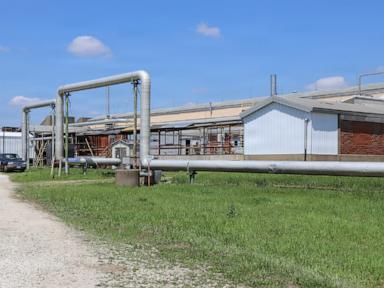
Every few months, the International Atomic Energy Agency drops a press release about satellite photos of Yongbyon, and the foreign policy establishment loses its collective mind. This November, IAEA Director General Rafael Grossi announced that Pyongyang finished exterior construction on a rapid new extension to its original uranium enrichment facility. Within hours, the usual chorus of wire services and think-tank commentators recycled the exact same breathless script: Kim Jong Un is scrambling to churn out more weapon-grade fissile material, diplomacy is dead, and the sky is falling.
They are wrong. Not about the concrete—the roof is visibly there on commercial satellite imagery. They are dead wrong about what it means.
Treating a new annex at North Korea's oldest, most heavily surveilled nuclear complex as a terrifying escalation misses the entire point of modern proliferation. If you want to understand why Pyongyang built an extension right in front of Western spy satellites, stop reading sensationalist headlines and start thinking like a nuclear fuel-cycle engineer.
The Yongbyon Decoy Trap
I have spent years watching intelligence analysts and diplomatic teams burn endless political capital obsessing over square footage at Yongbyon while missing the real industrial shifts happening fifty miles away. Whenever Pyongyang pours concrete at its flagship complex, Washington and Seoul react like a bull charging a red cape.
Think about the basic operational reality. The IAEA has not had an inspector on the ground in North Korea since 2009. Everything Grossi and his team know comes from overhead imagery and open-source intelligence. North Korean engineers know the exact orbital schedules of Western commercial and military satellites. They know every trench, cooling tower, and roof truss at Yongbyon is photographed in high resolution daily.
You do not build your crown-jewel, covert weapons production surge in a fishbowl.
Look at the broader timeline that mainstream coverage conveniently glosses over. Just two months before this November annex announcement, the IAEA confirmed that North Korea had already finished constructing a massive, brand-new enrichment plant elsewhere at the Yongbyon complex—a facility big enough to house up to 28 centrifuge cascades. Before that, Pyongyang expanded its clandestine Kangson enrichment site.
Why on earth would a state that just finished a sprawling, modern enrichment hall suddenly throw up a comparatively modest, ad hoc extension onto its original 2010-era plant in less than ten weeks?
David Albright and the team at the Institute for Science and International Security (ISIS) have modeled the geometry of this exact building. Yes, if packed with P-2 style centrifuge cascades derived from the A.Q. Khan network designs, the hall could theoretically crank out over 100 kilograms of weapon-grade uranium annually. That is the scare number journalists love to quote.
Here is the part that gets buried at the bottom of technical reports: that annex is just as likely—if not more likely—dedicated to producing low-enriched uranium (LEU) for North Korea's experimental light-water reactor, which finally went operational earlier this year, or serving as a specialized feed-and-withdrawal and R&D bay.
The Physics of Fissile Material Nobody Explains
To see why the mainstream coverage is broken, you have to understand the bottleneck in North Korea's arsenal. It is not raw enrichment floor space anymore.
Let's strip away the jargon and look at how uranium enrichment actually works:
- Natural Uranium: Mined from the ground, it contains roughly 0.7 percent Uranium-235 (the fissile isotope that sustains a chain reaction) and 99.3 percent Uranium-238 (dead weight for a bomb).
- Low-Enriched Uranium (LEU): Enriched to between 3 and 5 percent U-235. This is reactor fuel. Getting from 0.7 percent to 4 percent does the vast majority of the heavy thermodynamic lifting—roughly 70 to 80 percent of the total separative work required to make bomb material.
- Weapon-Grade Uranium (WGU): Enriched to 90 percent or higher U-235. Once you have a stockpile of LEU, jumping from 4 percent to 90 percent takes comparatively little centrifuge time and floor space.
Most commentators talk about enrichment plants as if they are monolithic bomb factories. They are not. They are modular chemical engineering plants running uranium hexafluoride gas through thousands of spinning aluminum or maraging-steel tubes.
When North Korea brought its new light-water reactor online in 2026, it created a massive, continuous appetite for LEU fuel rods. A reactor needs tonnes of low-enriched uranium every year. A nuclear warhead needs roughly 15 to 25 kilograms of weapon-grade uranium.
By fixing our gaze on a single annex at the original Yongbyon plant, we confuse industrial fuel-cycle scaling with an immediate warhead breakout. Worse, we hand Kim Jong Un an effortless propaganda victory. Every time he wants to remind an incoming or sitting U.S. administration that Pyongyang holds nuclear leverage, he puts a construction crew to work under the cameras at Yongbyon.
Dismantling the Three Biggest Myths About Yongbyon
If you search for news on North Korea's nuclear program today, you will run into three persistent questions driven by decades of outdated assumptions. Every single one rests on a flawed premise.
1. "Can sanctions or a surgical strike stop the Yongbyon expansion?"
No. Anyone pitching a targeted strike on Yongbyon in 2026 is selling fantasy. Unlike plutonium production—which requires massive, unmistakable nuclear reactors, cooling towers, and chemical reprocessing plants that belch detectable krypton-85 gas—gas centrifuge enrichment has virtually zero thermal or radiological signature.
Centrifuges run in standard industrial warehouses powered by the regular electrical grid. You can hide a cascade capable of producing several bombs' worth of fissile material inside an unremarkable shoe factory or a mountain tunnel. Even if you leveled every building at Yongbyon tomorrow, North Korea's dispersed network of undeclared facilities—Kangson and whatever underground sites haven't been spotted yet—would keep spinning uninterrupted.
2. "How many nuclear bombs does North Korea actually have right now?"
Nobody outside Pyongyang knows, and anyone giving you a precise figure is guessing. South Korean Defense Minister Ahn Gyu-back recently put the ceiling at 120 warheads. Meanwhile, the Federation of American Scientists (FAS) and the Stockholm International Peace Research Institute (SIPRI) estimate the assembled stockpile is closer to 60.
Notice that 100 percent variance between reputable defense establishments. That gap exists because intelligence agencies can only estimate how much fissile material North Korea could have produced based on rough guesses about centrifuge efficiency, failure rates, and operating hours. Counting warheads is a parlor game. Once a nation crosses the threshold of 50 survivable nuclear weapons mounted on solid-fuel road-mobile missiles, whether they have 60 or 120 does not alter the deterrence math on the Korean Peninsula.
3. "Does expanding Yongbyon mean North Korea is preparing for a seventh nuclear test?"
This is pure correlation-equals-causation laziness. Expanding fissile material production is an industrial manufacturing decision; conducting an underground nuclear detonation at Punggye-ri is a political and warhead-design decision.
North Korea already tested a high-yield thermonuclear device in September 2017. The only technical reason Kim Jong Un needs a seventh test is to validate miniaturized tactical warheads for short-range battlefield missiles or multiple independently targetable reentry vehicles (MIRVs) for intercontinental ballistic missiles. Building a new centrifuge hall at Yongbyon neither accelerates nor delays a test at Punggye-ri.
What Actually Matters in 2026
Imagine a scenario where Washington and Seoul actually succeed in negotiating a total freeze and dismantling of the entire Yongbyon complex—every reactor, every reprocessing line, and every centrifuge hall, including this brand-new November annex. The cameras roll, the cooling towers come down, and diplomats pop champagne.
In that scenario, North Korea would still remain a fully armed nuclear weapons state with dozens of warheads, an active enrichment plant at Kangson, and intact solid-fuel ICBM production lines.
That is the uncomfortable truth the mainstream narrative refuses to confront. In 2019, at the Hanoi summit, Kim Jong Un offered to dismantle Yongbyon in exchange for lifting the heaviest UN economic sanctions. Back then, Yongbyon was still the undisputed heart of the program. Seven years later, Pyongyang has systematically decentralized its nuclear infrastructure to make Yongbyon expendable.
Today, Yongbyon serves two primary functions for the regime:
- Bulk fuel production for its domestic nuclear power ambitions and tritium generation (essential for boosting thermonuclear yields).
- A diplomatic lightning rod designed to absorb Western intelligence bandwidth and serve as a high-visibility bargaining chip if talks ever resume.
To be completely candid, my contrarian view carries a serious risk of its own: underestimating Pyongyang's parallel track. Just because Yongbyon is a shiny distraction does not mean North Korea isn't aggressively expanding its warhead count. If the regime is simultaneously running its new 28-cascade facility at Yongbyon, operating Kangson at full tilt, and feeding enriched uranium into tactical warhead assembly lines, the sheer volume of fissile material could soon allow Pyongyang to arm every single artillery rocket and short-range ballistic missile along the Demilitarized Zone with a nuclear tip.
Dismissing the threat would be suicide. Misdiagnosing the threat is almost as bad.
Stop Watching the Concrete and Start Watching the Supply Chain
If you are a policymaker, defense analyst, or investor trying to read the real risk temperature in Northeast Asia, stop reacting every time Rafael Grossi holds up a satellite photo of a new roof at Yongbyon. That building is a lagging indicator of decisions Kim Jong Un made three years ago.
Instead, track the three bottlenecks North Korea still cannot easily fake or hide:
- Specialty metallurgy and vacuum components: High-speed gas centrifuges require precision bearings, specialized lubricants, and high-strength aluminum or carbon-fiber rotors that wear out. Tracking illicit procurement networks routing dual-use machinery through front companies tells you far more about real enrichment capacity than counting buildings.
- Tritium and lithium-6 production: Fission bombs are yesterday's news. Modern, compact tactical warheads require thermonuclear boosting. Watch thermal signatures and isotope separation activity tied to heavy water and reactor target irradiation, not standard centrifuge halls.
- Solid-fuel missile transporter-erector-launchers (TELs): A warhead sitting in a bunker is just radioactive metal. It only becomes an operational threat when mated to a mobile launcher. Heavy chassis manufacturing and propellant mixing facilities are the true pacing items of North Korean nuclear readiness.
The next time a headline warns that North Korea has added another wing to its original uranium plant, save your outrage. Pyongyang is no longer building a secret bomb program in the shadows—it is running a mature, diversified nuclear-industrial complex in broad daylight, and watching us panic over the wrong building every single time.
Watch the IAEA Chief's statement on the Yongbyon expansion for the official UN briefing that sparked the latest wave of mainstream coverage.