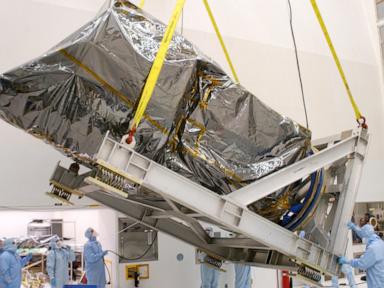
The media spent weeks hyperventilating over the fiery demise of the Neil Gehrels Swift Observatory. Headlines painted a tragic picture of a heroic twenty-two-year-old NASA telescope dragged down by an angry sun, its fate sealed only because a commercial robotic docking experiment sputtered out before it could throw a mechanical life preserver.
The lazy consensus is simple: we lost a legendary machine, the rescue mission flopped, and orbital decay is an unmitigated disaster that we must stop at all costs through aggressive life-extension missions. Meanwhile, you can explore similar events here: Inside the Federal Court Investigation That Just Upended the DC Golf Course Battle.
That narrative is entirely backwards.
The real story isn't that Swift fell or that Katalyst Space Technologies' LINK spacecraft failed to rendezvous and push the telescope back to a safe altitude. The real story is that spending millions of dollars trying to resuscitate a two-decade-old, radiation-fried piece of mid-2000s hardware was a profound misallocation of capital and engineering bandwidth. We have fallen in love with museum-keeping in orbit. We need to let things die. To understand the full picture, we recommend the detailed report by Al Jazeera.
The Fallacy of the Orbital Antique
Let us look at the baseline engineering reality. Swift launched in November 2004. It was designed for a baseline mission life of two years. It survived for twenty-two. By any objective metric, the spacecraft gave humanity a ten-thousand-percent return on investment, mapping gamma-ray bursts and supernovas across the cosmos long after its warranty expired.
Yet, when solar maximum activity kicked in, heating the thermosphere and bloating the outer layers of our atmosphere, increased drag pulled Swift downward. Panic ensued. NASA panicked. Contractors built three-armed robotic servicing prototypes in a desperate scramble.
Why?
Orbital salvage has become the new tech-industry fetish. We treat every defunct piece of aluminum and silicon as an asset worth preserving, ignoring the brutal economics of obsolescence. Swift carried instruments built with technology frozen around 2002. Keeping it alive meant burning modern capital to maintain a vintage artifact when modern constellations can do the job with exponentially higher fidelity.
Imagine a scenario where a commercial shipping company spent a fortune trying to retrofit a 1980s delivery van with autonomous driving pods instead of buying a new electric fleet. You would call them insane. Yet in space, because of sentimental attachment and risk-averse bureaucracy, we applaud the attempt to prop up the dead.
The Cost of Sentimental Engineering
The failed rescue mission involving the LINK spacecraft teaches us a harsh lesson about orbital servicing that the aerospace community is too polite to admit: retrofitting non-docking-compatible hardware is a fool's errand.
Swift was never designed to be grabbed, refueled, or pushed by a robotic arm. Trying to force a mechanical interface onto a legacy platform built two decades ago introduces massive single points of failure. The three-armed robot ran into control issues, drifted away, and eventually met its own fiery end. Millions of dollars vanished into the ionosphere, all to chase a ghost.
The laziness of the "failed rescue" narrative lies in the assumption that losing Swift leaves an unfillable vacuum. Space science has moved on. The instruments required to catch transient cosmic events today are smaller, cheaper, and vastly more sensitive than the heavy monolithic architecture of the early 2000s. By clinging to Swift, we delayed the transition toward distributed, resilient architectures.
The Beauty of Controlled Destruction
Let us stop pretending that atmospheric re-entry is an existential tragedy. Low-Earth orbit is not a permanent storage unit. It is an industrial highway where congestion is becoming a literal hazard.
When objects like Swift burn up cleanly in the upper atmosphere, they clear orbital slots for hardware that actually matters. The 1.5-ton observatory served its purpose, crossed the finish line, and cleared the lane. The U.S. Space Force tracked its descent over Indonesia and North Sumatra, and the world did not end. Debris dispersal models worked precisely as intended. The system functioned.
We do not need to save every satellite we ever launched. We need to stop viewing orbital decay as a failure mode and start recognizing it as the natural, necessary lifecycle of space infrastructure.
If you want to advance space exploration, stop mourning twenty-year-old telescopes that owe us nothing. Build better, cheaper, highly disposable systems that can be replaced before they become orbital liabilities. Stop trying to give mouth-to-mouth resuscitation to a corpse in the thermosphere. Let the old guard burn, and fund the next generation.