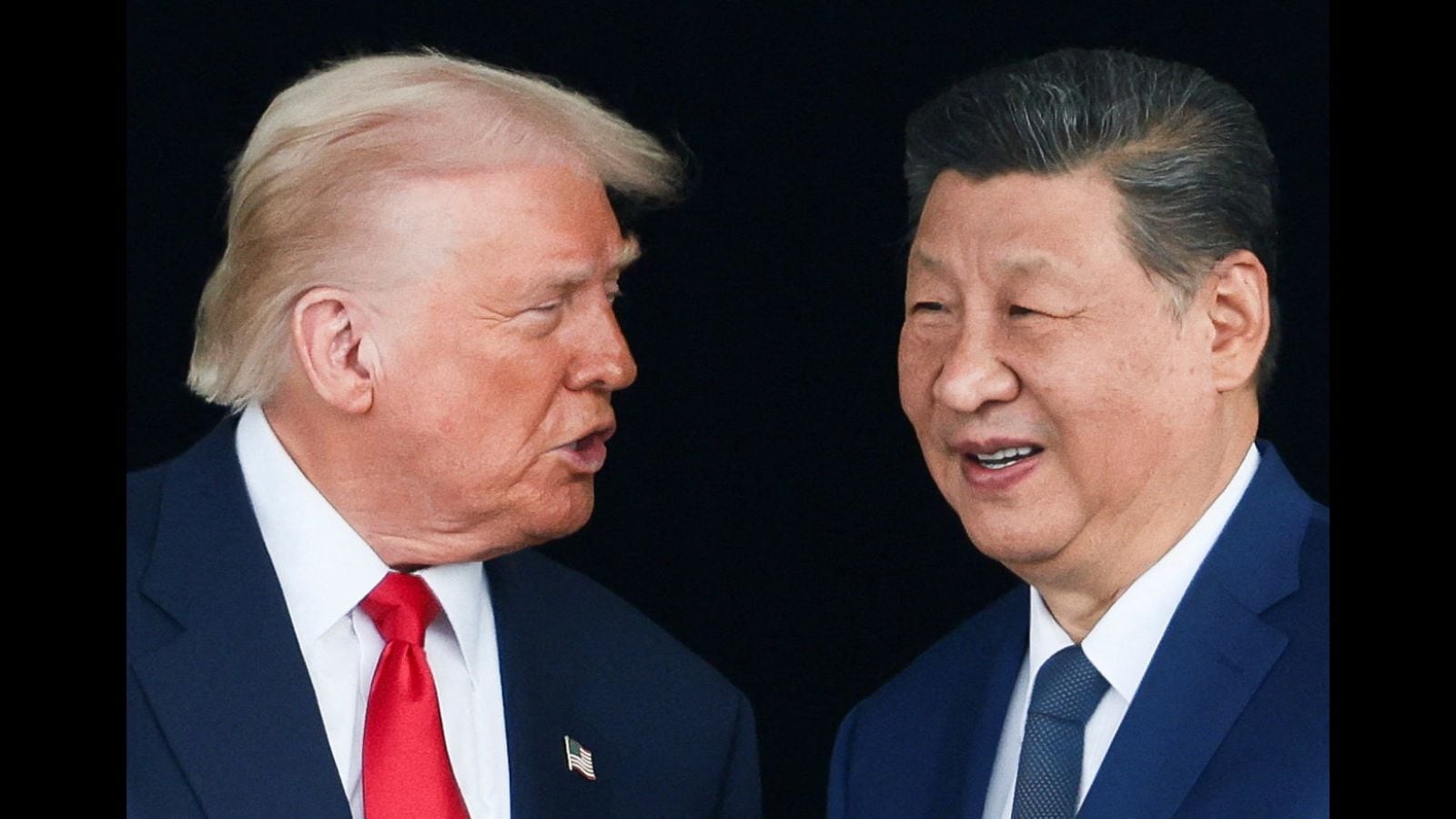
Every financial news desk on Earth is currently hyperventilating over next week's White House summit between Donald Trump and Xi Jinping. The mainstream press wants you to believe the fate of the global economy hinges on whether two men shake hands over soybean quotas and 60 percent tariff threats.
They are wrong. Completely, dangerously wrong.
If you are adjusting your supply chain, hedging currency, or rebalancing your portfolio based on the official White House trade agenda, you are already three years behind the actual war. The competitor coverage treats this meeting like a 1990s NAFTA negotiation. They obsess over headline tariff rates, agricultural purchase promises, and whether Beijing will blink on intellectual property enforcement. That is pure political theater designed for cable news chyrons and domestic voter bases.
The real battle is not happening at the port of Los Angeles or inside the Roosevelt Room. It is happening in the invisible plumbing of global capital, transshipment hubs in Southeast Asia, and the sovereign balance sheets of central banks.
The Lazy Consensus Around Bilateral Tariffs
Standard business journalism operates on a comforting, outdated assumption: tariffs are a blunt instrument that raise consumer prices, hurt exporters, and eventually force the targeted country to the negotiating table to strike a grand bargain.
Read any mainstream preview of next week's summit and you will see the exact same checklist:
- Will Trump follow through on universal baseline tariffs or targeted hikes on Chinese electric vehicles and green tech?
- Will Xi offer a revival of a Phase One-style purchasing agreement to buy American energy and farm goods?
- How much will these tariffs add to the American Consumer Price Index?
This framing misses the structural reality of how global trade actually functions in 2026. I have spent the last decade advising mid-market manufacturers and logistics operators across the Pacific Rim, and I have watched companies blow millions of dollars reacting to headline tariff announcements while completely ignoring the physical rerouting of goods.
A tariff is not a wall. It is a speed bump that redirects traffic onto side streets.
When Washington slaps a punitive duty on direct imports from Shenzhen, the factory does not close, and the goods do not suddenly get made in Ohio. Instead, the Chinese parent company ships semi-finished components to a newly leased warehouse in Haiphong, Monterrey, or Penang. Workers bolt on the final assembly, stamp a new country-of-origin label on the box, and ship it straight into the United States duty-free.
The bilateral trade deficit between the U.S. and China shrinks on paper. Politicians declare victory at podiums. Meanwhile, the U.S. trade deficit with Vietnam and Mexico explodes to record highs, and the underlying reliance on Chinese upstream inputs—from active pharmaceutical ingredients to processed rare earths—remains untouched.
What Is Actually on the Table Behind Closed Doors
If tariffs are mostly theater, why is Xi Jinping flying to Washington? And why is Trump hosting him?
Because both leaders face severe domestic constraints that have nothing to do with standard trade theory, and everything to do with survival.
Beijing's Deflationary Trap
China is not negotiating from a position of export strength; it is negotiating from a position of internal structural exhaustion. Overcapacity in domestic manufacturing has triggered a brutal deflationary spiral. Producer prices have been underwater for years, local government financing vehicles are drowning in bad debt, and domestic consumption refuses to pick up the slack.
Beijing desperately needs external demand to absorb its excess industrial output—specifically in solar panels, lithium-ion batteries, and electric vehicles. If the United States and Europe lock their doors simultaneously, China's industrial engine stalls. Xi is not coming to Washington to concede on state subsidies. Subsidies are the lifeblood of the Chinese Communist Party's economic model. He is coming to buy time and carve out exemptions for specific industrial champions while offering meaningless concessions on agricultural commodities China already needs to buy anyway.
Washington's Fiscal Arithmetic
On the other side of the table, Trump does not view tariffs merely as a negotiating tactic to lower foreign trade barriers. That is what traditional free-market economists get wrong when they try to predict his moves.
In Trump's economic worldview, tariffs serve two entirely different purposes:
- Revenue generation to offset the massive fiscal cost of extending domestic tax cuts amid surging interest payments on the national debt.
- Industrial coercion aimed not at Beijing, but at American and allied CEOs to force domestic capital expenditure.
Notice the contradiction that mainstream analysts refuse to point out: you cannot simultaneously use tariffs to raise hundreds of billions of dollars in federal revenue and use them to eliminate imports entirely. If imports drop to zero, tariff revenue drops to zero. One goal cannibalizes the other.
Dismantling the Myths You Keep Reading
To understand what will actually happen the morning after the White House press conference, we need to strip away the three biggest misconceptions dominating current coverage.
Myth 1: A "Grand Bargain" Will Restore Stability
The Premise: Investors hope Trump and Xi will sign a comprehensive deal that removes uncertainty and returns U.S.-China trade to predictable rules.
The Reality: Uncertainty is not a bug in this relationship; it is the primary weapon. The era of binding, multilateral trade enforcement died when the World Trade Organization's Appellate Body was paralyzed years ago. Any deal signed next week will be purely transactional, revocable by executive order or administrative decree within 24 hours. Treating a White House communiqué as a long-term business guarantee is financial malpractice.
Myth 2: Tariffs Automatically Cause Runaway Inflation
The Premise: Every 10 percent hike in tariffs translates directly into a proportional spike in consumer prices at Walmart and Target.
The Reality: This ignores currency mechanics and margin compression. When the U.S. imposes heavy tariffs, the U.S. dollar typically appreciates against the offshore yuan (CNH), absorbing a significant chunk of the tariff cost before the goods ever clear customs. Furthermore, Chinese exporters facing domestic deflation routinely slash their factory-gate prices—eating the margin loss themselves just to keep assembly lines running and retain market share. Consumers feel a fraction of the headline rate, while corporate profit margins on both sides of the Pacific quietly bleed out.
Myth 3: Supply Chains Are "Decoupling"
The Premise: Western companies are severing ties with China and bringing manufacturing back to North America.
The Reality: We are witnessing lengthening, not decoupling. As economists like Richard Baldwin and supply chain researchers at the Bank for International Settlements have documented through input-output data, global value chains are simply adding extra nodes. A laptop assembled in India or a server rack built in Mexico still relies on circuit boards, specialty chemicals, and sub-components originating in mainland China. Next week's summit will accelerate this shell game, enriching middlemen in third-party countries while leaving the core geopolitical vulnerability completely exposed.
The Real Agenda Nobody Is Reporting
While cameras focus on the handshake on the South Lawn, look at the three under-the-radar flashpoints that will actually dictate winners and losers over the next 24 months:
- Rules of Origin Enforcement: The U.S. Trade Representative and Customs and Border Protection are shifting from policing direct Chinese shipments to auditing "substantial transformation" in third countries. If the White House announces tighter rules of origin requirements for goods entering from ASEAN nations or under the USMCA framework, that will hit global corporate earnings ten times harder than a blanket tariff hike on Beijing.
- Outbound Investment Screening: Trade in physical goods is yesterday's war. The real choke point is capital and compute. Watch for any movement—or pointed silence—on executive restrictions governing U.S. venture capital, private equity, and sovereign wealth flows into Chinese artificial intelligence, quantum computing, and semiconductor fabrication.
- De Minimis Loophole Closure: Billions of dollars in direct-to-consumer packages currently flood into the U.S. every single day under the Section 321 de minimis threshold, bypassing tariffs and customs inspections entirely. Gutting this exemption requires zero negotiation with Xi Jinping, can be executed unilaterally by Washington, and would immediately upend global air freight pricing and e-commerce logistics.
Imagine a Scenario Where They Actually Sign a Deal
Let us run a quick thought experiment. Imagine a scenario where Trump and Xi surprise every cynic in Washington next week. They emerge from the Cabinet Room smiling, announcing a sweeping new trade framework: China agrees to purchase $250 billion in U.S. energy, aircraft, and agricultural products over three years, and Washington agrees to freeze new tariff escalations.
Wall Street rallies 3 percent in an afternoon. Headlines declare peace in our time.
Now look six months past that hypothetical headline. China does not have the domestic private-sector demand to absorb $250 billion in American goods without massive state intervention, meaning state-owned enterprises simply divert purchases from Brazil and Australia to the U.S. to hit the political quota. Meanwhile, U.S. export controls on high-end semiconductors remain locked in place because national security hawks in Congress will not allow them to be traded away for soybeans. Within nine months, one side accuses the other of failing to meet purchasing targets, and the exact same tariff threats return.
We already ran this exact experiment in 2020 with the Phase One deal. China hit less than 60 percent of its promised purchasing targets. The structural conflict did not pause for a single day.
The Downside of Ignoring the Political Noise
Now, let me be brutally honest about the flaw in my own argument.
If you operate purely on structural economic logic and ignore political theater, you can still get burned in the short term. Markets do not trade on five-year supply chain realities in the first forty-eight hours after a summit; they trade on algorithmic sentiment, headline-scraping bots, and knee-jerk fear. A single unscripted comment from the podium next Tuesday can trigger a 4 percent swing in semiconductor equities or send agricultural futures limit-down before lunch.
If you are heavily leveraged in short-term options or running razor-thin working capital without liquidity buffers, political theater can bankrupt you long before structural reality proves you right. You cannot ignore the noise entirely—you just have to stop mistaking the noise for the signal.
How to Position Before the Cameras Roll
Stop waiting for a policy readout from the White House press office to make operational decisions. By the time a tariff schedule is published in the Federal Register, the smart money has already moved.
- Audit Tier-2 and Tier-3 Suppliers Immediately: If you run a physical goods business, knowing your Tier-1 assembly partner is in Vietnam or Mexico is useless. Map your bill of materials down to the raw chemical, sub-component, and tooling level. If more than 30 percent of your value-add traces back to mainland China, you are exposed to rules-of-origin crackdowns regardless of what happens at the summit.
- Price Political Volatility Into Contracts: Stop signing fixed-price, multi-year supply agreements without explicit tariff pass-through clauses and force majeure triggers tied to customs reclassification. Every cross-border contract signed in 2026 must assume sudden regulatory friction as the baseline, not an anomaly.
- Follow Capital Flows, Not Trade Balances: Watch the currency markets—specifically the spread between onshore and offshore yuan—and track industrial real estate absorption in northern Mexico, Malaysia, and the American Midwest. Capital expenditure commits billions of dollars in concrete and steel; politicians commit nothing at a podium.
Next week, Trump and Xi will perform their roles for a global audience. One will project strength to his domestic base; the other will project statesmanship to a nervous Party congress. The press will breathlessly transcribe every word, dissect every handshake, and declare a winner by Friday afternoon.
Let them watch the stage. Keep your eyes on the exits.