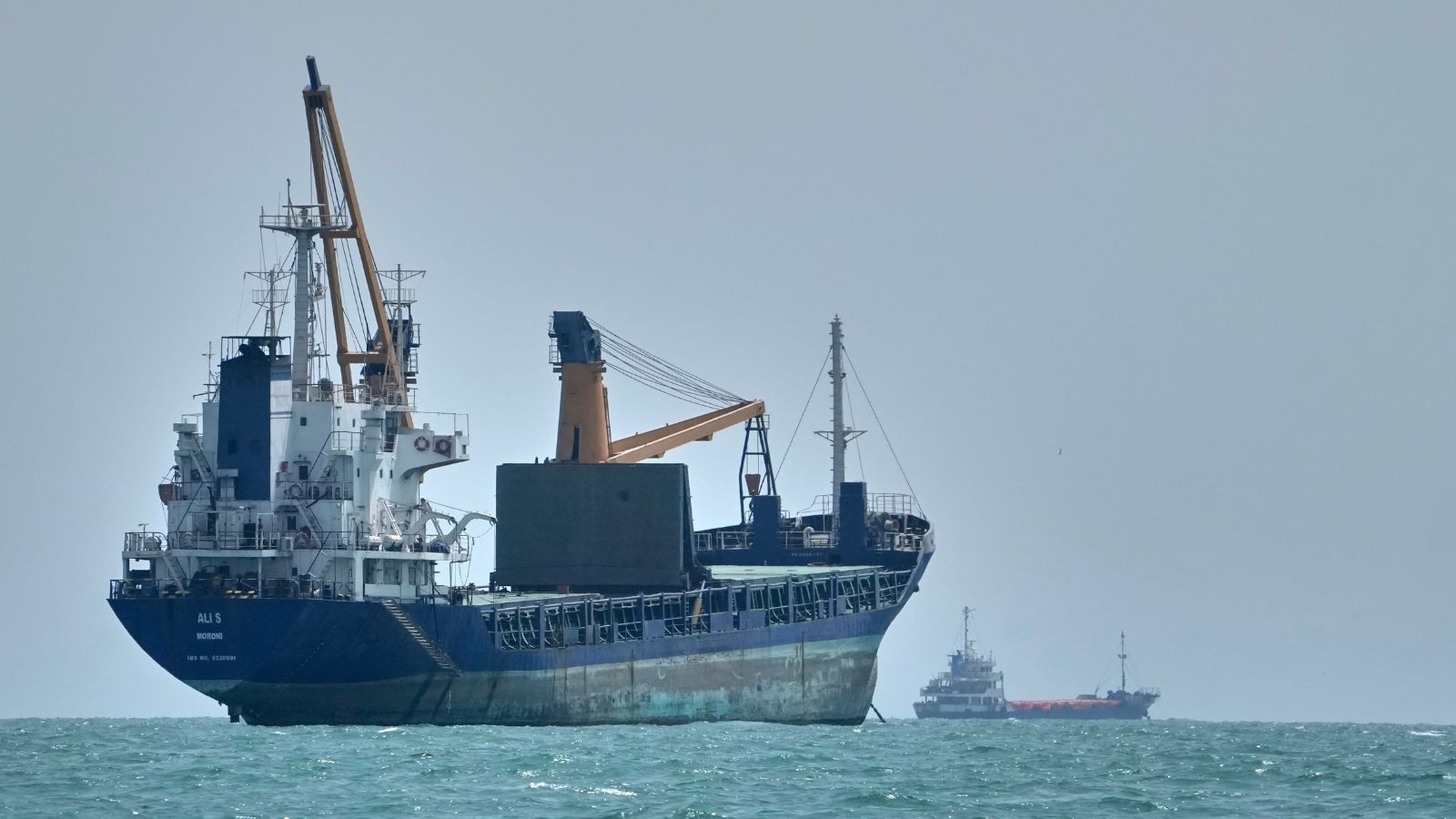
Every major newsroom is currently hyperventilating over Kpler tracking data showing commodity ship transits through the Strait of Hormuz hitting a floor of roughly ten vessels a day. Headlines frame this drop as a catastrophic new failure, treating the latest exchange of naval strikes between Washington and Tehran as an unprecedented shock to global logistics.
The lazy consensus buys the narrative that a few targeted tankers catching fire near Kharg Island represents a sudden, sharp fracture in global energy corridors. You might also find this similar article insightful: Strait of Hormuz Maritime Risk Pricing and Flow Degradation Mechanics.
It is a completely flawed reading of reality. The Strait of Hormuz did not just break this week. It has been structurally choked, functionally bypassed, and heavily militarized since early 2026. Focusing on daily moving averages shifting from fifteen down to ten ships is financial journalism equivalent to tracking the daily heart rate of a patient who has been on life support for six months and acting surprised when they twitch.
The real story is not that traffic dipped to a May-era low. The real story is that global markets have constructed an elaborate fiction where normal commercial navigation through this chokepoint is still expected to function, shielding buyers from a permanent structural baseline shift. As reported in detailed coverage by Al Jazeera, the results are significant.
The Metrics of Mass Deception
Let us look at the raw mechanics that the mainstream financial press completely glosses over. Before the kinetic escalation fundamentally re-engineered regional logistics, over one hundred vessels squeezed through that twenty-one-mile stretch daily. Today, even during brief tactical thaws, throughput sits down by roughly ninety-five percent compared to historical baselines.
When the United States Central Command reports striking Iranian oil tankers off Kharg Island, and the Islamic Revolutionary Guard Corps retaliates against unauthorized tonnage, analysts rush to update risk premiums on crude futures. They treat these skirmishes as exogenous shocks. They are not shocks. They are the new baseline operating conditions of a permanently contested body of water.
Maritime intelligence firms like Marisks correctly label the current environment as extreme risk for any linked tonnage, yet energy traders continue to price these events as temporary anomalies before a return to historical norms. That assumption is financial malpractice.
Imagine a scenario where a highway bridge has its middle span blown out, leaving only a frayed rope bridge guarded by armed sentries on both sides. You do not write market reports marveling that daily commuter counts dropped by five cars compared to last Tuesday. You accept that the bridge is gone, and anyone still trying to drive across it is playing a high-stakes game of economic roulette.
The Myth of the Navigational Quick Fix
The persistent delusion among shipping executives is that naval escorts and widened maritime lanes can magically sanitize a war zone. Operation Project Freedom and similar naval initiatives were sold to the public as silver bullets that would escort commerce safely through the Persian Gulf.
They failed to account for basic naval architecture and insurance realities. Insurance underwriters do not care about political press releases from the Joint Maritime Information Center. When United Kingdom Maritime Trade Operations log dozens of projectile strike incidents resulting in severe structural damage to commercial hulls, insurance syndicates respond with mathematical coldness. War risk premiums make unhedged voyages economically non-viable for standard operators.
The ships still creeping through—down to two vessels on a Saturday, ticking up to six on a Sunday—are largely outliers hugging territorial boundaries or operating with tracking transponders dark. They are anomalies driven by desperate state actors or specialized regional players, not the resumption of healthy free-market trade.
Parsing whether ten ships passed today instead of fifteen misses the forest for the burning trees. The physical architecture of Gulf-centric energy transport has broken permanently. Pipeline bypasses, alternative overland corridors, and strategic re-routing to Red Sea and Asian hubs are no longer emergency contingencies; they are the core infrastructure of modern trade.
Stop Pricing the Phantom Recovery
The danger for investors and supply chain directors lies in the psychological anchor of historical data. Shipping algorithms are hardcoded to expect mean reversion. They assume that after every geopolitical spike comes a cooling-off period where tanker traffic normalizes back to pre-crisis volumes.
That mean reversion is a ghost. Tehran and Washington have institutionalized a low-intensity maritime attrition cycle where commercial hulls are leveraged as political currency.
Stop waiting for the Strait of Hormuz to reopen. Stop adjusting your supply chain models based on weekly Kpler fluctuations. When a choke point becomes a theater of direct kinetic engagement, the only rational strategy is to price the route out of your logistics equation entirely.
The market is paying the price for a war that started months ago, yet it insists on reading yesterday's skirmish as the cause of a disease that has already reshaped the global economy.
Accept that the old map is gone. Build your supply chains for a world where the water stays closed.


