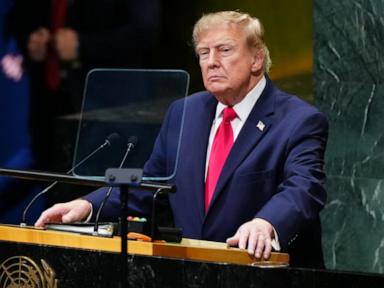
Using the United Nations General Assembly podium to justify military conflict with Iran represents a deliberate inversion of the institution’s foundational charter, shifting its function from a forum for collective security to a theater for unilateral deterrence signaling. When a United States president addresses an international body designed to prevent armed conflict in order to validate ongoing or imminent kinetic operations against a member state, the address ceases to be diplomatic persuasion. It becomes an exercise in coercive communication aimed simultaneously at three distinct audiences: domestic political stakeholders, hesitant coalition partners, and the adversarial leadership in Tehran. Standard media coverage typically reduces such speeches to partisan soundbites or superficial recaps of executive rhetoric. A rigorous strategic breakdown reveals that these addresses follow a precise structural logic rooted in international relations theory, specifically coercive diplomacy, audience cost generation, and legalistic reframing.
The Structural Paradox of the General Assembly Podium
The United Nations was engineered in 1945 around Article 2(4) of its Charter, which prohibits the threat or use of force against the territorial integrity or political independence of any state. Consequently, delivering a defense of war from the General Assembly rostrum creates an immediate institutional friction. The speaker must operate within an environment structurally hostile to unilateral military action while utilizing the global broadcast reach that only the UN provides. You might also find this similar coverage insightful: The Sanctuary That Shattered Trust.
This dynamic forces the executive branch to abandon traditional multilateral consensus-building in favor of legitimacy arbitrage. Rather than seeking a formal Security Council resolution—which faces guaranteed vetoes from permanent members with competing geopolitical interests, notably Russia and China—the administration uses the General Assembly to establish a moral and strategic record. The objective is not to win a vote, as the General Assembly holds no binding authority over military deployments. The objective is to raise the political cost of neutrality for allied nations and to demonstrate resolve to the adversary.
In strategic communications, this is governed by Audience Cost Theory, formulated by political scientist James Fearon. When a head of state makes explicit, public commitments on an international stage regarding military objectives and red lines, retreating from those positions incurs severe domestic and international reputational penalties. By locking in a hawkish rationale before 193 member states, the executive intentionally narrows its own diplomatic off-ramps. This self-imposed constraint signals to Tehran that the threat of sustained or escalated force is credible because backing down has become politically prohibitive for the White House. As discussed in recent articles by NBC News, the implications are worth noting.
The Four Pillars of Executive Justification
An analysis of modern executive rhetoric defending military confrontation with the Islamic Republic reveals a consistent four-part architecture. Rather than relying on a single casus belli, the speech constructs an interlocking set of rationales designed to insulate the administration from legal, strategic, and domestic critiques.
1. The Preemptive Self-Defense Doctrine
Because the UN Charter restricts the legal use of force to Security Council authorization or self-defense under Article 51, the speech must frame military action not as aggression, but as delayed reaction. The narrative establishes a timeline of prior provocations—ranging from maritime interdictions in the Strait of Hormuz to proxy attacks on regional infrastructure—to argue that hostilities were initiated by Iran long before the United States responded kinetically. By stretching the definition of "imminent threat" to encompass cumulative low-intensity conflict, the executive attempts to bring unilateral strikes under the umbrella of inherent self-defense.
2. The Nuclear Threshold Imperative
The core strategic anchor of the justification is nuclear non-proliferation. The argument relies on a binary risk assessment: the cost of conventional military engagement is framed as finite and manageable, whereas the cost of a nuclear-armed Iran is presented as existential and irreversible. This framing deliberately bypasses debates over the efficacy of previous diplomatic frameworks, such as the Joint Comprehensive Plan of Action (JCPOA), by asserting that breakout timelines have compressed to a point where diplomatic verification is no longer structurally viable. In economic terms, this is an asymmetric risk-management play, treating military intervention as a necessary insurance premium against catastrophic tail risk.
3. The Proxy Network Attribution Model
A critical failure point in conventional deterrence against Iran has historically been Tehran's use of plausible deniability through the "Axis of Resistance"—including Hezbollah, the Houthis, and various militias in Iraq and Syria. A sophisticated UN defense explicitly collapses the distinction between the state sponsor and the non-state actor. The rhetoric establishes a strict principal-agent liability framework, declaring that the United States holds the Iranian state directly accountable for the kinetic outputs of its regional proxies. This doctrinal shift eliminates Tehran’s buffer zone, signaling that asymmetrical attacks in the periphery will trigger symmetrical or superior retaliation against the core.
4. The Burden-Sharing Ultimatum
Addressing the international body allows the president to reframe a bilateral conflict as a defense of global public goods. By emphasizing the security of international maritime chokepoints—specifically the Bab el-Mandeb and the Strait of Hormuz—the speech links US military action to global energy stability and supply chain integrity. The underlying message to European and Asian allies is transactional: American military power is subsidizing global trade security, and international partners must therefore align with US sanctions regimes and diplomatic isolation campaigns rather than maintaining independent commercial channels with Tehran.
Causal Mechanisms Missed by Surface-Level Reporting
Standard news summaries treat a UN war defense as a static political event—a series of applause lines or walkouts. In reality, the speech triggers specific causal chains across diplomatic, economic, and military domains that alter the operating environment for months afterward.
The Erosion of Strategic Ambiguity
When an administration details its rationale for war at the UN, it is forced to define its end-state conditions. If the stated objective is the permanent dismantling of nuclear and ballistic missile infrastructure, Tehran interprets this not as a limited coercive campaign, but as a prelude to regime decapitation. This clarity can inadvertently backfire. By removing strategic ambiguity, the speech may incentivize the Iranian leadership to accelerate nuclear weaponization as the only viable deterrent against an existential threat, creating a classic security dilemma where defensive measures by one state trigger offensive escalations by the other.
Commodity Market Pricing and Risk Premiums
The immediate measurable impact of UN podium rhetoric is rarely diplomatic; it is financial. Energy traders and maritime insurers parse executive language for indicators of escalation duration and geographic scope. A speech that frames conflict as a prolonged campaign to degrade state capacity immediately injects a geopolitical risk premium into Brent crude futures and spikes war-risk insurance rates for vessels transiting the Persian Gulf. The speech thus functions as an economic shock mechanism, tightening global financial conditions and testing the inflation tolerance of Western economies that must absorb higher energy costs to sustain political support for the conflict.
Diplomatic Coalition Fracturing
While the intent of a UN address is to rally international support, rigid unilateral framing often accelerates the formation of counter-coalitions. Non-aligned nations in the Global South frequently view unilateral military justifications through the lens of sovereignty preservation. When the United States bypasses UN mechanisms while using the UN stage to validate force, it provides rhetorical ammunition to rival powers. Beijing and Moscow utilize this friction to position themselves as defenders of the Westphalian state system and international law, deepening diplomatic alignment with Tehran and complicating US efforts to enforce secondary sanctions.
Operational Limitations of Podium Diplomacy
Relying on high-profile international addresses to sustain a military campaign carries severe structural limitations that strategists must account for when evaluating the long-term viability of the policy.
- The Credibility-Capability Gap: Rhetoric at the UN establishes expansive strategic goals, such as restoring regional stability or permanently eliminating proliferation risks. However, air and naval power alone rarely achieve maximalist political objectives without ground occupation, which remains politically non-viable. When stated goals exceed the operational capacity of the deployed force posture, the administration faces an inevitable credibility deficit.
- Domestic-International Message Collision: A speech designed to project uncompromising strength to domestic voters often alienates the exact foreign ministries required to provide overflight rights, basing access, and intelligence sharing. Host nations in the Middle East face acute domestic pressures and prefer quiet, compartmentalized security cooperation over public alignment with an overt US war narrative.
- Asymmetric Information Disadvantages: In an open forum, the executive cannot disclose sensitive intelligence sources and methods to prove the imminence of a threat. Consequently, the justification relies on executive assertion rather than verifiable evidence. Following historical intelligence failures in the region, international audiences apply a heavy discount rate to unverified executive claims, limiting the persuasive power of the address outside already committed allies.
Evaluating the Strategic Trajectory
To assess the actual impact of an executive defense of war at the UN, analysts must look past the immediate media cycle and track three concrete indicators over the subsequent 30 to 90 days:
- Force Posture Adjustments: Verify whether the rhetoric is matched by logistics. True escalation is signaled not by speech transcripts, but by the deployment of carrier strike groups, aerial refueling tankers, and theater missile defense batteries (such as THAAD and Patriot systems) into the Central Command area of responsibility.
- Secondary Sanction Enforcement: Monitor Treasury Department actions against third-country entities facilitating Iranian oil exports. If the UN speech is a prelude to sustained conflict, it will be followed by aggressive enforcement against Chinese independent refiners and shipping networks to sever Tehran's hard currency reserves.
- Back-Channel De-escalation Signals: Track diplomatic traffic through traditional intermediaries such as Oman, Qatar, or Switzerland. Often, maximum-pressure rhetoric at the UN is paired with quiet back-channel communications establishing narrow rules of engagement to prevent unintended escalation into a regional conflagration.
The definitive strategic play following a UN war justification is the immediate transition from public signaling to quiet coalition consolidation. The administration must utilize the heightened threat perception generated by the speech to extract concrete basing, intelligence, and financial enforcement concessions from regional partners behind closed doors, before the domestic political cycle and global energy market volatility erode its diplomatic leverage.


