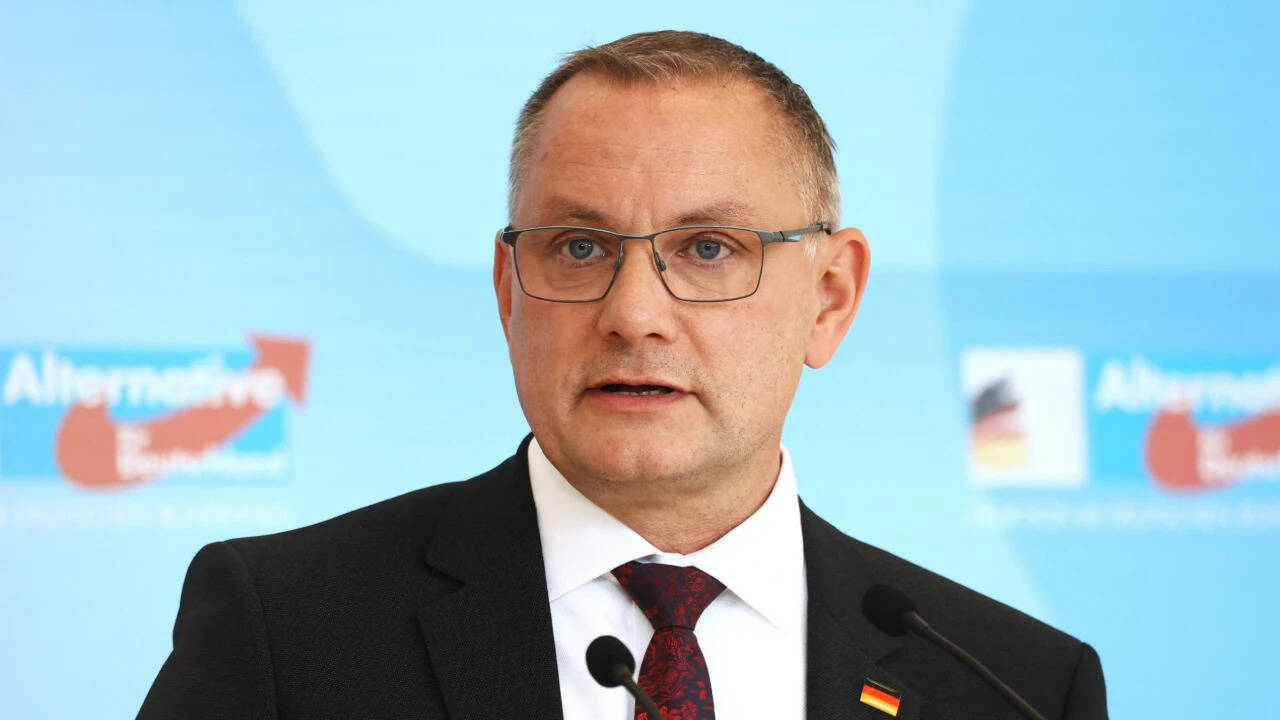
The Alternative for Germany (AfD) is converting electoral momentum into institutional leverage by demanding a formal parliamentary inquiry into the Nord Stream pipeline sabotage. Rather than functioning as a purely forensic exercise, this maneuver operates as an asymmetric political wedge designed to fracture the ruling coalition, exploit unresolved industrial grievances, and reframe Germany's energy security crisis around domestic accountability rather than external aggression.
Standard media coverage treats the AfD's backing of a Nord Stream probe as an isolated populist talking point or a predictable alignment with Russian foreign policy interests. That framing misses the structural mechanics of German parliamentary procedure and energy economics. When an opposition party surges in regional and national polling—particularly in the eastern states where industrial energy costs dictate electoral survival—demanding a Untersuchungsausschuss (parliamentary committee of inquiry) becomes a high-yield operational play. It forces the federal government to choose between two damaging options: stonewalling on national security grounds, which validates populist narratives of an opaque elite, or releasing classified intelligence assessments, which risks exposing diplomatic friction with Western allies and revealing the depth of Berlin's strategic vulnerability. For a more detailed analysis into similar topics, we suggest: this related article.
The Structural Mechanics of the Parliamentary Inquiry
In the German Bundestag, a formal committee of inquiry is not a symbolic gesture. Under Article 44 of the Basic Law, the Bundestag has the right—and upon the motion of one-quarter of its members, the duty—to establish an investigative committee. While the AfD alone has historically faced coordination hurdles in meeting the 25 percent threshold without support from other opposition factions like Die Linke or the Sahra Wagenknecht Alliance (BSW), the mere mobilization around the issue alters the legislative agenda.
The operational utility of a parliamentary probe rests on three distinct institutional mechanisms: For additional information on this development, in-depth reporting is available at Associated Press.
- Subpoena and Document Production: An investigative committee holds powers analogous to those of a criminal court. It can compel testimony from intelligence officials, chancellery staff, and energy ministry bureaucrats, while demanding internal communications regarding pre- and post-sabotage security assessments.
- Asymmetric Information Warfare: Even when findings are classified, the procedural battles over redactions and witness lists generate continuous media cycles. The opposition does not need to prove a definitive conspiracy to achieve its objective; it only needs to demonstrate that the executive branch is withholding information from the electorate.
- Coalition Wedge Dynamics: The governing traffic-light coalition (SPD, Greens, FDP) relies on fragile consensus regarding foreign policy and fiscal discipline. A sustained inquiry into critical infrastructure protection forces coalition partners to defend past energy dependencies—specifically the SPD's historical backing of Nord Stream 2—while simultaneously justifying current high-cost energy transitions championed by the Greens.
The limitation of this strategy lies in institutional containment. The ruling majority controls the committee's chairmanship rotations and can invoke Staatswohl (state welfare/national security) exemptions to block the release of intelligence shared by foreign partners. However, invoking executive privilege in a high-trust, high-transparency parliamentary system carries a steep political tax.
The Economic Transmission Mechanism
To understand why the Nord Stream issue resonates beyond fringe geopolitics, one must trace the economic transmission mechanism from subsea infrastructure destruction to German household and industrial balance sheets. The September 2022 explosions physically severed three of the four strings of the Nord Stream 1 and 2 pipelines in the Baltic Sea. While Russian gas flows through Nord Stream 1 had already been throttled prior to the blasts, the physical destruction eliminated the option value of a rapid return to cheap pipeline gas.
In financial and industrial terms, destroying an asset eliminates its option value. Prior to the explosions, German heavy industry—chemicals, metallurgy, glass, and paper—operated under the implicit assumption that geopolitical stabilization could eventually restore baseline pipeline flows, capping long-term European gas price volatility. Once the pipelines were ruptured, that ceiling vanished. German manufacturers were forced to price permanent structural reliance on Liquefied Natural Gas (LNG) imports, which carry higher liquefaction, shipping, and regasification costs.
This structural shift created a measurable divergence in voter sentiment:
- Deindustrialization Anxiety: Energy-intensive firms began deferring domestic capital expenditure and shifting production capacity toward North America and Asia, where energy input costs remained a fraction of European levels.
- Regional Asymmetry: Eastern German states, where the AfD achieved its sharpest polling gains, host a disproportionate share of legacy industrial supply chains and exhibit lower household wealth buffers against inflation.
- Fiscal Crowding Out: The federal government's deployment of massive subsidy packages to cushion energy prices strained the constitutional debt brake (Schuldenbremse), forcing budget cuts elsewhere and amplifying voter resentment.
By tying the physical destruction of Nord Stream directly to household utility bills and industrial stagnation, the AfD bypasses abstract debates over international law. It converts a complex maritime sabotage event into a tangible bread-and-butter grievance.
Intelligence Attribution and the Information Vacuum
The persistence of the Nord Stream issue is fueled by a critical failure in strategic communication: the prolonged information vacuum surrounding the official investigations. Three separate national investigations were launched by Sweden, Denmark, and Germany. Both Sweden and Denmark closed their probes in early 2024 without publicly naming perpetrators, citing a lack of jurisdiction in Sweden's case and insufficient grounds for criminal prosecution in Denmark's.
Germany's Federal Public Prosecutor (Generalbundesanwalt) maintained the sole active criminal investigation, focusing on forensic leads involving a chartered sailing yacht, the Andromeda, and a small team of operatives. Yet leaks to international media—pointing toward Ukrainian-linked operatives on one hand, and counter-theories involving Russian state actors or Western intelligence foreknowledge on the other—created a fractured evidentiary landscape.
From an analytical standpoint, this environment exhibits classic principal-agent friction between the state and the public:
- Known Facts: Four explosions occurred in the exclusive economic zones of Denmark and Sweden, rupturing three pipelines. Traces of subsea explosives were recovered from a vessel linked to the operation. German prosecutors issued arrest warrants for suspects connected to the maritime logistics of the operation.
- Educated Hypotheses: Intelligence assessments leaked to major outlets suggest a small, non-state or semi-autonomous team executed the technical dive, potentially without direct command-and-control authorization from top political leadership in Kyiv, or conversely, as part of a covert state-sanctioned operation designed to sever Russia's primary geopolitical leverage over Berlin.
- Political Exploitation: In the absence of an authoritative, transparent final report from the German executive branch, every intelligence leak functions as validation for opposition narratives. If the perpetrators were aligned with an allied nation, the government faces accusations of suppressing truth to protect diplomatic alliances at the expense of German taxpayers. If the perpetrators were Russian, critics question why Berlin failed to defend critical infrastructure in its immediate maritime backyard.
The AfD's demand for a probe exploits this exact ambiguity. In intelligence analysis, an unresolved attribution gap is rarely neutral; it inevitably favors the political actor willing to offer the simplest, most emotionally resonant causal chain.
Electoral Conversion and the Opposition Monopoly
The timing of the AfD's push reflects a disciplined application of political arbitrage. When mainstream parties converge on a consensus position—in this case, maintaining strict diplomatic discretion regarding the Nord Stream investigation while accelerating the decoupling from Russian hydrocarbons—they vacate a massive ideological flank.
The AfD has systematically occupied this abandoned territory, establishing a functional monopoly on anti-establishment energy skepticism. When polling surges validate this positioning, the party shifts from rhetorical opposition to procedural aggression. Backing a formal probe serves three immediate electoral functions:
- Legitimizing Grievance: Moving the debate from campaign rallies into a formal Bundestag committee elevates the narrative from fringe speculation to a matter of constitutional oversight.
- Neutralizing Competitors: The emergence of the BSW, led by Sahra Wagenknecht, threatened to split the populist, anti-sanctions vote in eastern Germany. By aggressively championing a Nord Stream investigation, the AfD reasserts ownership over the issue, forcing rival populist factions to either follow its lead or appear passive.
- Binding Mainstream Parties: Every vote against establishing an inquiry is recorded and weaponized in subsequent regional and federal campaigns as proof that the political establishment is actively covering up the destruction of German national assets.
This dynamic illustrates a core principle of political systems: when institutional gatekeepers suppress inquiry into high-salience economic shocks, they do not eliminate public skepticism; they merely transfer political capital to the actors most willing to breach institutional norms.
Strategic Forecasts and Institutional Countermeasures
The trajectory of the Nord Stream inquiry will dictate the boundaries of German energy and security policy ahead of the next federal election cycle. Regardless of whether the AfD and aligned opposition members successfully clear the procedural hurdles to empanel a formal Untersuchungsausschuss, the issue has already altered the strategic calculus in Berlin.
To neutralize the asymmetric advantage currently held by the AfD without compromising legitimate intelligence-sharing agreements, institutional actors must execute a controlled release of verified findings. Continuing to rely on procedural delays and diplomatic silence will only accelerate voter migration toward anti-system parties. The Federal Public Prosecutor and the Chancellery must establish a clear, public timeline for the conclusion of the domestic criminal investigation, separating verified forensic attribution from geopolitical speculation. Without a definitive, transparent accounting of how critical infrastructure serving the German economy was destroyed, the political premium on populist disruption will continue to compound.