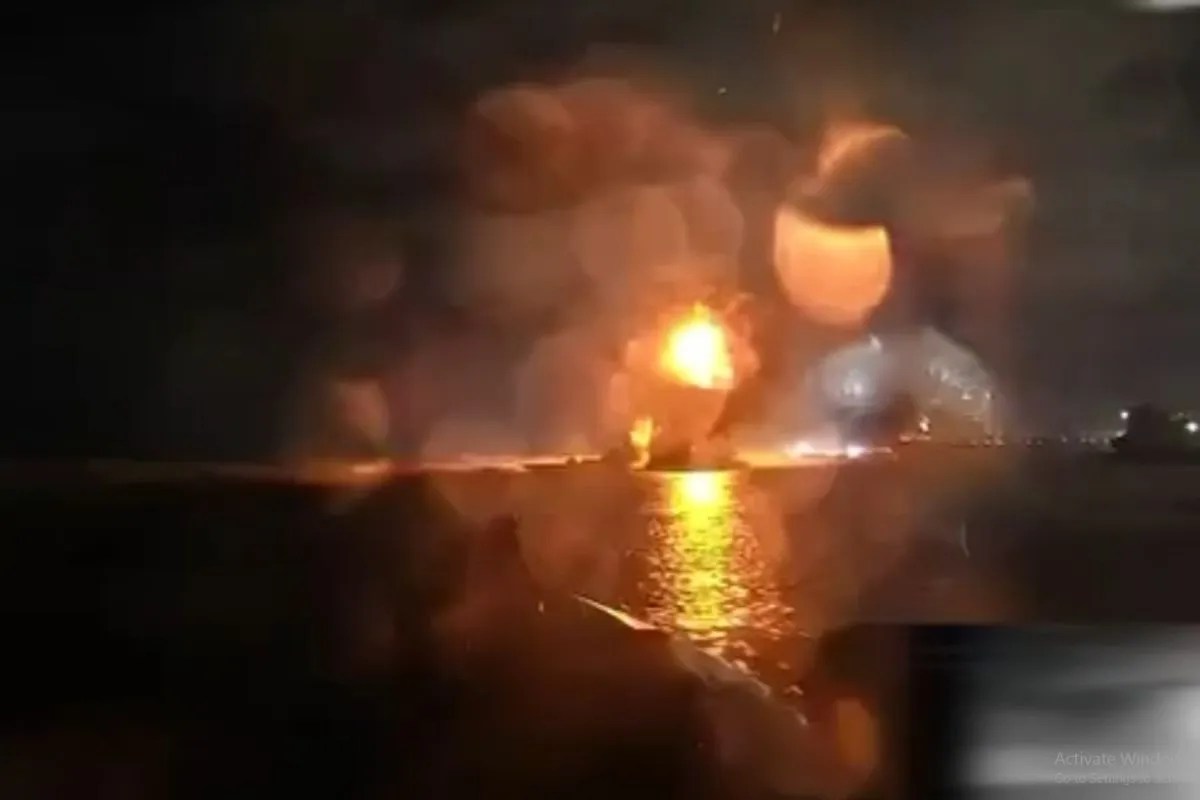
Everybody in the defense press is cheering the headline. A Ukrainian drone strike hitting a Russian warship parked at a naval base in Libya sounds like an action movie script. Long-range reach. Asymmetric brilliance. Another humiliating blow to the Russian Navy far from the Black Sea.
Stop applauding for five seconds and look at the map. Expanding on this idea, you can find more in: Why Protecting Grameen Bank Branches Misses the Real Threat in Bangladesh.
The lazy consensus says every Russian hull damaged anywhere on the planet is an automatic win for Kyiv. Defense commentators love a good David-versus-Goliath tally sheet. They count hulls, tally tonnage, and declare victory every time cheap carbon fiber ruins a multimillion-dollar piece of Soviet-era steel.
They are looking at the wrong scoreboard. Expanding a regional war of survival into the Mediterranean theater—specifically into the volatile, fragmented coastline of Libya—isn't a masterstroke of global reach. It is a high-risk gamble that trades tactical fireworks for severe geopolitical blowback. Observers at TIME have shared their thoughts on this situation.
The Geography of Overreach
To understand why this strike is a double-edged sword, you have to understand what Libya actually is right now. It is not a unified state. It is a fractured chessboard split between rival administrations, backed by competing regional powers, and policed by a fragile web of mercenary agreements and energy deals.
When Kyiv extends kinetic operations into North Africa, it isn't just hitting Moscow. It is kicking over a table in someone else's living room.
Look at who actually holds the keys to eastern Libya and the ports around Tobruk and Benghazi. Field Marshal Khalifa Haftar and the Libyan National Army control that turf, and they do so with a complex web of external backers—including Egypt, the United Arab Emirates, and Russia's Africa Corps (the rebranded remnants of the Wagner Group).
By launching drones into a Libyan port, Ukraine isn't operating in a vacuum. Those drones had to get there. Either they were launched from a covert vessel in the Mediterranean, smuggled overland through porous North African borders, or deployed by special operations teams operating on the ground. Every single one of those vectors violates the sovereign airspace or territorial waters of third-party nations that have zero interest in hosting an extension of the Eastern European front.
I have watched defense startups and state-backed logistics contractors burn through tens of millions of dollars trying to manage supply chains in North Africa. You do not move hardware across the Mediterranean without leaving fingerprints. Intelligence agencies in Rome, Cairo, Ankara, and Paris know exactly whose airspace was used and whose ports were compromised. And right now, European capitals—many of which rely heavily on Libyan crude oil and gas pipelines to keep their lights on after cutting off Russian energy—are sweating.
The Myth of "Cost-Free" Asymmetric Warfare
Defense analysts love to throw around the term asymmetric warfare without doing the actual accounting. Let's define it properly: asymmetric warfare is the use of unconventional tactics to exploit an enemy's specific vulnerabilities when you cannot match them in conventional mass.
What it is not is a free lunch.
The mainstream narrative argues that because an FPV drone or a modified long-range UAV costs a fraction of a frigate or a landing ship, the exchange rate is always favorable. On a pure balance-sheet basis, sure. Spending $50,000 to put a $100 million warship in drydock looks like the trade of the century.
Until you factor in the political capital spent to pull it off.
Consider the immediate fallout in the Mediterranean basin:
- Energy Market Jitters: Libya pumps over a million barrels of oil a day. A kinetic strike on a Libyan port signals to maritime insurers that the central Mediterranean is now an active war zone. War risk premiums spike overnight. Shipping lanes tighten. Who pays the price at the pump? The exact European voters whose governments are currently writing the checks to keep Kyiv funded.
- Alienating Fence-Sitters: For years, Ukrainian diplomacy has worked overtime to peel African nations away from Moscow's orbit. Striking targets inside an African country—even Russian military assets—hands Kremlin propagandists a golden hammer. Moscow doesn't even have to lie; they simply point to the wreckage on African soil and tell leaders across the Sahel and North Africa that Kyiv is exporting its war to their doorstep.
- The Escalation Ladder Has No Railing: If Ukrainian intelligence can hit Russian ships in the Mediterranean, what stops Moscow from arming Houthi militants in the Red Sea or proxy militias in the Levant with advanced anti-ship missiles to target commercial vessels linked to Kyiv's Western backers? In fact, intelligence reports have already flagged Russian discussions along those exact lines.
Answering the Wrong Question
Whenever a story like this breaks, the search engines light up with the same predictable questions. People ask, "How did Ukrainian drones reach Libya?" or "Does Ukraine have a navy capable of global strikes?"
You are asking the wrong question. The mechanics of the strike are just engineering—battery density, satellite uplinks, Starlink terminals, and smugglers' routes. Any decent aerospace engineer with a black budget can figure out how to put a warhead on a target 1,500 miles away.
The real question is: Who benefits when the conflict becomes borderless?
Think about this carefully. Ukraine's core strategic advantage since 2022 has been moral and legal clarity. A sovereign nation defending its internationally recognized borders against an unprovoked invasion. That clarity is what unlocks billions in Western aid, keeps NATO unified, and justifies crushing sanctions on Moscow.
The moment you start blowing up ships in third-party ports—thousands of miles from the front lines in Donbas or Crimea—that clarity blurs. Suddenly, the conflict looks less like a defensive war of national survival and more like a global shadow war between intelligence agencies.
Western policymakers hate shadow wars they can't control. Let's look at the heavy hitters in strategic theory—from Carl von Clausewitz to Thomas Schelling. Schelling's entire framework on deterrence and coercion relies on clear boundaries and predictable signaling. When you erase geographic boundaries, you destroy predictability. And when predictability dies, cautious bureaucrats in Washington, Berlin, and Brussels start quietly throttling back the approvals for long-range weapons.
The Naval Reality Nobody Wants to Admit
Let's also dismantle the myth that hitting a Russian warship in Libya meaningfully degrades Moscow's combat power in Ukraine.
It doesn't. Not even a little bit.
Turkey closed the Bosphorus and Dardanelles straits to military vessels under the Montreux Convention back in February 2022. That single legal mechanism locked Russia's Mediterranean task force out of the Black Sea. A Russian frigate or auxiliary vessel sitting in Tobruk cannot sail to Sevastopol. It cannot fire Kalibr cruise missiles at Kyiv or Odesa. It cannot support amphibious landings in the Sea of Azov.
In terms of the actual war for Ukrainian territory, a Russian ship parked in Libya is already neutralized. It is a floating logistics hub supporting Moscow's operations in sub-Saharan Africa—specifically gold mining, regime protection in Mali and Burkina Faso, and migrant-route leverage against Europe.
Imagine a scenario where a boxer is in the twelfth round of a championship fight, bleeding and down on points, and decides to jump out of the ring to punch his opponent's cornerman in the parking lot. It might make the crowd roar. It might ruin the cornerman's night. It does absolutely nothing to win the fight inside the ropes.
Every drone, satellite channel, special operator, and intelligence dollar spent hunting a stranded Russian hull in North Africa is a resource not spent stopping Russian infantry advances in Donetsk or hunting glide-bomb launch platforms in the Kursk and Belgorod regions.
The Counter-Intuitive Playbook
To be completely fair, there is a valid strategic argument for Kyiv's global hunting trips—and ignoring it would be dishonest.
Russia's Africa Corps is a massive revenue engine. Moscow extracts billions in illicit gold, diamonds, and resource concessions across Africa to bypass Western sanctions and fund its war machine. Disrupting Russia's Mediterranean logistics hub in Libya chokes off the supply line feeding those mercenaries. If Russia cannot rotate troops or ship heavy equipment through Libyan ports, its leverage in Africa collapses.
That is the strongest possible steelman for the strike. And it still doesn't outweigh the blowback.
If Kyiv wants to bleed Russia's global footprint without triggering a diplomatic backlash in Europe and Africa, kinetic strikes in neutral or semi-neutral ports are the worst way to do it. Here is what actually works:
- Economic and Maritime Interdiction via Third Parties: Instead of blowing up ships in port, feed real-time tracking, hull registration fraud, and sanction-evasion intelligence directly to European maritime authorities and port states. Forcing a Russian shadow-fleet vessel to sit at anchor for six months under legal seizure in a Spanish or Greek port costs Moscow just as much money, carries zero risk of civilian casualties, and keeps European governments on your side.
- Target the Logistics, Not the Flag: If covert operations must happen in Africa, they should focus strictly on local mercenary commanders and illicit resource extraction hubs deep in the interior, where local governments have already begged for help—not major Mediterranean ports sitting right across the water from NATO's southern flank.
- Keep the Kinetic Focus on the Black Sea and Crimean Chokepoints: Every ounce of naval drone innovation should be concentrated on making the Black Sea completely uninhabitable for Russian naval and commercial logistics. Sinking a landing ship near Novorossiysk directly alters the battlefield math in Ukraine. Damaging a vessel in Tobruk just generates a news cycle.
War is not a content creation exercise. Viral videos of burning ships do not liberate occupied cities, and headlines about global reach do not keep air defense interceptors flowing into warehouses.
When a military starts chasing symbolic victories on the other side of the world while the home front is screaming for ammunition and manpower, it isn't projecting strength. It is losing focus.