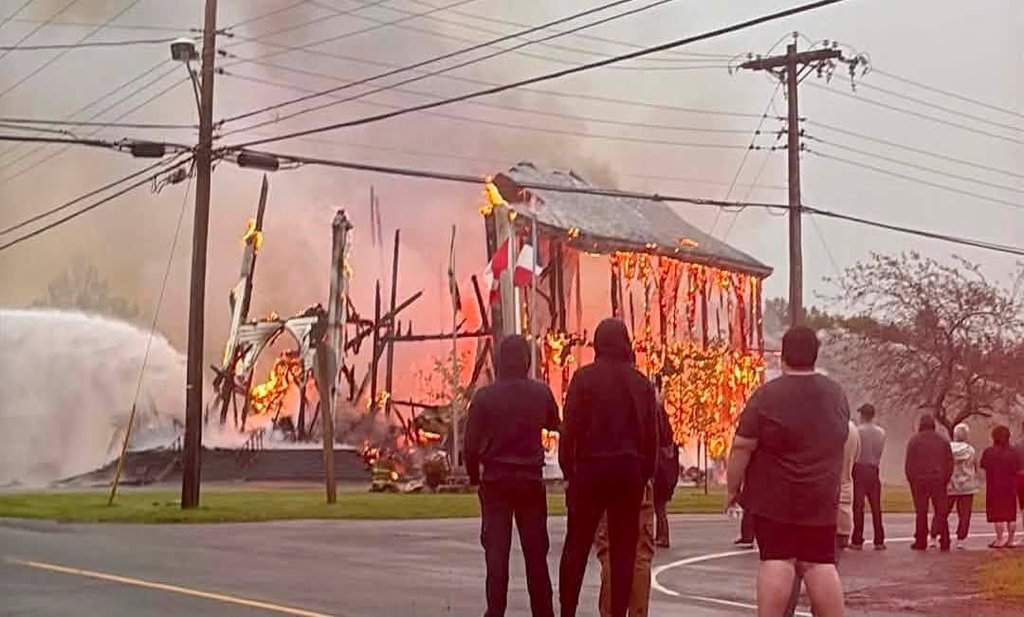
The destruction of a historic asset through incendiary means represents a catastrophic failure of municipal risk management, heritage asset preservation, and preventative law enforcement. When a 68-year-old male was charged with arson by New Brunswick police following the catastrophic burning of a historic church, public discourse predictably centered on moral outrage and the immediate operational response of emergency services. Beneath the surface of local reporting lies a complex structural breakdown involving structural vulnerability, asset classification failures, and the economics of municipal emergency deployment.
Understanding this incident requires stripping away sensationalism to examine the underlying mechanisms governing rural-urban heritage protection, the cost function of structural fire suppression in aging infrastructure, and the criminal justice parameters surrounding elder-perpetrated property destruction.
The Baseline Mechanics of Heritage Vulnerability
Historic structures operate under a severe physical handicap when subjected to intentional ignition. Older buildings, particularly those constructed in the nineteenth and early twentieth centuries, utilize heavy timber framing, dry lath-and-plaster walls, and open cavity spaces that lack modern fire-blocking assemblies.
When an ignition source is introduced into these uncompartmentalized spaces, fire propagation follows exponential growth curves rather than linear ones. Modern building codes mandate compartmentalization, fire-rated drywall, and automated suppression systems that buy critical minutes for intervention. Historic churches are typically exempt from retrofitting these capital-intensive safety layers due to historical preservation statutes or prohibitive municipal budgets.
[Ignition Source] -> [Uncompartmentalized Cavities] -> [Exponential Fire Spread] -> [Structural Collapse]
This creates an inverse security paradox: the architectural features that grant the structure its historical and cultural value—exposed timber, open sanctuaries, unsealed vertical shafts—simultaneously act as pathways for rapid thermal transfer and oxygen supply. The New Brunswick incident highlights how legal protections for aesthetic heritage inadvertently create high-risk tactical environments for emergency responders and low-friction environments for malicious actors.
The Economic Impact of Emergency Response Deployment
When a heritage structure catches fire, the economic and logistical burden placed on municipal services escalates rapidly. Volunteer or municipal fire departments face an immediate triage problem upon arrival.
Direct Resource Allocation Variables
- Water Supply Deficits: Historic rural or semi-urban areas often lack high-capacity municipal water mains, requiring tanker shuttles that delay sustained suppression operations.
- Structural Collapse Risk: The degradation of unreinforced masonry and heavy timber increases the collapse zone, forcing departments into a defensive exterior posture rather than an interior offensive attack.
- Specialized Demolition Costs: Post-fire site stabilization requires heavy machinery, environmental mitigation for hazardous materials like asbestos or lead paint, and forensic engineering oversight.
The cost function of such an incident extends far beyond equipment wear and tear. It absorbs municipal insurance reserves, drains volunteer personnel capacity, and permanently erases an uninsurable community asset. The financial loss cannot be captured by replacement cost valuations alone, as the craftsmanship and material availability required to replicate a historic edifice are economically prohibitive in contemporary construction markets.
Criminal Justice Parameters in Elder Perpetration
The apprehension and charging of a 68-year-old individual for arson introduces a distinct set of criminological and procedural challenges. Arson committed by older adults represents a statistical anomaly within criminal databases, where property destruction offenses are predominantly concentrated in younger demographics.
When an older adult engages in severe property destruction, forensic psychologists and investigators typically evaluate three distinct motivational vectors: cognitive decline or neurodegenerative conditions affecting impulse control, severe economic desperation tied to property disputes or insurance fraud, and acute grievance-based retaliation against community institutions.
The procedural response by the New Brunswick police department required navigating specific evidentiary thresholds:
- Origin and Cause Determination: Forensic investigators must isolate the point of origin using burn patterns, calcification of concrete, and gas chromatography-mass spectrometry to detect accelerants.
- Chain of Custody for Physical Evidence: Given the total destruction of the primary scene, extracting intact trace evidence from peripheral debris zones requires meticulous grid searches.
- Motive and Opportunity Mapping: Establishing premeditation through digital footprints, witness testimony regarding prior threats, or physical acquisition of accelerants.
The complexity of prosecuting an older demographic involves balancing public accountability with institutional capabilities for holding defendants with potential cognitive or health vulnerabilities through pretrial detention phases.
Systemic Failures in Pre-Incident Intervention
Preventing the destruction of irreplaceable community assets requires shifting focus from post-incident criminal charges to pre-incident vulnerability mitigation. Municipalities frequently treat heritage buildings as static monuments rather than dynamic operational risks that require active surveillance and hardening.
Standard municipal oversight relies heavily on passive security: locked doors, infrequent police patrols, and community watch programs. Against a determined actor, these measures offer zero resistance. Effective asset protection requires an intelligence-led security framework that assesses threat vectors based on local social friction points, historical grievances, and physical site access audits.
Furthermore, insurance underwriters bear a portion of the systemic failure. By continuing to insure high-value historic assets under standard commercial property forms without mandating thermal imaging monitoring, remote-activated fire suppression curtains, or perimeter intrusion detection, the insurance market subsidizes lax physical security standards.
Strategic Allocation of Municipal Capital
To prevent future catastrophic losses of historic architecture, municipal governments and heritage boards must abandon reactive compensation models in favor of mandatory risk-reduction frameworks.
Municipalities must establish dedicated capital improvement funds specifically earmarked for retrofitting non-invasive fire detection and suppression technologies into historically protected buildings. This includes installing linear heat detection cables in concealed attic spaces and dry-pipe sprinkler systems that operate without threatening water damage during false alarms.
Law enforcement agencies must integrate heritage asset mapping into their jurisdictional threat assessments. By identifying high-value, vulnerable structures within municipal boundaries, patrols can incorporate dynamic routing that increases visibility around historical sites during high-risk windows, such as overnight hours or periods of civil tension.
The structural failure observed in New Brunswick is not merely a localized criminal event; it is an indictment of a broader systemic refusal to treat cultural infrastructure as critical physical assets requiring rigorous, data-backed defense mechanisms. Without structural hardening and proactive threat modeling, communities will continue to watch their history burn while relying on post-facto legal charges to remedy irreversible physical losses.